Umbwe Route
What Is the Umbwe Route?
The Umbwe Route is one of the most dramatic and demanding paths to the summit of Mount Kilimanjaro, the highest peak in Africa at 5,895 metres (19,341 feet) above sea level. Located in northern Tanzania, Kilimanjaro is the world’s tallest free-standing mountain and a UNESCO World Heritage Site. Among its eight official climbing routes, the Umbwe Route stands out as the shortest, steepest, and most direct path to the summit crater.
Named after the Umbwe River valley through which it ascends, this route approaches Kilimanjaro from the southwest, climbing steeply and relentlessly through dense rainforest before emerging onto alpine moorland and eventually the high-altitude arctic desert zone. Its directness is both its defining feature and its greatest challenge — there is very little room for gradual acclimatisation.
The Umbwe Route gained its fearsome reputation not through folklore, but through fact. The rapid elevation gain leaves little margin for error, and altitude sickness is a genuine risk for those who push too hard too fast. For this reason, the route is strongly recommended only for experienced trekkers who have prior high-altitude experience and are in excellent physical condition.
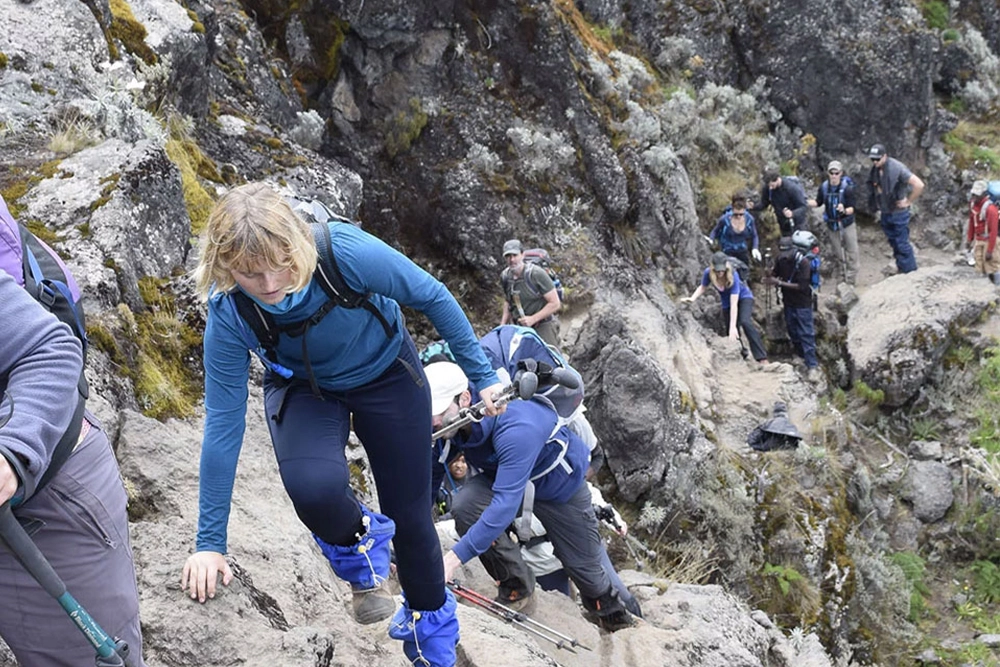
Route Name | Umbwe Route |
Mountain | Mount Kilimanjaro, Tanzania |
Summit | Uhuru Peak — 5,895 m (19,341 ft) |
Total Distance | Approx. 53 km (33 miles) round trip |
Duration Options | 6, 7, or 8 days |
Difficulty | Very Difficult — Hardest route on Kilimanjaro |
Success Rate | Approximately 60–70% |
Best Season | January–March & June–October |
Park Gate | Umbwe Gate, Kilimanjaro National Park |
Descent Route | Mweka Route (most common) |
Why Is Umbwe Famous? The Umbwe Route is widely regarded as the most difficult route on Kilimanjaro. It ascends steeply and directly with little of the gradual altitude gain found on routes like Lemosho or Machame. Its rugged, remote character, combined with extraordinary forest scenery and far fewer crowds, makes it the route of choice for seasoned mountaineers and adventurers seeking an authentic, challenging Kilimanjaro experience. |
2. How Many Kilometres Is the Umbwe Route?
The total distance of the Umbwe Route varies depending on whether the 6-day or 8-day itinerary is followed, and which descent path is used. Below is a clear breakdown of the distances involved.
Total Distance
Ascent (Umbwe Gate to Uhuru Peak) | Approx. 24–26 km (15–16 miles) |
Descent via Mweka Route | Approx. 17–18 km (10–11 miles) |
Descent via Barafu to Mweka Gate | Approx. 18 km |
Total Round Trip Distance | Approx. 53 km (33 miles) |
Vertical Ascent (Total Elevation Gain) | Approx. 4,315 m (14,154 ft) |
3. Umbwe Route Elevation Profile
Understanding the elevation profile of the Umbwe Route is essential for grasping why it is considered the hardest route on Kilimanjaro. The route begins at relatively low elevation and ascends steeply in a very compressed horizontal distance, giving climbers far less time to acclimatise compared to other routes.
Key Elevation Points
Umbwe Gate (Start) | 1,600 m (5,249 ft) |
Camp 1 — Umbwe Cave Camp | 2,940 m (9,646 ft) |
Camp 2 — Barranco Camp | 3,976 m (13,044 ft) |
Karanga Camp (optional rest) | 3,995 m (13,107 ft) |
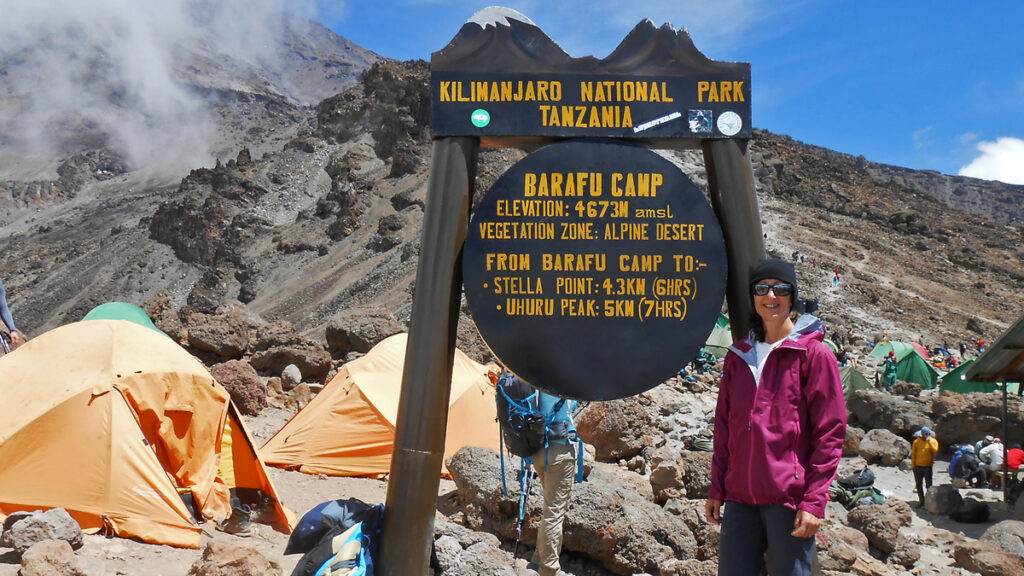
Barafu Camp (High Camp) | 4,673 m (15,331 ft) |
Stella Point (Crater Rim) | 5,739 m (18,831 ft) |
Uhuru Peak (Summit) | 5,895 m (19,341 ft) |
Descent: Mweka Camp | 3,100 m (10,171 ft) |
Mweka Gate (End) | 1,640 m (5,381 ft) |
The elevation gain from the gate to the summit is approximately 4,295 metres (14,091 feet). Critically, the climb from Camp 1 to Camp 2 gains over 1,000 metres in a single day — a level of elevation gain that significantly increases the risk of Acute Mountain Sickness (AMS). This compressed gain is the primary reason why the Umbwe Route demands serious respect.
Acclimatisation Warning The Umbwe Route offers one of the steepest ascent profiles of any Kilimanjaro route. The rapid altitude gain means the body has less time to produce additional red blood cells and adjust to lower oxygen pressure. Climbers should expect to spend at least one night at Barranco Camp to allow partial acclimatisation before proceeding to Barafu for the summit push. Even with this rest day, the Umbwe Route remains significantly more demanding than longer routes such as Lemosho (8 days) or the Northern Circuit (9–10 days). |
Why Is Umbwe Famous? The Umbwe Route is widely regarded as the most difficult route on Kilimanjaro. It ascends steeply and directly with little of the gradual altitude gain found on routes like Lemosho or Machame. Its rugged, remote character, combined with extraordinary forest scenery and far fewer crowds, makes it the route of choice for seasoned mountaineers and adventurers seeking an authentic, challenging Kilimanjaro experience. |
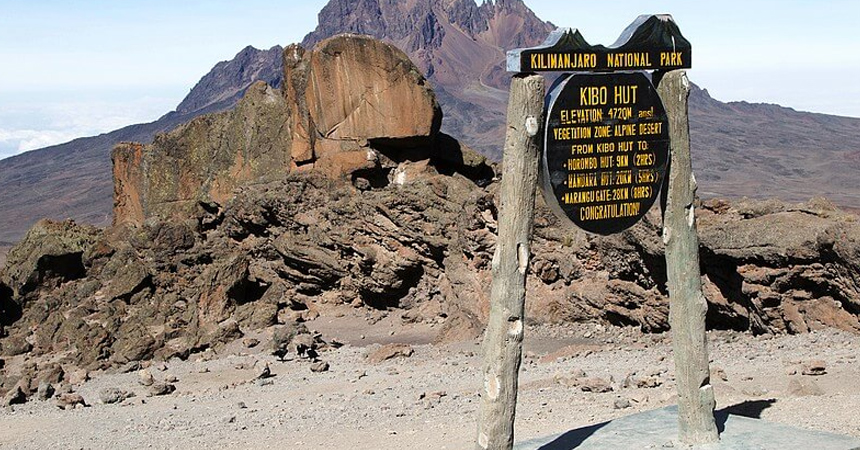
How Many Kilometers Is the Umbwe Route?
The total distance of the Umbwe Route varies depending on whether the 6-day or 8-day itinerary is followed, and which descent path is used. Below is a clear breakdown of the distances involved.
Total Distance
Ascent (Umbwe Gate to Uhuru Peak) | Approx. 24–26 km (15–16 miles) |
Descent via Mweka Route | Approx. 17–18 km (10–11 miles) |
Descent via Barafu to Mweka Gate | Approx. 18 km |
Total Round Trip Distance | Approx. 53 km (33 miles) |
Vertical Ascent (Total Elevation Gain) | Approx. 4,315 m (14,154 ft) |
3. Umbwe Route Elevation Profile
Understanding the elevation profile of the Umbwe Route is essential for grasping why it is considered the hardest route on Kilimanjaro. The route begins at relatively low elevation and ascends steeply in a very compressed horizontal distance, giving climbers far less time to acclimatise compared to other routes.
Key Elevation Points
Umbwe Gate (Start) | 1,600 m (5,249 ft) |
Camp 1 — Umbwe Cave Camp | 2,940 m (9,646 ft) |
Camp 2 — Barranco Camp | 3,976 m (13,044 ft) |
Karanga Camp (optional rest) | 3,995 m (13,107 ft) |
Barafu Camp (High Camp) | 4,673 m (15,331 ft) |
Stella Point (Crater Rim) | 5,739 m (18,831 ft) |
Uhuru Peak (Summit) | 5,895 m (19,341 ft) |
Descent: Mweka Camp | 3,100 m (10,171 ft) |
Mweka Gate (End) | 1,640 m (5,381 ft) |
The elevation gain from the gate to the summit is approximately 4,295 metres (14,091 feet). Critically, the climb from Camp 1 to Camp 2 gains over 1,000 metres in a single day — a level of elevation gain that significantly increases the risk of Acute Mountain Sickness (AMS). This compressed gain is the primary reason why the Umbwe Route demands serious respect.
4. How Difficult Is the Umbwe Route?
The Umbwe Route is consistently rated the most difficult route on Kilimanjaro. It earns this reputation through a combination of factors: the gradient is exceptionally steep in the lower and middle sections, the forest section demands careful footwork on muddy, root-laced terrain, and the acclimatisation window is far shorter than on other routes.
Difficulty Rating by Factor
Overall Difficulty | 5/5 — Hardest route on Kilimanjaro |
Physical Demand | Very High — steep daily ascents |
Technical Difficulty | Moderate — some scrambling required |
Acclimatisation Opportunity | Low — compressed elevation gain |
Trail Condition | Steep, rooty forest; alpine moorland above |
Navigation | Well-marked but narrow and remote |
Crowd Level | Very Low — among the least trafficked routes |
Weather Exposure | High above Barranco — exposed ridgelines |
What Makes Umbwe So Hard?
- Steep Forest Ascent: The first two days climb through dense montane rainforest on narrow, root-covered trails that are frequently wet and slippery. There is virtually no flat or gentle ground.
- Rapid Altitude Gain: The route reaches 2,940 m on Day 1 and nearly 4,000 m by Day 2. Other routes take 3–4 days to reach similar altitudes.
- Limited Acclimatisation Days: A standard 6-day itinerary offers very little buffer time. Even an 8-day version is considered aggressive by altitude medicine standards.
- Remote and Isolated: The lower Umbwe Route is one of the least-used trails on the mountain. Emergency rescue access is more difficult than on the popular Machame or Marangu routes.
- Summit Night Demands: The final push from Barafu to Uhuru Peak involves hiking overnight through sub-zero temperatures (as low as -20°C), strong winds, and very thin air above 5,500 m.
Who Should Climb Umbwe?
The Umbwe Route is best suited for physically fit, experienced trekkers who have previously trekked above 4,000 metres and have a solid understanding of altitude sickness symptoms. It is not recommended for first-time Kilimanjaro climbers, those who have never trekked at altitude, people with cardiovascular or respiratory conditions, or anyone prioritising summit success over the experience. Guides and park rangers on the mountain will advise climbers showing signs of altitude sickness to descend immediately regardless of route.
5. Umbwe Route Success Rate
The summit success rate on the Umbwe Route is one of the lowest among all Kilimanjaro routes. Due to the rapid ascent profile and compressed acclimatisation window, a significant number of climbers fail to reach Uhuru Peak, turning back at Stella Point (5,739 m) or descending even earlier due to altitude sickness.
Success Rate Comparison by Route
Route | Duration | Success Rate | Difficulty |
Umbwe Route | 6–8 days | ~60–70% | Very Difficult |
Marangu Route | 5–6 days | ~65% | Moderate |
Machame Route | 6–7 days | ~85% | Difficult |
Lemosho Route | 7–8 days | ~90% | Moderate–Hard |
Rongai Route | 6–7 days | ~80% | Moderate |
Northern Circuit | 9–10 days | ~95% | Moderate |
Choosing the 8-day Umbwe itinerary significantly improves the success rate compared to the 6-day option. An additional acclimatisation day at Barranco Camp — combined with the Barranco Wall ascent for altitude adjustment — helps the body cope more effectively with the extreme altitude of Barafu and the summit zone. Even so, success is never guaranteed, and climbers must remain vigilant for symptoms of AMS throughout the trek.
What Is the Most Successful Route on Kilimanjaro?
The most consistently successful route on Kilimanjaro — in terms of the highest percentage of climbers reaching Uhuru Peak — is the Northern Circuit Route, followed closely by the Lemosho Route. Both routes are celebrated for providing extended time on the mountain, superior acclimatisation, and a gradual, well-spaced altitude gain profile.
The Northern Circuit Route
The Northern Circuit is the longest route on Kilimanjaro, taking 9–10 days and circumnavigating almost the entire mountain before approaching the summit from the northwest. It has the highest success rate of any route at approximately 90–95%. The extended duration allows exceptional acclimatisation and covers extraordinary and varied terrain including the rarely-visited northern slopes.
The Lemosho Route
The Lemosho Route is often considered the best overall balance of success rate (approximately 90%), scenery, and challenge. At 7–8 days, it offers more acclimatisation time than Machame or Umbwe while passing through the spectacular Shira Plateau and joining the Southern Circuit to approach the summit from Barafu. Many operators consider it the premier route for summit success combined with outstanding scenery.
Why Does Umbwe Have a Lower Rate?
By comparison, the Umbwe Route’s compressed ascent gives climbers’ bodies less time to adapt to altitude. High-altitude medicine research consistently shows that summit success rates correlate directly with total time spent on the mountain above 3,000 metres. The Umbwe Route’s directness — its defining characteristic and greatest appeal — is precisely what limits its success rate relative to longer alternatives.
Which Park Do You Climb Kilimanjaro Through?
All routes on Mount Kilimanjaro — including the Umbwe Route — pass through Kilimanjaro National Park, a protected area managed by the Tanzania National Parks Authority (TANAPA). The park was established in 1973 and was designated a UNESCO World Heritage Site in 1987. It covers an area of 1,688 square kilometres and encompasses the mountain in its entirety above the forest line.
Umbwe Gate
The Umbwe Route begins at Umbwe Gate, situated on the southern slopes of Kilimanjaro near the village of Umbwe, approximately 12 kilometres north of Moshi town. All climbers must register at the gate, pay their park fees, and confirm their guide and porter arrangements before beginning their ascent. The gate sits at approximately 1,600 metres above sea level.
Park Fees (USD, per climber)
Conservation Fee | USD $70 per day |
Camping / Hut Fee | USD $50–$60 per night (hut: $60) |
Rescue Fee | USD $20 per trip |
Guide Fee | Paid to licensed operator (variable) |
Porter & Staff Fees | Included in operator package |
Typical Total Park Fees (7 days) | Approximately USD $700–$900 per person |
All fees are paid through licensed climbing operators who handle park registrations, permits, and staff wages. It is illegal to climb Kilimanjaro without a licensed guide. TANAPA regulations also require minimum porter-to-climber ratios and set mandatory standards for porter welfare including equipment, food, accommodation, and wages — standards enforced at all park gates.
Umbwe Route Map Overview
The Umbwe Route follows a generally southwesterly-to-northeasterly trajectory from the forest belt to the summit. While a detailed topographic map is essential equipment for any Kilimanjaro climb, the route overview below provides a clear narrative of the geographic path taken.
Geographic Route Narrative
- Start: Umbwe Gate (1,600 m) — Located south of Kilimanjaro, near Moshi. This is the trailhead where all registration occurs.
- Days 1–2: Lower Forest Zone — The trail immediately enters dense montane rainforest. The path follows a narrow ridge above the Umbwe River gorge, climbing steeply through giant heather, Podocarpus trees, and moss-draped undergrowth.
- Camp 1: Umbwe Cave Camp (2,940 m) — The first overnight camp, located where the forest begins to thin into a more open zone. The ‘cave’ is a rock overhang that provides shelter.
- Camp 2: Barranco Camp (3,976 m) — The route emerges from the forest into open moorland and alpine heath. At Barranco, the route joins the popular Southern Circuit, used by Machame and Lemosho trekkers.
- Camp 3: Barafu High Camp (4,673 m) — The final camp before the summit, situated on a high ridge in the alpine desert zone. This is where summit night begins, typically departing around midnight.
- Summit: Stella Point (5,739 m) & Uhuru Peak (5,895 m) — The final climb ascends through scree and snow to the crater rim at Stella Point, then continues along the rim to Uhuru Peak.
- Descent: Mweka Route Descent — The standard descent follows the Mweka Route, the most direct descent path on the southern slopes, finishing at Mweka Gate.
Map Tip Purchase a detailed 1:50,000 topographic map of Kilimanjaro produced by the Kilimanjaro National Park Authority or by specialist cartographers such as Wielochowski/Savage. Your guide will also carry route maps. GPS devices with pre-loaded Kilimanjaro tracks are useful supplementary tools but are not a substitute for proper guiding. |
Umbwe Route Kilimanjaro Huts & Camps
Unlike the Marangu Route — which is the only Kilimanjaro route with permanent mountain huts — the Umbwe Route is a tented camping route. Climbers sleep in tents provided by their operators at designated campsites. There are no permanent structures on the Umbwe Route itself, although the Barranco Camp area (which the route shares with Machame and Lemosho) is a well-established site with pit latrines and emergency shelter points.
Campsite Details
Camp | Elevation | Facilities | Notes |
Umbwe Cave Camp | 2,940 m | Pit latrines | Rock overhang shelter; forest setting; quiet and remote |
Barranco Camp | 3,976 m | Toilets, water | Joins Southern Circuit; busy with Machame/Lemosho groups |
Karanga Camp (optional) | 3,995 m | Toilets | Available on 8-day itinerary; improves acclimatisation |
Barafu High Camp | 4,673 m | Toilets, rangers | Exposed; cold and windy; summit departure point |
Mweka Camp (descent) | 3,100 m | Toilets, porters | First descent camp; warm and forested; morale boost |
What to Expect at Camp
- Sleeping tents, dining tents, and portable toilets are all provided by the operator.
- Meals are prepared by camp cooks and include three hot meals per day plus hot beverages.
- Porters transport all equipment — climbers carry only their personal daypack.
- Umbwe Cave Camp can feel remote and isolated, which adds to the adventurous character of the route.
- Barafu Camp is exposed to wind and cold; good sleeping bags rated to at least -15°C are essential.
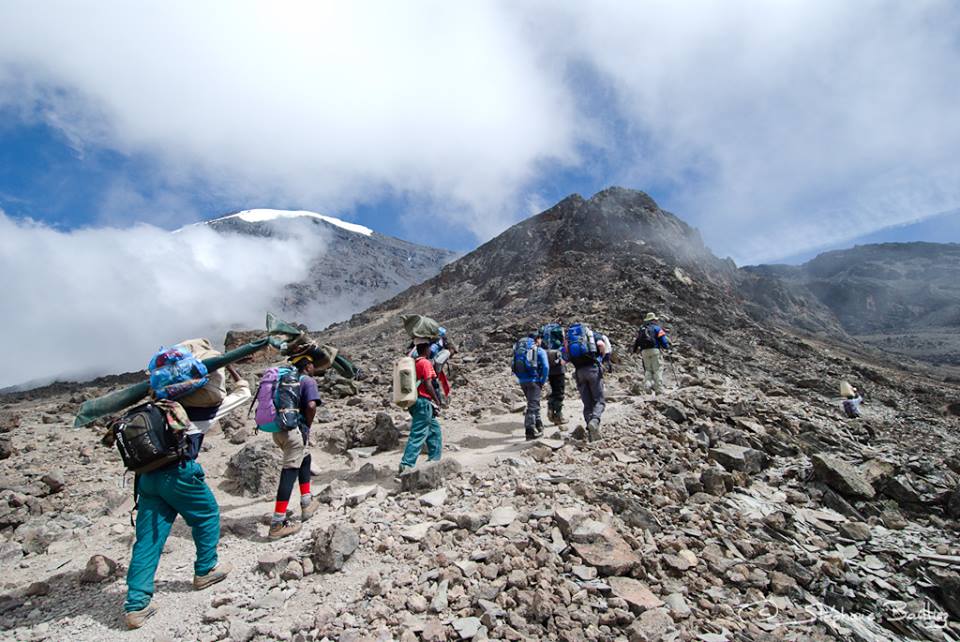
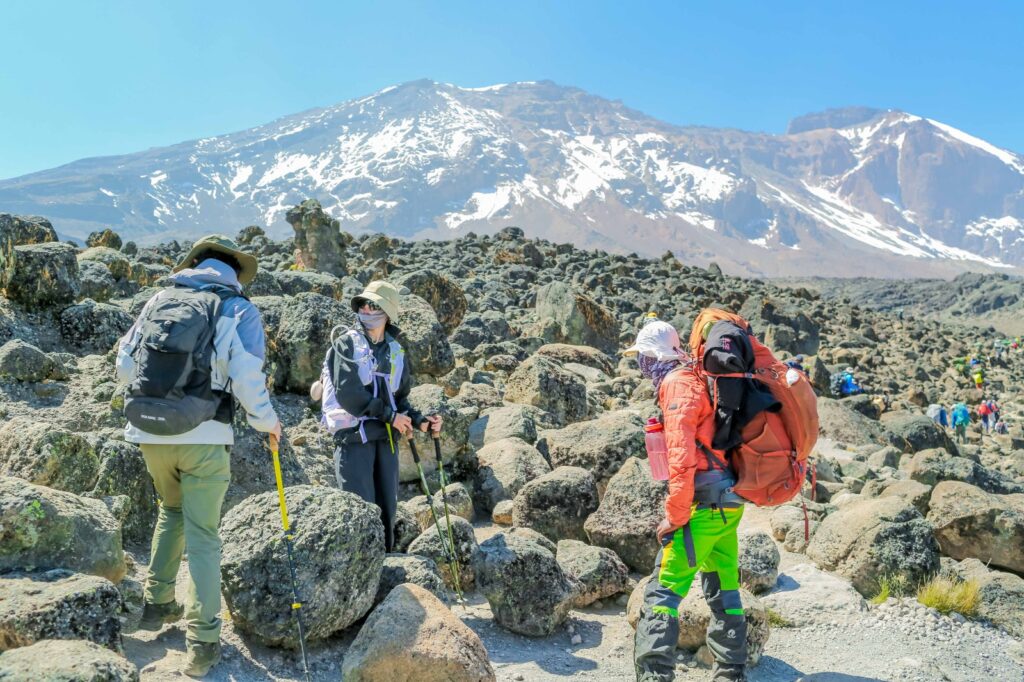
Umbwe Route Kilimanjaro — 6-Day Itinerary
The 6-day Umbwe Route itinerary is the most compact option. It is recommended only for very experienced high-altitude trekkers in peak physical fitness. The rapid pace leaves little room for acclimatisation rest, and the summit success rate on this schedule is lower than on the 8-day version. Nevertheless, for seasoned adventurers, it offers an intense and deeply satisfying challenge.
Day | Stage / Camp | Distance | Elevation |
Day 1 | Moshi → Umbwe Gate → Umbwe Cave Camp | ~9 km | 1,600 m → 2,940 m |
Day 2 | Umbwe Cave Camp → Barranco Camp | ~8 km | 2,940 m → 3,976 m |
Day 3 | Barranco Camp → Barafu Camp (via Barranco Wall & Karanga) | ~10 km | 3,976 m → 4,673 m |
Day 4 | Summit night: Barafu → Uhuru Peak → Barafu | ~5 km up | 4,673 m → 5,895 m → 4,673 m |
Day 5 | Barafu → Mweka Camp (descent) | ~9 km | 4,673 m → 3,100 m |
Day 6 | Mweka Camp → Mweka Gate → Moshi | ~10 km | 3,100 m → 1,640 m |
Day-by-Day Notes (6-Day)
Day 1 — Into the Forest
After gate registration and briefing, the trail enters dense montane rainforest almost immediately. The path ascends a narrow ridge above the Umbwe River gorge on a steep, often muddy trail. Mosses, ferns, and tree heathers drape the forest in a primeval atmosphere. The hike takes 5–7 hours and gains approximately 1,340 metres, making it a demanding introduction to the mountain.
Day 2 — Emerging from the Forest
The second day continues climbing steeply before breaking out of the forest into open moorland with giant lobelias and senecio groundsels — the surreal high-altitude vegetation of Kilimanjaro. Barranco Camp sits in a spectacular valley beneath the Great Barranco Wall, one of the mountain’s most dramatic geological features. Total hiking time: 4–6 hours.
Day 3 — The Barranco Wall & Barafu
This is the most physically demanding day of the 6-day itinerary. The morning begins with the famous Barranco Wall scramble — a steep, exposed but non-technical climb up the vertical headwall of the valley. The route then traverses across the mountain’s southern flank, passing through Karanga Valley before the final steep climb to Barafu High Camp. Total time: 6–8 hours.
Day 4 — Summit Night
Departure from Barafu typically occurs between midnight and 2 AM to ensure arrival at Uhuru Peak around sunrise. The ascent follows a zigzagging scree path upward through extreme cold and wind. Stella Point on the crater rim is reached after approximately 5–7 hours; Uhuru Peak is a further 45–60 minutes along the rim. After photographs and reflection at the roof of Africa, descent begins immediately to Barafu, then continues to Mweka Camp.
Day 5–6 — Descent via Mweka
The descent follows the Mweka Route, a direct path through alpine desert, moorland, and back into the forest. Mweka Camp provides a final camping night and celebration dinner. Day 6 sees climbers descend to Mweka Gate where certificates are collected and porters are tipped.
Umbwe Route Kilimanjaro — 8-Day Itinerary
The 8-day Umbwe Route itinerary is the recommended option for climbers who want to maximise their summit success chances while still experiencing the dramatic directness of the Umbwe approach. The additional days are used for acclimatisation rest at Barranco Camp and an extra rest halt at Karanga Valley, giving the body critical time to adjust before the summit push.
Day | Stage / Camp | Distance | Elevation |
Day 1 | Moshi → Umbwe Gate → Camp 1 (Lower Camp) | ~7 km | 1,600 m → 2,450 m |
Day 2 | Lower Camp → Umbwe Cave Camp | ~5 km | 2,450 m → 2,940 m |
Day 3 | Umbwe Cave Camp → Barranco Camp | ~8 km | 2,940 m → 3,976 m |
Day 4 | Acclimatisation Day — Barranco Camp (rest & explore) | Short hike | 3,976 m (rest day) |
Day 5 | Barranco Camp → Barranco Wall → Karanga Camp | ~6 km | 3,976 m → 3,995 m |
Day 6 | Karanga Camp → Barafu High Camp | ~5 km | 3,995 m → 4,673 m |
Day 7 | Summit push: Barafu → Uhuru Peak → Mweka Camp | ~14 km total | 4,673 m → 5,895 m → 3,100 m |
Day 8 | Mweka Camp → Mweka Gate → Moshi | ~10 km | 3,100 m → 1,640 m |
Advantages of the 8-Day Itinerary
- Acclimatisation Rest Day: Spending an additional night at Barranco (3,976 m) allows haemoglobin levels to increase and pulmonary function to improve before the higher camps.
- Barranco Wall as Acclimatisation Aid: Completing the Barranco Wall scramble and returning to sleep at the same altitude (‘climb high, sleep low’) enhances adaptation.
- Karanga Night: An extra overnight at Karanga (3,995 m) further prolongs the body’s time in the acclimatisation zone.
- Improved Stamina for Summit Night: Climbers who arrive at Barafu better rested have significantly more stamina for the 1,200 m summit push.
- Higher Success Rate: The 8-day itinerary improves success rates from approximately 60% to 70–75%.
12. Why Climb Kilimanjaro Through the Umbwe Route?
Given that other routes offer higher success rates, why would a climber choose Umbwe? The answer lies in the unique combination of qualities that make this route unlike any other path on the mountain. For those who are prepared and fit enough to attempt it, the Umbwe Route delivers an experience that remains unmatched in its intensity, solitude, and raw beauty.
Top Reasons to Choose the Umbwe Route
- Solitude — Fewest Crowds: Umbwe is one of the least-used routes on Kilimanjaro. Whereas Machame can accommodate hundreds of climbers simultaneously, Umbwe typically sees fewer than a dozen groups at a time. This extraordinary solitude transforms the climb into something closer to wilderness mountaineering.
- Pristine Forest — The forest section of Umbwe is among the most spectacular on the mountain. The narrow ridge trail above the river gorge creates an immersive, cathedral-like environment where wildlife — including Colobus monkeys and rare birds — is frequently encountered in undisturbed settings.
- The Challenge — There is a particular satisfaction in climbing Kilimanjaro by its hardest route. Reaching Uhuru Peak via Umbwe is an achievement that commands respect among mountaineering communities. It tests not just physical fitness but mental fortitude and determination under extreme conditions.
- Vertical Drama — The rapid ascent of Umbwe creates a dramatically compressed view of Kilimanjaro’s ecological zones. Within two days, climbers transition from tropical rainforest to alpine moorland — a transition that takes three or four days on longer routes. This concentration of terrain changes creates a powerful sense of vertical journey.
- Mountaineering Heritage — The directness of the Umbwe Route aligns with mountaineering tradition. Early explorers and alpinists who pioneered Kilimanjaro ascents in the 19th and early 20th centuries sought the most direct lines. Climbing Umbwe connects modern trekkers to that tradition of purposeful, uncompromising mountain travel.
- Photography — The combination of difficulty, solitude, and forest scenery makes the Umbwe Route a premium photographic environment. Unobscured views across the Kilimanjaro massif, the eerie beauty of the moorland zone, and the pristine forest canopy create spectacular opportunities not found on busier routes.
Is Umbwe Right for You? Ask yourself these questions before committing to Umbwe: Have you previously trekked at altitudes above 4,000 m? Are you physically active year-round with strong cardiovascular fitness? Are you comfortable with steep, technical terrain including scrambling? Can you tolerate remote conditions far from emergency infrastructure? If you answer yes to all four, and are committed to proper preparation, the Umbwe Route may be the most memorable climb of your life. |
13. What Is the Hardest Route on Kilimanjaro?
The Umbwe Route is unambiguously the hardest route on Kilimanjaro. It earns this distinction across every metric used to assess mountaineering difficulty: gradient, acclimatisation window, technical demands, remoteness, and summit success rates. No other route on the mountain presents as compressed and demanding a combination of these factors simultaneously.
Why Umbwe Is the Hardest
Metric | Umbwe vs Other Routes |
Daily Elevation Gain | Up to 1,300 m/day vs 600–800 m on Lemosho/Machame |
Total Acclimatisation Time | 1–2 days vs 3–5 days on Northern Circuit |
Trail Technical Difficulty | Steep ridge, scrambling vs moderate hiking on Marangu |
Summit Success Rate | 60–70% vs 85–95% on Lemosho/Northern Circuit |
Emergency Access | Difficult in lower sections vs well-patrolled main routes |
Crowd Density | Very few climbers vs hundreds on Machame/Marangu |
It is important to distinguish ‘hardest’ from ‘most dangerous.’ The Umbwe Route is not inherently dangerous for a prepared and properly guided climber. Altitude sickness is a manageable risk when its symptoms are recognised early and descent is executed promptly. The route’s hardness lies in the physical and physiological demands it places on climbers, not in any technical mountaineering hazard.
Some sources mention the Western Breach Route as an alternative of comparable difficulty; however, the Western Breach carries genuine objective hazard from rockfall and is only recommended for climbers with technical climbing experience and appropriate equipment. For hiking routes proper, Umbwe stands alone as the hardest option.
14. Preparation, Gear & Tips for the Umbwe Route
Physical Preparation
Training for the Umbwe Route should begin at least 3–6 months before the climb. The goal is to develop cardiovascular endurance, leg strength, and the mental resilience to keep moving when the body is under stress. Recommended training includes:
- Long-distance hiking with elevation gain — aim for weekly hikes of 20+ km with at least 800–1,000 m of ascent.
- Stair climbing or step machine training to build quadriceps and glutes for sustained steep ascent.
- Running or cycling to build cardiovascular base.
- If possible, complete at least one high-altitude trek above 3,500 m before Kilimanjaro to understand your body’s response to altitude.
Essential Gear List
Clothing & Insulation | Equipment & Accessories |
• Down jacket (800 fill or higher) • Thermal base layers (2 sets) • Fleece mid-layer • Waterproof jacket & trousers • Trekking trousers (2 pairs) • Warm hat & balaclava • Neck gaiter / scarf • Liner gloves + insulated gloves • Gaiters (for scree & snow) • Hiking boots (waterproof, broken in) • Camp shoes / sandals | • Trekking poles (essential for Umbwe) • 4-season sleeping bag (-15°C rated) • Daypack (25–35 litres) • Headlamp + spare batteries • Sunglasses (CE4 / UV400 rated) • SPF 50+ sunscreen • Hydration system or water bottles (3L capacity) • Water purification tablets • First aid kit + altitude medication (consult doctor) • High-energy snacks • Passport / permits / emergency contacts |
Altitude Sickness & Medication
Acute Mountain Sickness (AMS) is the most significant health concern on the Umbwe Route. Symptoms include headache, nausea, dizziness, fatigue, and disturbed sleep. More severe forms — High Altitude Pulmonary Oedema (HAPE) and High Altitude Cerebral Oedema (HACE) — can be fatal if descent is not initiated immediately. Diamox (Acetazolamide) is commonly prescribed as a prophylactic and therapeutic medication; consult your physician before the climb. The golden rule of altitude: if in doubt, go down.
15. Conclusion — Is the Umbwe Route Worth It?
The Umbwe Route is not for everyone. Its uncompromising gradient, compressed acclimatisation window, and remote character demand genuine physical preparation, prior altitude experience, and a willingness to accept a higher level of discomfort than other Kilimanjaro routes. For climbers who meet these conditions, however, the Umbwe Route offers something that no other path on the mountain can deliver in quite the same way: a raw, authentic, and deeply earned summit.
To stand on Uhuru Peak having climbed the steepest, most direct, and most challenging line on Africa’s greatest mountain is to join a small and select group of Kilimanjaro summiteers. The solitude of the forest, the drama of the Barranco Wall, the extreme cold of summit night, and the final steps to 5,895 metres — all of it is amplified by the knowledge that you chose the hard path.
Choose the 8-day itinerary for the best balance of challenge and summit success. Hire an experienced, licensed operator with guides who have specific Umbwe Route experience. Train consistently for at least six months beforehand. Hydrate relentlessly, ascend slowly, and listen to your body. Do these things, and the Umbwe Route will reward you with one of the most remarkable experiences in adventure travel anywhere on earth.
Final Recommendation For most climbers seeking their first Kilimanjaro summit, the Lemosho or Machame routes are better choices with higher success rates and more gradual acclimatisation. The Umbwe Route is ideal for experienced high-altitude trekkers seeking maximum challenge, solitude, and the deep satisfaction of reaching Uhuru Peak via Africa’s most demanding and direct path. |