Marangu Route
The Marangu Route is Kilimanjaro’s oldest and most established trekking path, often nicknamed the ‘Coca-Cola Route’ due to its relative popularity and the availability of soft drinks at the mountain huts. It is the only route on Kilimanjaro that offers dormitory-style sleeping huts, making it a more comfortable option compared to the camping routes. The trail begins and ends at Marangu Gate, creating an ‘out-and-back’ itinerary that follows the same path both ways.
Established in the late 19th century, the Marangu Route was the original trail used by the first documented summit attempt by Hans Meyer and Ludwig Purtscheller in 1889. Today it remains one of the most popular routes on the mountain, accounting for a significant percentage of all Kilimanjaro climbs each year.
The route passes through four ecological zones — rainforest, moorland, alpine desert, and the arctic summit zone — offering climbers a remarkable diversity of landscapes over a relatively compact distance. Despite its reputation as the ‘easiest’ route, reaching Uhuru Peak demands solid physical preparation, the right gear, and respect for altitude.
Route Type | Out-and-back (same trail up and down) |
Starting Point | Marangu Gate (1,879 m / 6,165 ft) |
Summit | Uhuru Peak, 5,895 m / 19,341 ft |
Total Distance | Approximately 64 km (40 miles) round trip |
Available Durations | 5 days (min), 6 days (recommended), 7–8 days (best acclimatization) |
Accommodation | Mountain huts (dormitory-style) |
Best Season | January–March and June–October |
Park Entry Fees | Required — see Section 3 for full breakdown |
How Many Kilometres Is the Marangu Route?
The Marangu Route covers approximately 64 kilometres (40 miles) in total distance for the full round-trip ascent and descent. Because the route uses the same trail going up and coming down, the one-way distance from Marangu Gate to Uhuru Peak is roughly 32 kilometres (20 miles).
Stage-by-Stage Distance Breakdown
Campsite / Stage | Elevation | Distance (One-Way) | Overnight |
Marangu Gate | 1,879 m (6,165 ft) | Start | No |
Mandara Hut | 2,720 m (8,924 ft) | 8 km (5 mi) | Night 1 |
Horombo Hut | 3,720 m (12,205 ft) | 12 km (7.5 mi) | Night 2 & 3 |
Kibo Hut | 4,703 m (15,430 ft) | 15 km (9.3 mi) | Night 4 |
Uhuru Peak (Summit) | 5,895 m (19,341 ft) | 6 km (3.7 mi) | No overnight |
TOTAL (one-way) | — | ~32 km (20 mi) | — |
TOTAL (round trip) | — | ~64 km (40 mi) | — |
The distances are measured along the trail and are approximate, as the trail winds through varied terrain including dense rainforest, open moorland, and steep volcanic scree. The final 6 km to the summit, from Kibo Hut, is the most demanding stretch due to the steep gradient and extreme altitude.
What to Pay to Climb Kilimanjaro — Park Fees & Costs
Climbing Kilimanjaro requires payment of multiple mandatory fees set by the Tanzania National Parks Authority (TANAPA). These fees must be paid in full before beginning the climb and are typically managed through your licensed climbing operator. All fees are quoted in US Dollars (USD).
Mandatory TANAPA Fee Schedule (2024–2025)
Fee Category | Per Person/Day (USD) | Typical 6-Day Total |
Park Entrance Fee | $70 / day | $420 |
Hut / Camping Fee (Marangu huts) | $60 / night | $300 |
Rescue Fee (one-time) | $20 / trip | $20 |
Conservation Fee | $2 / day | $12 |
Value Added Tax (VAT) on services | 18% | Variable |
Guide & Porter Fees (operator-set) | ~$250–$350 total | Varies |
Total Cost of Climbing Kilimanjaro via Marangu
When you factor in all government fees, operator charges, equipment rental, tips, and international flights, the total cost of climbing Kilimanjaro via the Marangu Route typically falls in the following ranges:
- Budget Operator (5-day Marangu): $1,500 – $2,000 per person
- Mid-Range Operator (6-day Marangu): $2,000 – $2,800 per person
- Premium Operator (7–8 day Marangu): $3,000 – $4,500+ per person
Tips for guides and porters are not included in operator packages but are considered obligatory. The Kilimanjaro Porters Assistance Project (KPAP) recommends tipping approximately $20–$30 per day for guides and $5–$10 per day for porters.
How Difficult Is the Marangu Route?
The Marangu Route is widely considered the most accessible route on Kilimanjaro in terms of terrain and infrastructure. However, ‘accessible’ does not mean ‘easy.’ The primary challenge on any Kilimanjaro route is not physical fitness but altitude acclimatization. Acute Mountain Sickness (AMS) is the main reason climbers fail to summit, and the Marangu Route’s relatively compressed schedule makes acclimatization difficult.
Terrain & Physical Demands
The trail on the Marangu Route is generally well-defined, wide, and free of technical scrambling or glacier crossing. There are no ropes, ladders, or technical climbing sections. The trail conditions are:
- Marangu Gate to Mandara Hut: Gentle forest trail through dense rainforest, moderate incline
- Mandara Hut to Horombo Hut: Heather and moorland terrain, some steeper sections
- Horombo Hut to Kibo Hut: Rocky alpine desert, loose gravel, increasing altitude
- Kibo Hut to Uhuru Peak (Summit Night): Steep scree and volcanic rock, extreme cold, low oxygen
Altitude Challenge
The summit night ascent from Kibo Hut (4,703 m) to Uhuru Peak (5,895 m) is the hardest section of the entire climb. It typically begins around midnight and involves 6 hours of slow, laborious uphill hiking in sub-zero temperatures with limited oxygen. Many climbers experience severe headaches, nausea, fatigue, and dizziness at this stage.
Difficulty Rating Comparison
Difficulty Factor | Marangu Route | Rating |
Trail Technicality | Non-technical, well-marked path | Easy |
Physical Fitness Required | Moderate — regular hiking fitness | Moderate |
Altitude (AMS Risk) | High — compressed schedule | High |
Weather Exposure | Huts provide shelter | Moderate |
Summit Night Effort | Steep scree, extreme cold, thin air | Very Hard |
Overall Route Difficulty | Moderate-to-Challenging | ★★★☆☆ |
What Is the Most Successful Route on Kilimanjaro?
Despite the Marangu Route’s popularity, it does not hold the distinction of being the most successful route in terms of summit rate. The Lemosho Route and the Northern Circuit Route are widely regarded by experienced guides and operators as having the highest summit success rates on Kilimanjaro.
Summit Success Rate Comparison by Route
Route | Min Days | Success Rate | Key Advantage |
Northern Circuit | 9–10 days | ~95% | Longest route, best acclimatization |
Lemosho (8-day) | 8 days | ~90% | Gradual ascent, scenic wilderness |
Machame (7-day) | 7 days | ~85% | Popular, good altitude profile |
Rongai | 7 days | ~80% | Quieter, approaches from north |
Lemosho (7-day) | 7 days | ~80% | Good route, slightly rushed |
Machame (6-day) | 6 days | ~65% | Fast pace challenges acclimatization |
Marangu (6-day) | 6 days | ~60% | Huts, but same ascent/descent path |
Marangu (5-day) | 5 days | ~35% | Too fast for proper acclimatization |
The key factor driving success rates is the number of days spent on the mountain and how well the itinerary allows for altitude acclimatization. Routes that include acclimatization hikes — where climbers go higher during the day and sleep at lower elevation — consistently show better results than routes that ascend continuously every day.
Marangu Route Elevation Profile
The elevation profile of the Marangu Route is characterized by a steady, moderate ascent through distinct ecological zones before a steep final push to the summit. Here is a detailed elevation breakdown for each major point:
Location | Elevation (m) | Elevation (ft) | Zone |
Marangu Gate | 1,879 m | 6,165 ft | Rainforest |
Mandara Hut | 2,720 m | 8,924 ft | Rainforest / Heather |
Maundi Crater (side trip) | 2,780 m | 9,120 ft | Heather |
Horombo Hut | 3,720 m | 12,205 ft | Moorland |
Zebra Rocks (side trip) | 3,870 m | 12,697 ft | Moorland |
Mawenzi Tarn | 4,330 m | 14,206 ft | Alpine Desert |
Last Water Point | 4,200 m | 13,780 ft | Alpine Desert |
Kibo Hut | 4,703 m | 15,430 ft | Alpine Desert |
Hans Meyer Cave | 5,150 m | 16,896 ft | Arctic Zone |
Gilman’s Point (crater rim) | 5,681 m | 18,638 ft | Arctic / Glacial |
Stella Point | 5,739 m | 18,827 ft | Arctic / Glacial |
Uhuru Peak (SUMMIT) | 5,895 m | 19,341 ft | Arctic Summit |
Ecological Zones Along the Marangu Route
- Rainforest Zone (1,800–2,800 m): Lush montane forest with giant ferns, impatiens, colobus monkeys, and sunbirds. High humidity, frequent cloud cover, and temperatures between 12–25°C.
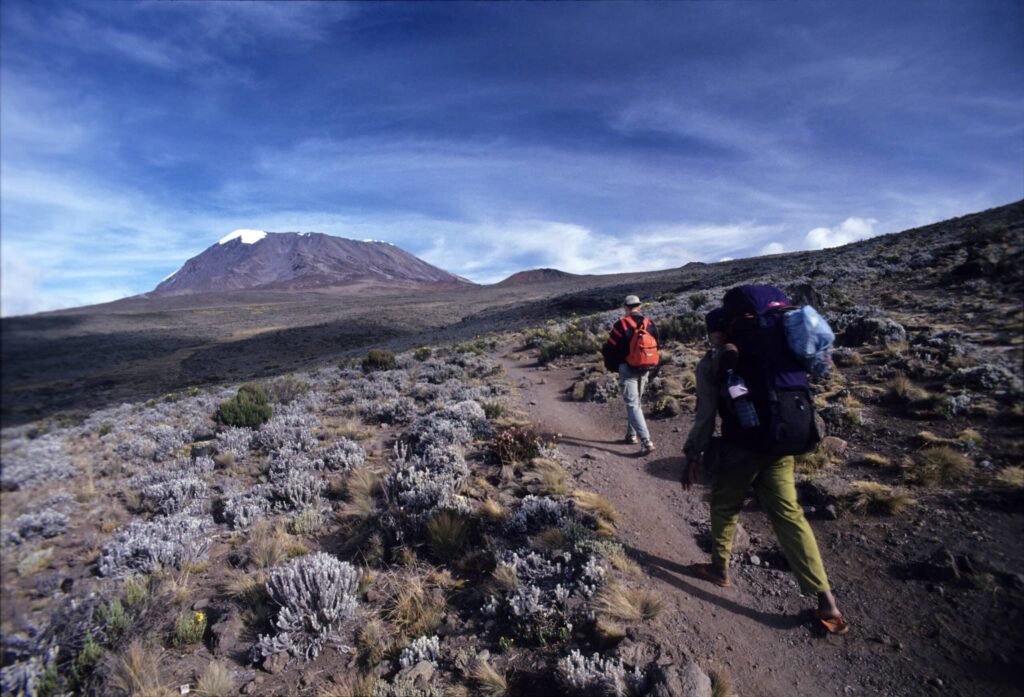
- Heather/Moorland Zone (2,800–4,000 m): Open heather moorland with giant heather and lobelia plants. Iconic ‘alien landscape’ feel with everlasting flowers. Temperatures 5–15°C during the day.
- Alpine Desert Zone (4,000–5,000 m): Sparse vegetation, volcanic rock, and thin soils. Very dry with dramatic temperature swings — hot by day, sub-zero at night.
- Arctic Zone (5,000 m and above): Barren, rocky terrain with permanent snow and ice fields. Glaciers are rapidly retreating. Summit temperatures can drop to -20°C at night.
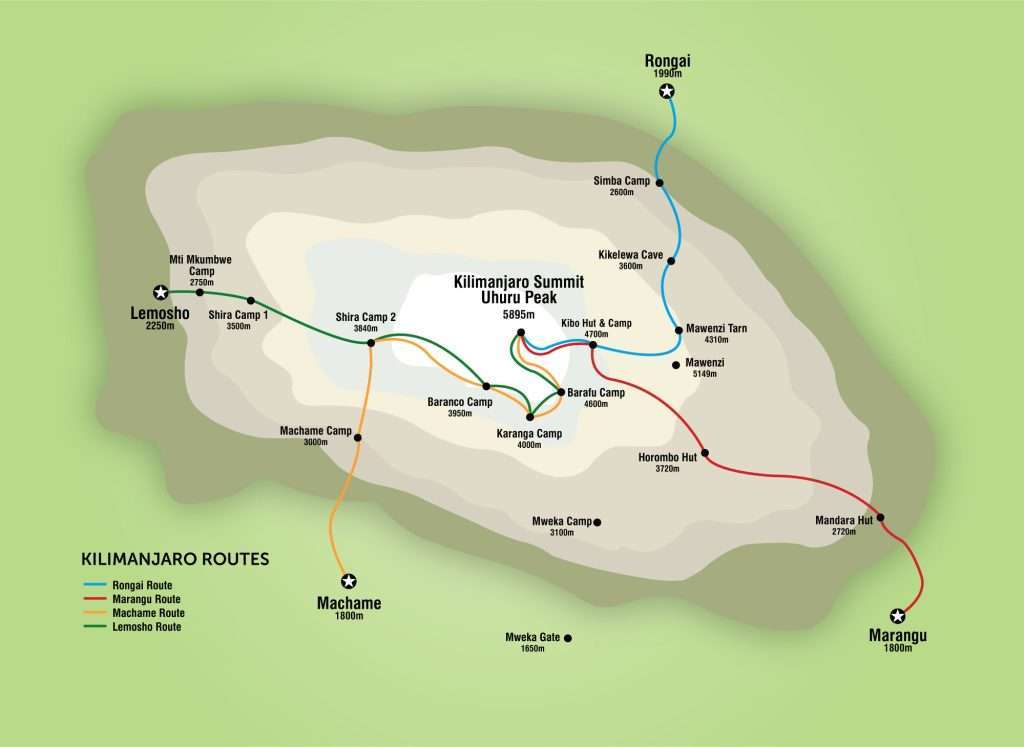
7. Marangu Route Map & Trail Description
The Marangu Route follows a clear, north-easterly path up the south-eastern flank of Kilimanjaro. As an out-and-back trail, the map of the Marangu Route shows climbers ascending and descending via the same path. Here is a detailed waypoint description to serve as your textual map guide:
Detailed Trail Description — Stage by Stage
Stage 1: Marangu Gate to Mandara Hut (8 km | +841 m elevation gain)
Starting at Marangu Gate (1,879 m), the trail enters dense montane rainforest immediately. The wide, well-maintained path climbs steadily northward through tall trees draped in moss and epiphytic plants. You may spot blue monkeys and colobus monkeys along this section. The trail crosses several small streams and forest clearings before reaching Mandara Hut (2,720 m) after 3–4 hours of hiking. A worthwhile 30-minute side trip leads to the Maundi Crater, offering views across the Kenyan plains on a clear day.
Stage 2: Mandara Hut to Horombo Hut (12 km | +1,000 m elevation gain)
This is the longest stage on the Marangu Route and the first day where you emerge above the treeline into open moorland. The trail passes through heath and grassland dotted with giant groundsels (Senecio kilimanjari) and giant lobelias — prehistoric-looking plants found only at high altitude on East African mountains. The iconic Mawenzi Peak becomes visible from this section, creating dramatic photo opportunities. Horombo Hut (3,720 m) sits in a beautiful alpine setting with views toward both Kibo (the main summit cone) and Mawenzi. Allow 5–7 hours for this stage.
Stage 3: Acclimatization Day at Horombo Hut (on 6-day and longer itineraries)
On a 6-day or longer itinerary, a full rest day is spent at Horombo Hut to aid acclimatization. This typically involves a hike to Zebra Rocks (3,870 m) — distinctive striped rocks formed by alternating bands of light and dark lava — or a guided walk toward Mawenzi Tarn (4,330 m). This ‘climb high, sleep low’ principle significantly improves acclimatization and summit success rates.
Stage 4: Horombo Hut to Kibo Hut (15 km | +983 m elevation gain)
The landscape becomes increasingly stark on this stage as you cross the ‘Saddle’ — the high plateau between Mawenzi and Kibo peaks. The vegetation virtually disappears, replaced by volcanic rock and gravel. The altitude becomes noticeably challenging. Many climbers experience their first symptoms of altitude sickness on this section. Kibo Hut (4,703 m) offers basic but essential shelter, a meal, and a few hours of rest before the summit night departure. Allow 5–6 hours for this stage.
Stage 5: Kibo Hut to Uhuru Peak — Summit Night (6 km | +1,192 m elevation gain)
This is the defining stage of the entire climb. Departure is typically between 11:00 PM and 1:00 AM to time the summit arrival for sunrise. The trail zigzags steeply up loose scree and volcanic rock in complete darkness, guided only by headlamps and the footsteps of your guide. Hans Meyer Cave (5,150 m) provides a brief rest point. Gilman’s Point (5,681 m) on the crater rim is the first major milestone. From here, a further 30–45 minutes along the crater rim leads to Uhuru Peak (5,895 m). Allow 5–7 hours for the ascent.
Stage 6: Descent from Uhuru Peak to Horombo Hut (21 km)
After a brief celebration at the summit, the descent begins immediately. The same trail is used all the way back down to Horombo Hut, where climbers spend a final night before completing the descent to Marangu Gate the following morning.
8. Marangu Route Kilimanjaro — 6-Day Itinerary
The 6-day Marangu Route is the most recommended itinerary, offering one additional acclimatization day at Horombo Hut compared to the minimum 5-day option. This extra day significantly improves summit success rates and overall safety.
6-Day Detailed Day-by-Day Schedule
Day | Route Segment | Distance | Elevation | Notes |
Day 1 | Marangu Gate → Mandara Hut | 8 km | 1,879→2,720 m | 3–4 hrs | Rainforest hike |
Day 2 | Mandara Hut → Horombo Hut | 12 km | 2,720→3,720 m | 5–7 hrs | Enter moorland |
Day 3 | Acclimatization at Horombo | 4–6 km | 3,720→3,870 m | Zebra Rocks day hike |
Day 4 | Horombo Hut → Kibo Hut | 15 km | 3,720→4,703 m | 5–6 hrs | Alpine desert |
Day 5 | Kibo → Summit → Horombo | 27 km | 4,703→5,895→3,720 m | 12–14 hrs total | Night ascent |
Day 6 | Horombo Hut → Marangu Gate | 20 km | 3,720→1,879 m | 5–7 hrs | Certificate at gate |
9. Marangu Route Kilimanjaro — 8-Day Itinerary
The 8-day Marangu Route is the extended option that provides the best possible acclimatization on this trail. While less common than the 5 or 6-day versions, the 8-day itinerary offers multiple rest days and side trips, dramatically improving summit success rates and the overall experience.
8-Day Detailed Day-by-Day Schedule
Day | Route Segment | Distance | Elevation | Notes |
Day 1 | Marangu Gate → Mandara Hut | 8 km | 1,879→2,720 m | 3–4 hrs | Rainforest zone |
Day 2 | Acclimatization at Mandara | 4 km | 2,720→2,780 m | Maundi Crater hike |
Day 3 | Mandara Hut → Horombo Hut | 12 km | 2,720→3,720 m | 5–7 hrs | Enter moorland |
Day 4 | Acclimatization at Horombo | 6 km | 3,720→3,870 m | Zebra Rocks hike |
Day 5 | Acclimatization — Horombo to Mawenzi Tarn | 8 km | 3,720→4,330 m | High-altitude day hike |
Day 6 | Horombo Hut → Kibo Hut | 15 km | 3,720→4,703 m | 5–6 hrs | Saddle crossing |
Day 7 | Kibo → Summit → Horombo | 27 km | 4,703→5,895→3,720 m | 12–14 hrs | Night ascent |
Day 8 | Horombo Hut → Marangu Gate | 20 km | 3,720→1,879 m | Certificate at gate |
The 8-day itinerary is especially recommended for climbers over the age of 50, those with limited previous high-altitude experience, or anyone who has previously suffered from Acute Mountain Sickness. The additional days at lower altitudes allow the body to gradually produce more red blood cells and adapt to lower oxygen availability.
10. Why Climb Kilimanjaro Through the Marangu Route?
Despite lower summit success rates compared to some longer routes, the Marangu Route remains a compelling choice for many climbers. Here are the key reasons why thousands of climbers select this route every year:
Top Reasons to Choose the Marangu Route
- Permanent Hut Accommodation: The Marangu Route is the only route on Kilimanjaro that offers sleeping in permanent mountain huts rather than tents. The huts at Mandara, Horombo, and Kibo provide bunk beds, mattresses, and a communal dining area — a significant comfort advantage, especially during bad weather.
- Lower Cost: Because huts eliminate the need for camping equipment (tents, dining tents, toilet tents), the Marangu Route is generally the least expensive option on Kilimanjaro, making it accessible to budget-conscious travellers.
- Well-Defined & Maintained Trail: The Marangu trail is one of the oldest and most walked paths on the mountain, meaning it is very well marked, wide, and easy to follow in poor visibility.
- Shorter Minimum Duration: For those with limited time, the 5-day Marangu is the shortest official option on the mountain, although this comes at the cost of a lower success rate.
- Historical Significance: As the route used in the first recorded successful summit of Kilimanjaro in 1889, climbing via Marangu connects you with over 135 years of mountaineering history.
- Access to Facilities: The huts include basic canteens selling snacks and hot beverages, solar charging points, and basic toilet facilities — luxuries not available on camping routes.
- Good for Families & First-Timers: The relatively straightforward terrain and hut accommodation make Marangu a popular choice for families with older teens and first-time high-altitude trekkers.
11. Marangu Route Kilimanjaro Huts
One of the defining features of the Marangu Route is its system of permanent mountain huts, which are unique on Kilimanjaro. These huts are managed by TANAPA and provide shelter, sleeping facilities, basic meals, and some limited supplies. Here is a detailed guide to each hut:
Mandara Hut — 2,720 m (8,924 ft)
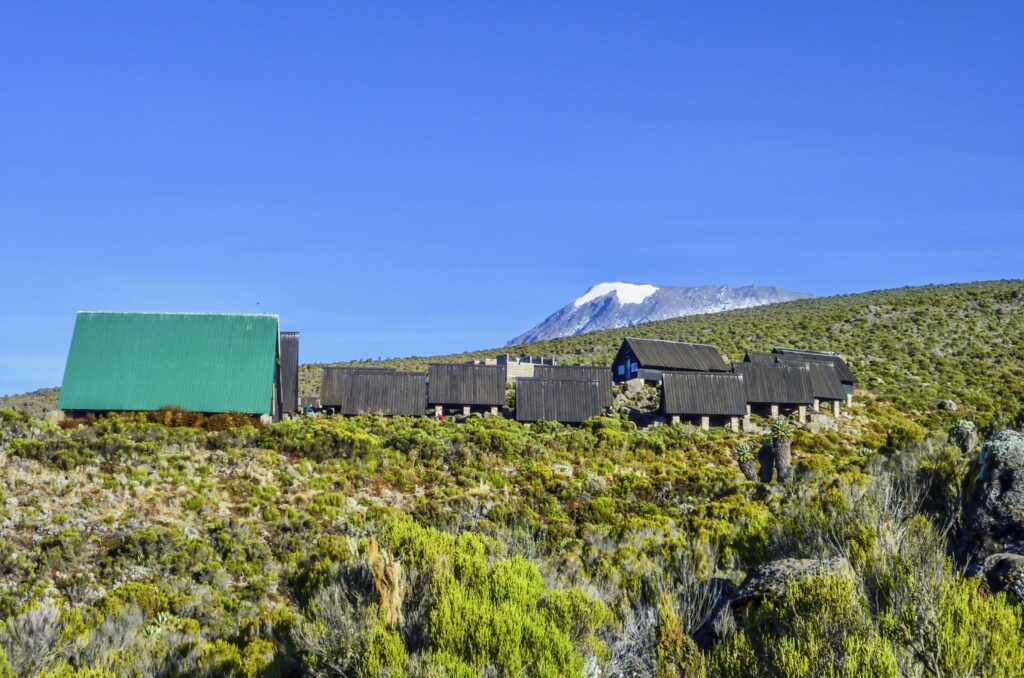
Mandara Hut is a complex of several wooden A-frame buildings located at the upper edge of the rainforest zone. It is named after the Chagga chief Mandara who ruled the Moshi area in the late 19th century. The hut complex can accommodate up to 200 climbers in bunk-bed dormitories. Facilities include a main dining and common room, basic toilets, and a small shop selling snacks, soft drinks, and basic supplies. Water is available nearby. A popular side trip from Mandara is the 30-minute walk to Maundi Crater, a scenic volcanic crater with excellent views on clear days.
Horombo Hut — 3,720 m (12,205 ft)
Horombo Hut is the largest and most comfortable of the three Marangu huts, and it serves as the acclimatization base on the 6-day and longer itineraries. The compound consists of over 20 individual wooden huts arranged in a cluster, with a capacity for approximately 200 climbers. Facilities include a large dining hall, solar-powered lighting, basic toilets, and a small shop with snacks, beverages, and emergency supplies. The altitude (3,720 m) means that some climbers begin to feel the effects of altitude at Horombo. Views of both Mawenzi and Kibo peaks are spectacular from the hut on clear mornings.
Kibo Hut — 4,703 m (15,430 ft)
Kibo Hut is the most austere of the three huts, reflecting its extreme location in the high alpine desert at the base of Kibo cone. The large stone building can house up to 60 climbers in open dormitories. At this altitude, most climbers experience poor sleep, headaches, and loss of appetite. The hut provides simple meals, hot drinks, and basic toilet facilities. Most climbers arrive at Kibo in early afternoon, try to sleep for a few hours, and then depart for the summit between 11 PM and 1 AM. A second smaller stone building (the ‘annexe’) provides overflow sleeping.
Hut Comparison Table
Hut | Elevation | Capacity | Facilities | Side Trips |
Mandara Hut | 2,720 m | ~200 beds | Dorms, toilets, shop | Maundi Crater |
Horombo Hut | 3,720 m | ~200 beds | Dorms, dining, shop, solar charging | Zebra Rocks, Mawenzi Tarn |
Kibo Hut | 4,703 m | ~60 beds | Basic dorms, toilets, meals | None (summit point) |
12. Marangu Route Success Rate
The success rate on the Marangu Route varies significantly depending on the duration of the itinerary chosen. It is one of the most frequently cited statistics when comparing Kilimanjaro routes, and understanding the numbers is essential for setting realistic expectations.
5-Day Marangu Success Rate | Approximately 25–35% reach Uhuru Peak |
6-Day Marangu Success Rate | Approximately 50–65% reach Uhuru Peak |
7-Day Marangu Success Rate | Approximately 65–75% reach Uhuru Peak |
8-Day Marangu Success Rate | Approximately 75–85% reach Uhuru Peak |
Gilman’s Point Reach Rate (6-day) | Approximately 70–80% (crater rim, not true summit) |
Why Does the Marangu Route Have a Lower Success Rate?
- Rapid Ascent Profile: The 5-day itinerary in particular gains elevation very quickly, leaving insufficient time for the body to adjust to reduced oxygen levels.
- Out-and-Back Trail: Unlike routes such as Machame that traverse different slopes (allowing passive acclimatization through varied terrain), Marangu’s out-and-back profile means climbers ascend the same consistent gradient without the ‘climb high, sleep low’ variations.
- Overcrowding: As the most popular route, Marangu can become crowded, which affects pace management and rest quality at the huts.
- Comfort Bias: The hut accommodation, while a genuine advantage, can lead some climbers to underestimate the mountain’s seriousness, resulting in inadequate preparation.
How to Improve Your Success Rate on Marangu
- Choose the 6-day or longer itinerary — this single change has the highest impact on success
- Arrive in Tanzania 2–3 days early to begin acclimatizing to altitude before the climb
- Consider climbing a smaller peak (e.g., Mount Meru, 4,566 m) in the week before Kilimanjaro
- Maintain the ‘pole pole’ (slowly, slowly) pace throughout — never rush
- Stay hydrated — drink 3–4 litres of water per day
- Consult your doctor about acetazolamide (Diamox) for altitude sickness prevention
- Book with an operator that employs experienced guides with wilderness first-aid training
13. What Is the Difference Between Marangu and Machame Routes?
The Marangu and Machame routes are the two most popular trails on Kilimanjaro, and they are frequently compared. While both routes summit at Uhuru Peak, they differ significantly in almost every other respect. Here is a comprehensive comparison:
Comparison Factor | Marangu Route | Machame Route |
Nickname | “Coca-Cola Route” | “Whiskey Route” |
Trail Type | Out-and-back (same path up/down) | Traverse (different ascent/descent paths) |
Accommodation | Permanent huts (dormitory beds) | Tents (camping throughout) |
Min. Duration | 5 days | 6 days |
Recommended Duration | 6 days | 7 days |
Summit Success Rate (6-day) | ~55–65% | ~75–85% |
Acclimatization Profile | Moderate — limited altitude variation | Better — includes Lava Tower at 4,630 m |
Scenery & Views | Good — forest and moorland | Outstanding — more varied landscapes |
Difficulty | Moderate | Moderate to Challenging |
Cost | Lower (no camping gear needed) | Higher (full camping equipment) |
Crowds | Very busy — most popular route | Busy — second most popular |
Best For | Budget travellers, comfort seekers | Higher success rate priority |
Certificate Issued | Yes — at Marangu Gate | Yes — at Mweka Gate |
The ‘Acclimatization’ Advantage of Machame Over Marangu
The most significant difference between the two routes is the acclimatization profile. On the Machame Route, the trail passes through Lava Tower (4,630 m) on Day 3 before descending to Barranco Camp (3,960 m) for the night. This classic ‘climb high, sleep low’ day of hiking at altitude followed by sleeping lower is a cornerstone of altitude acclimatization science.
The Marangu Route does not include an equivalent high-altitude excursion unless a specific acclimatization day to Mawenzi Tarn (4,330 m) is included on an 8-day itinerary. On the standard 6-day Marangu, the altitude profile is more linear and ascending, which explains the lower summit success rate compared to Machame.
Which Route Should You Choose?
Choose Marangu if: you prioritize comfort and sleeping in huts, are on a tighter budget, have limited time, or are climbing with older or younger family members who would struggle with camping in cold temperatures.
Choose Machame if: your primary goal is reaching the summit and you are willing to invest more money and time in a route with a better acclimatization profile. Machame also offers more dramatic and varied scenery.
14. How Far Is Marangu Gate from Mandara Hut?
Marangu Gate (also known as Marangu Park Gate or Park Headquarters Gate) is located at 1,879 metres elevation and serves as the official starting and finishing point of the Marangu Route. Mandara Hut sits at 2,720 metres.
Horizontal Distance | Approximately 8 kilometres (5 miles) |
Elevation Gain | +841 metres (2,759 feet) |
Average Hiking Time | 3 to 4 hours (at Kilimanjaro pace) |
Trail Type | Wide forest path through montane rainforest |
Difficulty | Easy to Moderate (first stage) |
Terrain | Forest trail, some mud in wet season, occasional boardwalks |
What to Expect on the Marangu Gate to Mandara Hut Stage
The trail begins at the TANAPA registration desk at Marangu Gate, where all permits and documentation are checked and finalized. From the gate, the trail enters dense montane rainforest almost immediately. The path is wide enough for two people to walk side by side and is well-signposted.
This first stage is considered a ‘warm-up’ day, with a gentle gradient and relatively comfortable temperatures. The trail crosses several small streams and passes through clearings before arriving at Mandara Hut. Key wildlife commonly spotted on this section includes blue monkeys (Cercopithecus mitis), colobus monkeys, various sunbirds, and the occasional chameleon.
The GPS coordinates for key points on this stage are approximately: Marangu Gate: 3.262°S, 37.515°E and Mandara Hut: 3.220°S, 37.523°E.
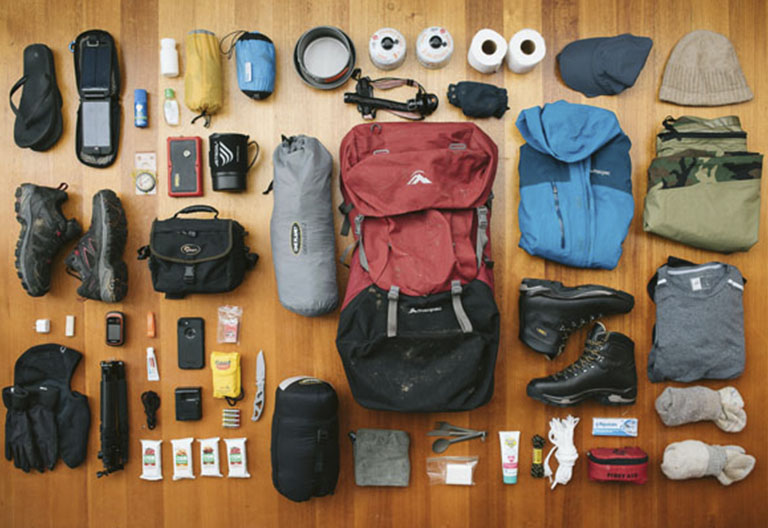
15. Essential Gear & Packing List for Marangu Route
Clothing & Layering System
- Moisture-wicking base layer (top and bottom) — 2 sets
- Insulating mid-layer: fleece or down jacket
- Waterproof and windproof outer shell jacket and trousers
- Insulated down jacket for summit night (rated to -15°C or colder)
- Hiking trousers — 2 pairs (one lightweight, one warmer)
- Warm hat / balaclava for summit night
- Sun hat for daytime hiking
- Neck gaiter or buff
- Warm gloves (liner gloves + outer waterproof mittens for summit)
- Thick hiking socks — 4–6 pairs
- Gaiters (useful on scree near summit)
Footwear
- Waterproof hiking boots with ankle support (broken in before the climb)
- Camp shoes or sandals for use at the huts
- Thermal inner socks for summit night
Equipment & Accessories
- Trekking poles (highly recommended — reduces knee strain on descent)
- Headlamp with extra batteries (essential for summit night)
- Daypack (25–35 litre) for daily hiking
- Large duffel bag for porter to carry (max 15 kg)
- Sleeping bag rated to -10°C to -15°C (even for hut use — huts can be cold)
- Sunglasses (UV400 protection — crucial above treeline)
- Sunscreen SPF 50+ and lip balm with SPF
- Water bottles or hydration bladder (3–4 litres capacity)
- Water purification tablets or filter (for natural water sources)
- Camera and power banks (cold drains batteries fast)
Health & Medications
- Acetazolamide (Diamox) — consult your doctor before travelling
- Ibuprofen or paracetamol for headache management
- Rehydration salts (ORS sachets)
- Personal first aid kit: blister care, bandages, antiseptic
- Prescription medications in original packaging
- Travel insurance documentation (must cover high-altitude trekking and helicopter evacuation)
16. Best Time to Climb Kilimanjaro via Marangu Route
Kilimanjaro can be climbed year-round, but weather patterns significantly affect summit conditions. There are two main climbing seasons:
Peak Season 1: January to March
This is the long dry season following the ‘short rains’ of November–December. January to March offers excellent visibility, drier trails, and cold but manageable temperatures. January and February are considered by many guides to offer the best overall conditions. Note that January can have cold night temperatures, which is actually beneficial for summit snow and ice conditions.
Peak Season 2: June to October
The longest and most popular climbing season runs from June through October, falling between the long rains (April–May) and the short rains (November–December). July, August, and September are the busiest months on the mountain but offer reliably dry conditions.
Seasons to Avoid
April and May bring the long rains — heavy, persistent precipitation that makes all trails muddy and slippery, reduces visibility, and makes the summit push extremely cold and wet. November and December bring lighter but still significant rainfall. While Kilimanjaro is never ‘closed,’ climbing in the rainy season is significantly more challenging and less enjoyable.
17. Pro Tips for Kilimanjaro Success via Marangu Route
- Train for 3–6 months before your climb: Incorporate long hikes with elevation gain, stair climbing, and cardio fitness training. The better your base fitness, the more energy you can divert to altitude adaptation.
- Walk pole pole (slowly): The Swahili phrase ‘pole pole’ (pronounced ‘po-lay po-lay’) means slowly. Your guide will repeat this constantly. Resist the urge to hike at your normal pace — the slower pace conserves oxygen and reduces AMS risk.
- Eat even when you have no appetite: Altitude suppresses appetite, but your body needs calories for energy and warmth. Force yourself to eat regular, carbohydrate-rich meals at the huts.
- Communicate symptoms immediately: Report any headache, nausea, confusion, or loss of coordination to your guide right away. Early intervention prevents serious altitude illness.
- Do not turn back unnecessarily, but do not ignore warning signs: Mild headache is normal above 3,500 m. Severe headache that doesn’t respond to hydration and ibuprofen, or any confusion or loss of balance, requires immediate descent.
- Book with a reputable operator: Look for KPAP Partner operators, TANAPA-licensed companies, and those with strong safety records. Ask specifically about guide-to-climber ratios (1:1 or better is ideal for summit night).
- Tip your crew appropriately: Guides, assistant guides, cooks, and porters all contribute to your success. Budget $100–$150 per climber for tip allocation, distributed according to KPAP guidelines.
Ready to Begin Your Kilimanjaro Journey?
The Marangu Route offers one of Africa’s most iconic trekking experiences — a journey from tropical rainforest to arctic summit that passes through four distinct ecological zones and 135 years of mountaineering history. Whether you choose the 5-day, 6-day, or 8-day itinerary, preparation, patience, and the right team will be the cornerstones of your success. Walk pole pole, hydrate well, listen to your guides, and the Roof of Africa will be within your reach.
Karibu Kilimanjaro — Welcome to Kilimanjaro.