Rongai Route
Mount Kilimanjaro, Africa’s highest peak and the world’s tallest free-standing volcano, draws tens of thousands of climbers each year from every corner of the globe. Rising majestically to 5,895 metres (19,341 feet) above sea level in northern Tanzania, Uhuru Peak on Kilimanjaro’s Kibo crater rim represents one of the most iconic and accessible high-altitude summits on Earth — requiring no technical climbing skills, only physical fitness, mental determination, and proper acclimatization.
Among the seven official routes on Kilimanjaro — Marangu, Machame, Lemosho, Shira, Rongai, Northern Circuit, and Umbwe — the Rongai Route stands apart as the only route that approaches the mountain from the north, beginning near the Kenyan border. Also known historically as the Loitokitok Route, Rongai was reopened in the 1990s after years of closure and has grown steadily in popularity ever since, particularly among climbers seeking solitude, drier weather conditions, and a more gradual ascent profile.
This comprehensive guide answers every important question about the Rongai Route: its total distance, the park fees you must pay, its difficulty rating, its elevation profile, campsite huts, itinerary options, success rates, and why it stands as one of Kilimanjaro’s finest choices for summit aspirants.
QUICK FACTS AT A GLANCE
Total Route Distance | ~73 km (45 miles) round trip |
Summit Elevation | 5,895 m (19,341 ft) — Uhuru Peak |
Starting Gate | Rongai Gate — 1,950 m (6,398 ft) |
Success Rate | ~85–90% (6-day) / ~95% (8-day) |
Difficulty | Moderate — suitable for fit beginners |
Approach Side | Northern slopes (via Loitokitok, Kenya border) |
Best Itinerary Options | 6 days (minimum) or 8 days (recommended) |
Is the Rongai Route the Northern Route?
Yes — the Rongai Route is universally recognised as Kilimanjaro’s northern route, and this geographical distinction is one of its most defining characteristics. While every other established route on Kilimanjaro — Marangu, Machame, Lemosho, Shira, and Umbwe — approaches the mountain from the south or southwest, the Rongai Route climbs from the northeast, beginning close to the Tanzania-Kenya border near the small Tanzanian town of Loitokitok.
This northern approach carries profound practical implications for climbers:
- Drier Conditions: The southern and southwestern slopes of Kilimanjaro receive far more rainfall due to prevailing trade winds and the proximity of Tanzania’s agricultural highlands. The northern slopes sit in a partial rain shadow, receiving significantly lower annual precipitation. This makes the Rongai Route particularly attractive during Tanzania’s long rainy season (March to May) and short rainy season (October to November), when southern routes can be extremely wet and unpleasant.
- Fewer Crowds: Because most climbers fly into Kilimanjaro International Airport (near Moshi or Arusha) and then drive to southern trailheads, the northern Rongai gate receives far fewer visitors. Climbers on the Rongai Route frequently report days of virtually uninterrupted wilderness, a stark contrast to the well-trodden southern paths.
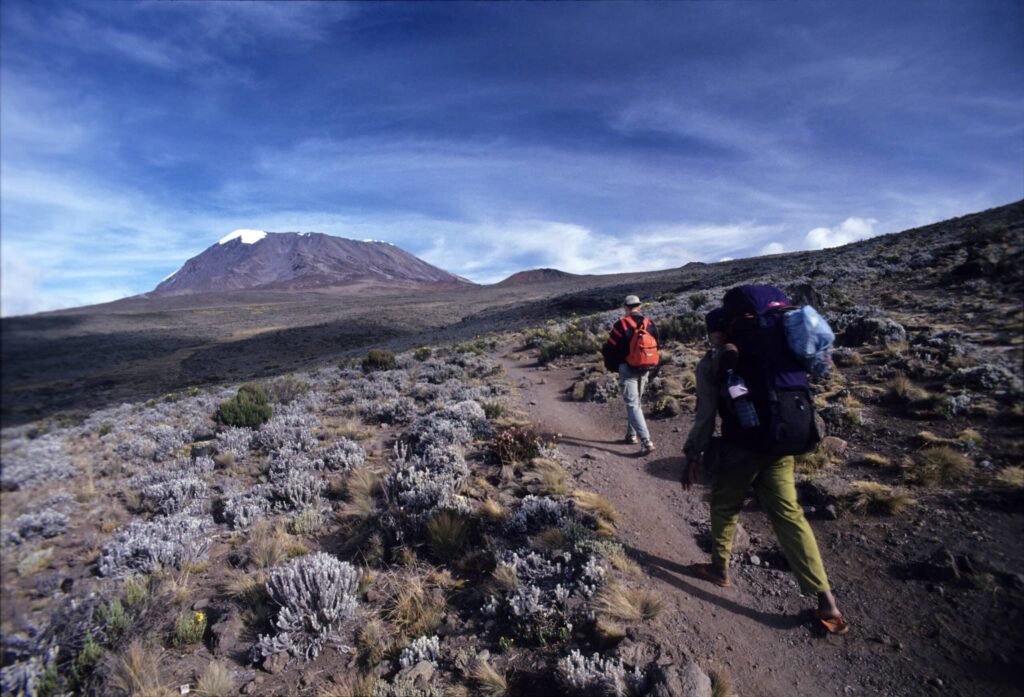
- Unique Landscape: The northern slopes showcase a distinctly different ecological character — semi-arid moorland, open heath zones, and views across the Amboseli plains toward Kenya that are simply unavailable from any southern route.
- Single Direction vs. Circuit: Most Rongai itineraries ascend via the north and descend via the southeast (toward Marangu or Mweka), giving climbers exposure to two distinct sides of the mountain.
The Northern Circuit, a newer and longer route, also traverses the northern slopes, but the Rongai Route remains the classic and most-used northern approach.
How Many Kilometres is the Rongai Route?
The total distance of the Rongai Route depends on the chosen itinerary and descent path, but the following figures represent the standard distances:
Route Segment | Distance (km) | Distance (miles) | Notes |
Rongai Gate to Simba Camp | 8.5 km | 5.3 miles | Day 1 ascent |
Simba Camp to Second Cave Camp | 9.0 km | 5.6 miles | Day 2 ascent |
Second Cave to Third Cave / Kikelewa | 7.0 km | 4.3 miles | Day 3 ascent |
Third Cave to School Hut / Kibo Huts | 8.0 km | 5.0 miles | Day 4 acclimatisation |
Kibo Huts / School Hut to Uhuru Peak | 5.5 km | 3.4 miles | Summit night ascent |
Uhuru Peak to Horombo / Mweka Gate (descent) | 18–22 km | 11–14 miles | Via Marangu or Mweka |
TOTAL (approximate) | ~65–73 km | ~40–45 miles | Full round trip |
The 6-day itinerary covers approximately 65–68 km in total, while the 8-day itinerary — which includes additional acclimatisation days — covers around 70–73 km due to acclimatisation hikes and slightly varied camp placements. These distances are approximate; exact figures vary by GPS measurement, the specific camps used, and whether side hikes are included during acclimatisation rest days.
For comparison, the Machame Route covers approximately 62 km, the Lemosho Route about 70 km, and the Marangu Route (the shortest) about 56 km round trip. The Rongai Route’s distance is therefore in the mid-range, longer than Marangu and Umbwe but comparable to Lemosho.
What Do You Pay (Park Fees) to Climb Kilimanjaro?
All climbers on Kilimanjaro must pay fees to the Tanzania National Parks Authority (TANAPA). These fees are non-negotiable and must be paid through a licensed tour operator registered with TANAPA. Fees are structured per person per day and cover different aspects of the climbing experience.
Current Fee Structure (2024–2025)
Fee Category | Rate (USD) | Notes |
Conservation Fee | $70/person/day | Charged for every day spent in the park |
Rescue Fee | $20/person (once) | One-time fee per climb, covers mountain rescue |
Camping Fee | $50/person/night | For all routes except Marangu (hut fee different) |
Marangu Hut Fee | $60/person/night | Instead of camping fee on Marangu Route |
Guide Fee (TANAPA) | Included in operator | Your licensed guide registers with TANAPA |
Porter Wages | Regulated by TANAPA | Minimum wage set by regulation |
VAT (Tanzania) | 18% | Applied to all services by tour operators |
Total Park Fee Estimates for Rongai Route
Itinerary | Conservation Fee | Camping Fee | Rescue Fee | Approximate Total Fees |
6-Day Rongai | $70 × 6 = $420 | $50 × 5 = $250 | $20 | ~$690 per person |
7-Day Rongai | $70 × 7 = $490 | $50 × 6 = $300 | $20 | ~$810 per person |
8-Day Rongai | $70 × 8 = $560 | $50 × 7 = $350 | $20 | ~$930 per person |
Note: These figures represent TANAPA fees only. Full climb packages from licensed operators also include guide fees, porter wages, accommodation before/after climb, airport transfers, meals on the mountain, climbing equipment, tips, and the operator’s service fee. Complete all-inclusive Rongai packages typically range from USD $2,000 to $4,500+ per person depending on itinerary length, group size, and operator quality.
Additional Cost Considerations
- International Flights: Not included in any package; varies widely by origin.
- Travel Insurance: Mandatory — must cover high-altitude trekking and emergency evacuation.
- Kilimanjaro Gear: Proper layering system, trekking poles, sleeping bag (rated to -15°C or lower), hiking boots. Budget $500–$1,500 if purchasing new gear.
- Tips for Crew: Strongly recommended at $10–$20/day per guide, $5–$10/day per porter as a minimum guideline.
- Visa for Tanzania: USD $50 for most nationalities (e-visa available online).
How Difficult is the Rongai Route?
The Rongai Route is generally classified as a moderate difficulty route — sitting in the middle of Kilimanjaro’s difficulty spectrum. It is one of the most beginner-friendly options on the mountain, but ‘beginner-friendly’ must be understood in context: all Kilimanjaro routes are serious high-altitude endeavours that demand respect, preparation, and physical fitness.
Why Rongai is Considered Moderate
- Gradual Gradient: The northern slopes of Kilimanjaro have a comparatively gentle gradient, particularly in the lower zones. The ascent from Rongai Gate through the forest and moorland is steady rather than steep, allowing the body time to acclimatise.
- No Technical Terrain: There is no scrambling, rock climbing, or glacier travel on the standard Rongai Route. The paths are well-maintained and clearly marked.
- Good Acclimatisation Profile: The route’s gradual elevation gain — particularly on 7- and 8-day itineraries — provides excellent opportunities for altitude adaptation. The ‘climb high, sleep low’ principle is easier to implement on Rongai than on faster routes like Marangu or Umbwe.
- Summit Night Challenge: Despite the route’s moderate character, summit night (the final push from Kibo Huts or School Hut to Uhuru Peak) is universally challenging. Climbers ascend from approximately 4,750 metres to 5,895 metres in 5–8 hours, often in freezing temperatures (-10°C to -25°C), high winds, and darkness. This section — the crater rim approach via the Western Breach scree — is what separates summit successes from turnarounds on all Kilimanjaro routes.
Rongai Difficulty Compared to Other Routes
Route | Difficulty Rating | Technical Terrain | Crowd Level | Recommended Duration |
Umbwe | Very Hard | Steep, exposed | Very Low | 6–7 days |
Machame | Hard | Moderate scrambling | High | 6–7 days |
Lemosho | Moderate–Hard | Some scrambling | Low–Medium | 7–8 days |
Rongai | Moderate | None | Low | 6–8 days |
Northern Circuit | Moderate | None | Very Low | 9–10 days |
Marangu | Moderate | None | Very High | 5–6 days |
Shira | Moderate–Hard | Some scrambling | Low | 7–8 days |
Physical Preparation Recommended
To maximise success chances on the Rongai Route, the following physical preparation is advised in the months before the climb:
- Regular cardiovascular exercise: running, cycling, swimming, or stair climbing — 4–5 days per week
- Long hiking days (6–10 hours) in the 2–3 months before the climb, ideally including some elevation gain
- Load-bearing practice: hike with a daypack (5–8 kg) to simulate mountain conditions
- High-altitude pre-exposure (optional but beneficial): weekend trips to elevations above 3,000 m
- Strength training: core, legs, and upper body to support trekking pole use
What is the Most Successful Route on Kilimanjaro?
The most successful route on Kilimanjaro — in terms of highest summit success rate — is the Northern Circuit Route, followed closely by the Lemosho Route on extended itineraries, and the Rongai Route on 8-day programmes. However, the answer depends heavily on the duration of the itinerary.
Route | Average Success Rate | Optimal Duration | Key Reason for Success |
Northern Circuit | ~95%+ | 9–10 days | Longest acclimatisation, full mountain circuit |
Lemosho (8-day) | ~90–95% | 8 days | Excellent profile, gradual gain, low altitude camp |
Rongai (8-day) | ~90–95% | 8 days | Gradual northern approach, good acclimatisation days |
Machame (7-day) | ~85–90% | 7 days | Popular, good profile but can be rushed |
Rongai (6-day) | ~80–88% | 6 days | Faster pace, less acclimatisation time |
Marangu (6-day) | ~65–80% | 6 days | Fastest gain, most altitude sickness |
Umbwe (6-day) | ~60–75% | 6 days | Most direct, most altitude sickness |
The critical insight is that route duration matters more than route choice. A climber taking 8 days on the Rongai Route will have dramatically better success chances than a climber taking 5 days on any route. TANAPA data and operator records consistently confirm that acclimatisation — spending sufficient nights at intermediate elevations before summit night — is the single most important factor in summit success.
The Rongai Route’s moderate gradient and northerly approach make it particularly well-suited for extended, acclimatisation-focused itineraries. When taken over 8 days, it rivals the best-performing routes on the mountain.
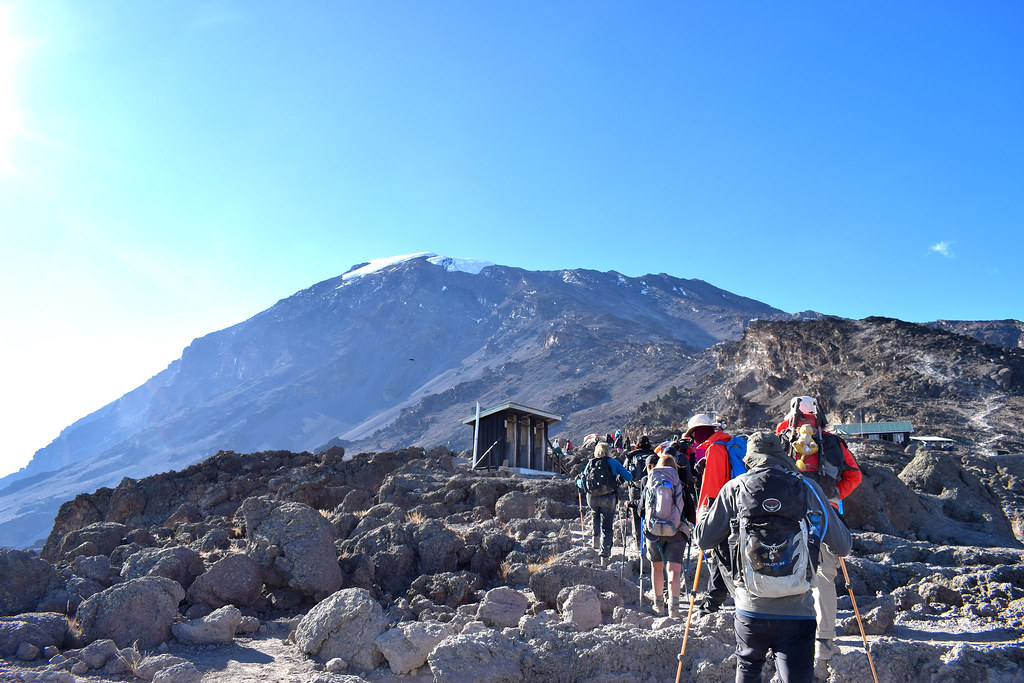
Rongai Route Elevation Profile
Understanding the elevation profile is essential for planning your acclimatisation strategy. The Rongai Route has one of the most forgiving elevation profiles of any Kilimanjaro route, particularly during the first three days.
Camp / Location | Elevation (metres) | Elevation (feet) | Approximate Altitude Gain from Previous |
Rongai Gate (Start) | 1,950 m | 6,398 ft | Starting point |
Simba Camp (Day 1) | 2,650 m | 8,694 ft | +700 m |
Second Cave Camp (Day 2) | 3,450 m | 11,319 ft | +800 m |
Kikelewa Cave Camp (Day 3) | 3,600 m | 11,811 ft | +150 m |
Mawenzi Tarn Camp (Day 3 alt.) | 4,330 m | 14,206 ft | +880 m from Second Cave |
Third Cave Camp (Day 3) | 3,900 m | 12,795 ft | +450 m |
School Hut (Day 4) | 4,750 m | 15,584 ft | +420–850 m |
Kibo Huts (alt. Day 4) | 4,703 m | 15,430 ft | Alternative high camp |
Gilman’s Point (Crater Rim) | 5,685 m | 18,652 ft | +935 m from high camp |
Stella Point | 5,756 m | 18,885 ft | +71 m from Gilman’s |
Uhuru Peak (Summit) | 5,895 m | 19,341 ft | +139 m from Stella |
Key Elevation Zones
- Cultivated Zone (800–1,800 m): Below the park gate. Farmland, coffee plantations, and villages surround the lower slopes.
- Forest Zone (1,800–2,800 m): Dense montane rainforest with lush vegetation, colobus monkeys, and rich birdlife. Rongai Gate sits at the upper boundary of this zone.
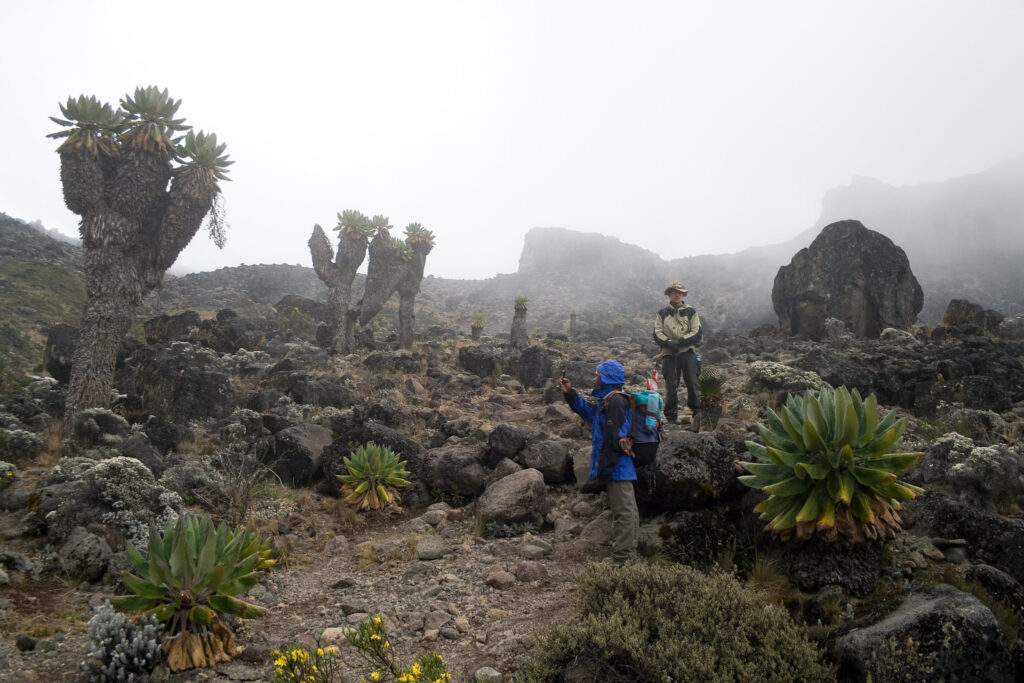
- Moorland / Heath Zone (2,800–4,000 m): Open grassland with giant heather, lobelias, and groundsels. This is where most acclimatization days are spent on Rongai.
- Alpine Desert Zone (4,000–5,000 m): Sparse vegetation, rocky terrain, dramatic temperature swings. School Hut and Kibo Huts sit in this zone.
- Arctic Zone (5,000–5,895 m): Glaciers, ice fields, volcanic rock. The summit is reached via scree slopes above the crater rim.
Altitude Sickness Awareness
Acute Mountain Sickness (AMS) typically begins to manifest above 2,500 m. Symptoms include headache, nausea, fatigue, loss of appetite, and disturbed sleep. The general rule — ‘if in doubt, descend’ — should always take precedence over summit ambitions. Diamox (acetazolamide) is sometimes used as a prophylactic; consult your physician before the climb.
Serious altitude illnesses — High Altitude Pulmonary Edema (HAPE) and High Altitude Cerebral Edema (HACE) — can be life-threatening and require immediate descent. The mountain rescue services on Kilimanjaro are well-practised, but prevention through gradual ascent remains the best strategy.
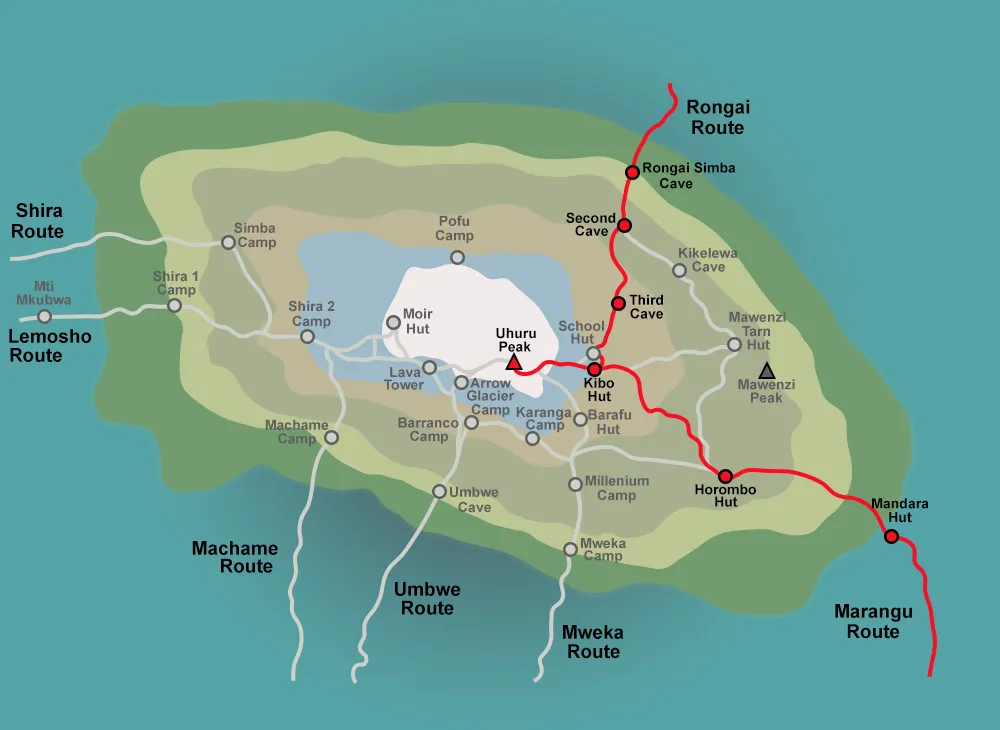
Rongai Route Map — Navigating the Northern Approach
While a printed or digital map is essential equipment for any Kilimanjaro climb, understanding the geographical layout of the Rongai Route helps climbers orient themselves during the ascent and descent.
Route Overview from North to South
The Rongai Route begins at the Rongai Gate, situated approximately 65 kilometres northeast of Moshi, near the village of Loitokitok close to the Kenyan border. The route initially travels in a southwesterly direction across the wide, open northern plateau of Kilimanjaro, entering the forest zone almost immediately after the gate.
Key navigational waypoints on the Rongai Route map include:
- Rongai Gate → Simba Camp: A broad, forested ridge trail heading southwest and gaining altitude steadily through montane forest.
- Simba Camp → Second Cave: The trail opens into moorland, offering first views of Mawenzi Peak and the crater rim.
- Second Cave → Third Cave / Kikelewa: Gradual traverse across open moorland. Mawenzi Tarn Camp (an alternative) offers spectacular views of the Mawenzi peak.
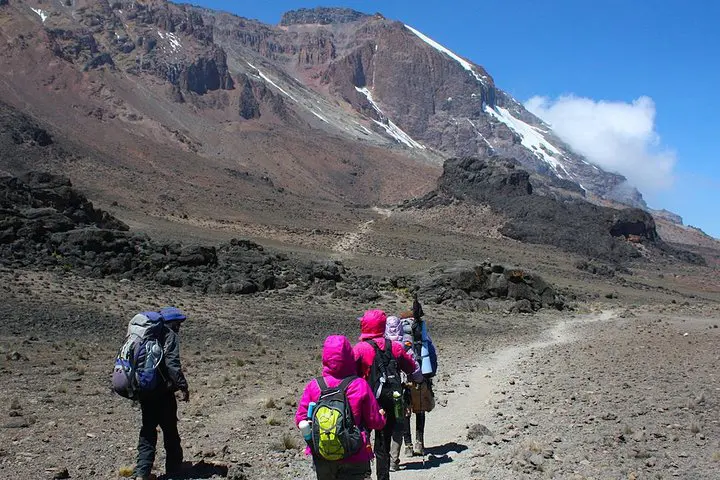
- Third Cave → School Hut or Kibo Huts: The path steepens as the alpine desert zone is entered, approaching the saddle between Kibo and Mawenzi.
- School Hut / Kibo Huts → Summit: The most prominent feature on any Rongai map is the summit night route, which ascends via the northeast face toward Gilman’s Point on the crater rim, then follows the rim to Uhuru Peak.
- Descent Route: Most operators descend via the Marangu or Mweka routes on the southeast face, arriving at Horombo Huts or Millennium Camp before continuing to Marangu or Mweka Gate.
Recommended Mapping Resources
- TANAPA Official Map: Available at the park gate and from registered operators
- Kilimanjaro 1:50,000 topographic map (Survey of Tanzania)
- GPS tracks available on Gaia GPS, AllTrails, and Wikiloc
- Digital: Maps.me offline maps with Kilimanjaro route overlays
- Tour operators provide laminated route maps as part of their briefing packages
Rongai Route Kilimanjaro Huts and Campsites
Unlike the Marangu Route — Kilimanjaro’s only route with purpose-built dormitory huts — the Rongai Route is a camping route. Climbers sleep in tents throughout the ascent (and descent if returning via Marangu, where huts are available). However, some camps have basic permanent structures called ‘caves’ (natural rock overhangs or built stone shelters) that have historically been used for shelter.
The Rongai Route Campsite System
Camp Name | Elevation | Terrain | Facilities | Typical Stay Night |
Simba Camp | 2,650 m | Forest edge / moorland | Pit latrines, stream water nearby | Night 1 |
Second Cave Camp | 3,450 m | Open moorland | Pit latrines, stream water | Night 2 |
Kikelewa Cave Camp | 3,600 m | Moorland | Pit latrines, water nearby | Night 3 (some itineraries) |
Mawenzi Tarn Camp | 4,330 m | Alpine desert | Pit latrines, tarn water | Night 3 (alt. itinerary) |
Third Cave Camp | 3,900 m | Moorland / alpine | Pit latrines, water stream | Night 3 (6-day itinerary) |
School Hut | 4,750 m | Alpine desert | Basic stone structures, limited water | Night 4 |
Kibo Huts | 4,703 m | Alpine desert / saddle | Dormitory huts (basic), pit latrines | Night 4 (alternative) |
Horombo Huts (descent) | 3,720 m | Moorland | Dormitory huts, water, basic meals | Night 5 (Marangu descent) |
Detailed Campsite Descriptions
Simba Camp (2,650 m)
Simba Camp is the first night’s destination on the Rongai Route, set on the boundary between the montane forest and the open moorland. The camp is named after the Swahili word for lion, reflecting the wildlife heritage of the region. Camp facilities are basic — pit latrines and natural water sources nearby — with operators providing portable toilet tents and cooking facilities. The forest edge setting provides shelter from wind, and the camp’s relatively low altitude means most climbers sleep well on the first night. Views begin to emerge across the northern plains toward Kenya.
Second Cave Camp (3,450 m)
Second Cave Camp sits in open moorland, offering expansive views in all directions. The ‘cave’ refers to a large natural rock overhang that has historically sheltered climbers and wildlife alike. At 3,450 metres, this is the altitude where the first signs of AMS sometimes appear — mild headaches and slight breathlessness are common and generally not a cause for concern if mild. The camp is well-positioned for photography, with Mawenzi Peak becoming prominently visible to the south. Nights at Second Cave can be cold, with temperatures dropping to -5°C to -10°C.
Third Cave Camp / Kikelewa Cave (3,600–3,900 m)
Third Cave Camp and Kikelewa Cave are closely spaced campsites in the upper moorland zone, depending on which itinerary variant is followed. Kikelewa Cave Camp at 3,600 metres is preferred on 7- and 8-day itineraries because it offers an acclimatisation hike up to Mawenzi Tarn without committing to a full day’s ascent. Third Cave at 3,900 metres is used on the 6-day itinerary for those pushing higher more quickly.
Mawenzi Tarn Camp (4,330 m)
Mawenzi Tarn Camp is one of the most scenically spectacular camps on all of Kilimanjaro. Perched above a high-altitude glacial tarn (mountain lake) beneath the jagged Mawenzi Peak, this camp offers views that rival anything on the mountain. On 8-day Rongai itineraries, climbers typically spend two nights at Mawenzi Tarn, with an acclimatisation rest day in between — hiking higher and returning to sleep lower. The altitude here (4,330 m) is sufficient to drive meaningful physiological adaptation before the final push to 5,895 metres.
School Hut (4,750 m)
School Hut is the preferred high camp for Rongai Route climbers making their summit attempt. Situated at 4,750 metres on the northeast face of Kibo, School Hut sits approximately 200 metres higher than the alternative Kibo Huts camp, giving climbers a slight advantage in terms of the total climbing distance on summit night. The hut itself is a basic stone structure, but most climbers sleep in tents alongside it. Water is extremely limited at this elevation, and temperatures regularly drop below -15°C.
Kibo Huts (4,703 m)
Kibo Huts is the more famous of the two high camp options, and the one associated with the Marangu Route. On the Rongai Route, some operators opt for Kibo Huts over School Hut due to slightly better facilities (stone dormitory bunks) and established logistics. Summit night from Kibo Huts typically begins around midnight, with climbers aiming to arrive at Gilman’s Point on the crater rim by dawn.
Rongai Route Kilimanjaro — 6-Day Itinerary
The 6-day Rongai itinerary is the minimum recommended duration for this route. It provides adequate acclimatisation for fit, experienced hikers but leaves little room for error. Climbers with no prior high-altitude experience should strongly consider the 7- or 8-day option.
Day | Stage | Elevation | Distance | Hiking Time | Description |
Day 1 | Rongai Gate → Simba Camp | 1,950 m → 2,650 m | ~8.5 km | 4–5 hours | Through dense forest, first moorland views |
Day 2 | Simba Camp → Second Cave Camp | 2,650 m → 3,450 m | ~9.0 km | 4–5 hours | Open moorland, Mawenzi views appear |
Day 3 | Second Cave → Third Cave Camp | 3,450 m → 3,900 m | ~7.0 km | 3–4 hours | Upper moorland, heather and giant lobelia |
Day 4 | Third Cave → School Hut (via acclimatisation) | 3,900 m → 4,750 m | ~8.0 km | 5–6 hours | Steep alpine desert, pre-summit rest afternoon |
Day 5 | School Hut → Summit → Descent to Horombo | 4,750 → 5,895 → 3,720 m | ~23 km | 14–18 hours total | Summit night departure midnight; descent after summit |
Day 6 | Horombo → Marangu Gate → Moshi | 3,720 m → 1,860 m | ~19 km | 5–7 hours | Final descent, certificate presentation, departure |
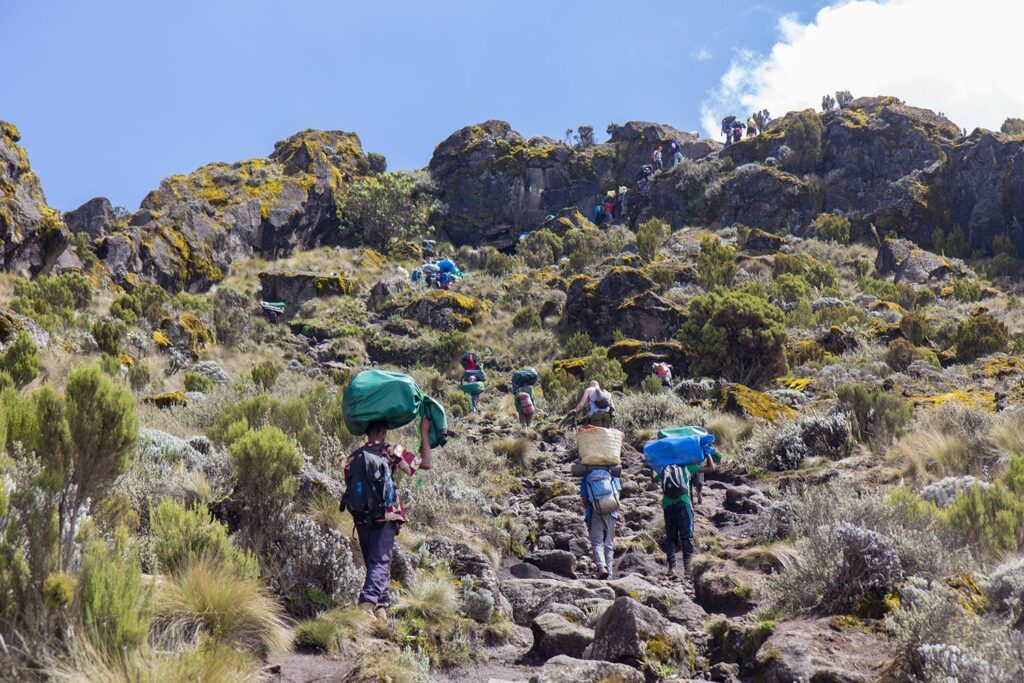
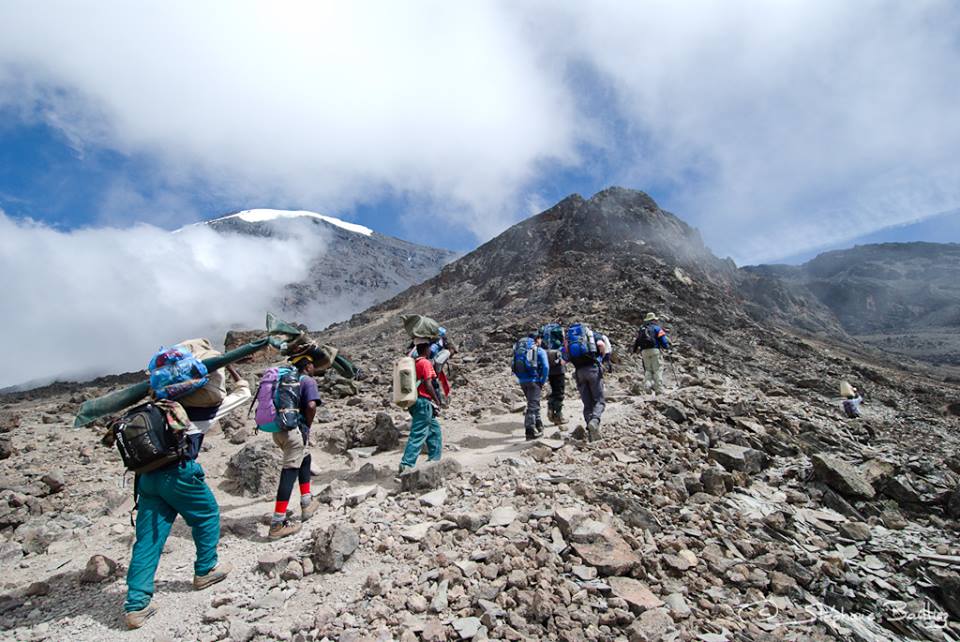
Day-by-Day Narrative — 6-Day Rongai
Day 1: Rongai Gate to Simba Camp
Your adventure begins with a drive from Moshi (approximately 3 hours northeast) to the Rongai Gate at 1,950 metres. After completing registration formalities and meeting your guide and porter team, the trail begins through dense montane forest. The gradient is gentle to moderate, and the trail winds between giant podocarpus trees draped in old man’s beard lichen. This initial section often yields sightings of colobus monkeys, colourful sunbirds, and bushbuck. As the forest thins and the first heathers appear, Simba Camp comes into view — a welcome sight after your first mountain day. Tonight’s dinner in your mess tent is the first of many mountain meals prepared by your dedicated camp cook.
Day 2: Simba Camp to Second Cave Camp
Today marks your full entry into the moorland zone. The landscape transforms dramatically as the forest gives way to wide-open grassland studded with giant heathers and the first of Kilimanjaro’s iconic giant groundsels (Senecio kilimanjari). The trail continues in a southwesterly direction, and by mid-morning, the broken spires of Mawenzi Peak (5,149 m) — Kilimanjaro’s second-highest summit — become a constant companion on the horizon. Second Cave Camp offers one of the first genuine high-altitude experiences: cold nights, bright stars, and the exhilarating sense of having left the ordinary world far behind.
Day 3: Second Cave Camp to Third Cave Camp
The moorland continues to dominate today’s landscape as you push toward Third Cave Camp at 3,900 metres. This relatively short but meaningful day allows the body to adapt to increasing altitude. Giant lobelias and bizarre dendrosenecio trees line the path. By this stage, some climbers experience mild AMS symptoms — a normal part of the acclimatisation process. The pace today should be deliberate: pole pole (slowly slowly), the Swahili mantra of Kilimanjaro guiding philosophy.
Day 4: Third Cave Camp to School Hut
This is the pivotal day of the 6-day itinerary, as you leave the moorland behind and enter the stark, otherworldly alpine desert. The vegetation thins to almost nothing, replaced by volcanic ash, scree, and bare rock. School Hut at 4,750 metres is reached by early afternoon, giving climbers precious time to rest, hydrate aggressively, eat a substantial dinner, and prepare gear for the summit attempt. Sleep will come early and may be fitful — this is normal at altitude. Wake-up is typically at midnight.
Day 5: Summit Night and Descent
Summit night is the defining experience of every Kilimanjaro climb. Beginning around midnight from School Hut, climbers ascend by headtorch in near-total darkness, warmly layered against temperatures that can plunge to -20°C or below. The trail climbs relentlessly through scree and volcanic rock toward Gilman’s Point on the crater rim (5,685 m) — a milestone celebrated with a certificate in its own right. From Gilman’s, the crater rim trail continues to Stella Point (5,756 m) and finally to Uhuru Peak (5,895 m): the roof of Africa. After photographs and a moment of quiet triumph, descent begins immediately — typically via the Marangu route to Horombo Huts. The descent is long and legs will be weary.
Day 6: Horombo Huts to Marangu Gate
The final day is a long but straightforward walk down through moorland and forest to Marangu Gate at 1,860 metres. Here, TANAPA officials present summit certificates — green for reaching Gilman’s Point, gold for Uhuru Peak. Photographs with the summit certificate, farewells to your guide and porter team, and the journey back to Moshi complete your Kilimanjaro adventure.
Rongai Route Kilimanjaro — 8-Day Itinerary
The 8-day Rongai itinerary is considered the gold standard for this route and is strongly recommended for most climbers, particularly those with limited high-altitude experience or those who want to maximise their summit success probability. The additional two days are invested entirely in acclimatisation, and the difference in physiological adaptation — and thus summit success rate — is significant.
Day | Stage | Elevation | Distance | Hiking Time | Key Feature |
Day 1 | Rongai Gate → Simba Camp | 1,950 → 2,650 m | ~8.5 km | 4–5 hrs | Forest trail, gentle introduction |
Day 2 | Simba Camp → Second Cave Camp | 2,650 → 3,450 m | ~9.0 km | 4–5 hrs | Moorland opens up, Mawenzi visible |
Day 3 | Second Cave → Kikelewa Cave | 3,450 → 3,600 m | ~4.0 km | 2–3 hrs | Short day — acclimatisation emphasis |
Day 4 | Kikelewa Cave → Mawenzi Tarn Camp | 3,600 → 4,330 m | ~5.0 km | 3–4 hrs | Dramatic Mawenzi Tarn scenery |
Day 5 | Rest / Acclimatisation Day at Mawenzi Tarn | 4,330 m (hike to ~4,600 m) | ~5–7 km hike | 4–5 hrs | Hike high, sleep low — critical day |
Day 6 | Mawenzi Tarn → School Hut | 4,330 → 4,750 m | ~6.0 km | 4–5 hrs | Final high camp, summit preparation |
Day 7 | School Hut → Summit → Descent to Horombo | 4,750 → 5,895 → 3,720 m | ~23 km | 14–18 hrs | Summit night — the ultimate challenge |
Day 8 | Horombo → Marangu Gate → Moshi | 3,720 → 1,860 m | ~19 km | 5–7 hrs | Final descent and certificate collection |
Why the 8-Day Rongai is Superior
The key difference between the 6-day and 8-day Rongai itineraries lies in Days 3–5 of the extended programme. By spending an additional night at Kikelewa Cave (3,600 m) and two nights at Mawenzi Tarn (4,330 m) — with an acclimatisation hike on the rest day — climbers expose their bodies to progressively higher altitudes while allowing adequate recovery time.
During acclimatisation, the human body undergoes remarkable physiological changes: red blood cell production increases, breathing rate and depth adapt, and capillary density in muscle tissue improves. These adaptations take time — and time is precisely what the 8-day itinerary provides. Studies of Kilimanjaro summit statistics consistently show that itinerary duration is the strongest predictor of summit success.
The Mawenzi Tarn Acclimatisation Day (Day 5)
Day 5 of the 8-day itinerary is perhaps the most valuable day on the entire climb, even though no new camps are reached. Climbers arise at Mawenzi Tarn Camp (4,330 m), eat breakfast, and then hike upward toward the flanks of Mawenzi Peak — reaching altitudes of 4,500–4,600 metres or higher — before returning to the same camp for the night. This ‘climb high, sleep low’ protocol leverages the principle that altitude adaptation is triggered by the maximum altitude reached, not the altitude at which one sleeps. It is the single most effective acclimatisation technique used in high-altitude trekking.
Why Climb Kilimanjaro Through the Rongai Route?
With seven official routes to choose from, climbers frequently ask: why choose Rongai? The answer lies in a combination of unique advantages that no other single route delivers simultaneously.
Drier Weather Year-Round
The most compelling practical argument for the Rongai Route is its significantly drier weather compared to all southern approaches. The southern slopes of Kilimanjaro receive the majority of the mountain’s precipitation, driven by moisture-laden trade winds off the Indian Ocean. The northern slopes, protected by the mountain’s own mass, receive a fraction of this rainfall. Climbers attempting the Marangu, Machame, or Lemosho routes during the rainy seasons often endure days of continuous rain, mud, slippery trails, and obscured views. On the Rongai Route, the same calendar dates frequently yield clear skies, dry trails, and panoramic visibility.
This makes Rongai the preferred route for climbers travelling in April, May, and November — months when most other routes are at their wettest.
Solitude and Wilderness Experience
The Machame and Lemosho routes — despite their quality — can feel uncomfortably crowded during peak season (January–February and July–August). Some popular campsites host hundreds of tents simultaneously. The Rongai Route, by contrast, receives perhaps 5–10% of Kilimanjaro’s total climbing traffic. Campsites are quiet, the trail feels genuinely wild, and encounters with other climbing groups are infrequent. For travellers seeking an authentic wilderness experience rather than a heavily managed group tour, Rongai delivers a profoundly different atmosphere.
Unique Northern Landscape
The ecological and scenic character of the northern slopes is simply not available from any other route. The open savannah-like moorland of the north, the views across the Amboseli plains into Kenya, the proximity to Mawenzi Peak (seen from an angle impossible on southern routes), and the different array of flora and fauna make Rongai a distinctly unique experience even for climbers who have previously summited via other routes.
Gradual and Forgiving Ascent
The Rongai Route’s gentle gradient in the lower and middle sections makes it more forgiving for first-time altitude climbers. There are no steep, exposed scrambles (as on Machame’s Barranco Wall) and no dangerously direct ascent profiles (as on Umbwe). For climbers who are fit but inexperienced at altitude, Rongai offers the best combination of accessibility and summit opportunity.
Flexibility of Descent
Most Rongai itineraries descend via the Marangu or Mweka routes, giving climbers an opportunity to experience multiple ecological zones and landscapes during their expedition. This circuit approach — north to northeast ascent, southeast descent — means climbers effectively see two sides of the mountain during a single expedition.
Wildlife Viewing
The northern approach through less-trafficked forest and moorland increases the likelihood of wildlife encounters. Colobus monkeys are frequently seen in the forest section. Buffalo, elephant, and eland have been spotted on the lower slopes. The relative quietness of the route means animals are less disturbed and more visible than on busy southern trails.
Rongai Route Success Rate
The Rongai Route’s success rate — the percentage of climbers who reach Uhuru Peak (or at least Gilman’s Point on the crater rim) — varies depending on itinerary length, operator quality, individual fitness, and weather conditions. The following figures represent data compiled from TANAPA records, licensed operator statistics, and independent climber reports.
Itinerary Duration | Success Rate (Uhuru Peak) | Success Rate (Gilman’s Point) | Key Factor |
6-Day Rongai | ~75–85% | ~85–90% | Faster pace; less acclimatisation |
7-Day Rongai | ~85–90% | ~90–95% | Good balance of time and pace |
8-Day Rongai | ~90–95% | ~95–97% | Optimal acclimatisation; highest success |
These figures compare favourably to the overall Kilimanjaro success rate across all routes, which is estimated by TANAPA at approximately 65–70% (all routes, all durations combined). The Rongai Route’s success rates — particularly on longer itineraries — significantly exceed this average.
Factors That Influence Success
- Acclimatisation Time: As discussed, the single most powerful predictor of summit success. Longer itineraries consistently yield higher success rates.
- Physical Fitness: Climbers who arrive fit have dramatically better experiences and success rates. Cardiovascular endurance is most important.
- Operator Quality: A knowledgeable guide who monitors climbers for AMS symptoms, adjusts pace appropriately, and uses ‘climb high, sleep low’ tactics makes a measurable difference.
- Hydration: Dehydration at altitude accelerates AMS symptoms. Drinking 3–4 litres of water daily on the mountain is essential.
- Nutrition: Caloric intake at altitude is often suppressed by AMS. Forcing regular, high-calorie meals maintains energy for summit night.
- Weather: Kilimanjaro’s weather can be unpredictable. Summit success rates dip during unusually severe weather events, though the mountain’s high-pressure windows are generally predictable by experienced operators.
- Mindset: Mental determination — particularly during the long, cold hours of summit night — is frequently cited by summit veterans as the decisive factor when the body wants to stop.
What is the Hardest Route to Climb Kilimanjaro?
The Umbwe Route is universally considered the hardest route to climb Kilimanjaro. It is the shortest, steepest, and most direct of all Kilimanjaro’s established routes, and it carries the lowest success rate. Understanding what makes Umbwe so challenging provides useful context for appreciating the Rongai Route’s relative accessibility.
The Umbwe Route — Why It’s the Hardest
- Extreme Steepness: The Umbwe Route ascends the southwest ridge of Kibo in a near-direct line, with gradient angles that require hands-and-knees scrambling on some sections. It is the only route that can genuinely be called ‘steep’ by trekking standards.
- Shortest Duration: Most operators offer Umbwe as a 6-day route, but some push it in 5 days. This leaves almost no margin for acclimatisation, and success rates on short Umbwe itineraries fall as low as 50–60%.
- No Acclimatisation Profile: The Umbwe Route gains altitude extremely rapidly, pushing climbers through zones that other routes spend multiple days in. The body simply cannot adapt quickly enough for many climbers.
- Remote and Uncommercialised: The trail sees few other groups, meaning rescue response times can be longer and logistical support is thinner.
- Technical Exposure: While not requiring ropes or harnesses, Umbwe has sections of exposed ridge walking that require care and sure-footedness, particularly in wet or windy conditions.
Route Difficulty Rankings
Rank | Route | Difficulty | Primary Challenge |
1 (Hardest) | Umbwe | Very Hard | Extreme steepness, rapid altitude gain, low success rate |
2 | Machame | Hard | Long days, technical Barranco Wall section |
3 | Lemosho | Moderate–Hard | High altitude traverse, but excellent profile |
4 | Shira | Moderate–Hard | Starts at very high altitude (3,500 m) by vehicle |
5 | Rongai | Moderate | Gradual northern approach, beginner-accessible |
6 | Northern Circuit | Moderate | Long duration but very gradual, highest success rate |
7 (Easiest) | Marangu | Moderate | Shortest, fastest gain — paradoxically lowest success rate |
The Marangu Route — often marketed as the ‘tourist route’ or ‘Coca-Cola route’ — is technically the least strenuous in terms of terrain, but its short 5-6 day duration and rapid altitude gain make it statistically the route with the lowest overall summit success rate. Ease of terrain does not translate to ease of summiting.
Conclusion: Is the Rongai Route Right for You?
The Rongai Route stands as one of Kilimanjaro’s finest choices for a wide range of climbers — from first-time altitude trekkers seeking a forgiving northern approach to experienced mountaineers craving solitude and unique scenery. Its combination of drier weather, quieter trails, gradual gradient, stunning northern landscapes, and high success rates (especially on 8-day itineraries) makes it a compelling alternative to the busier southern routes.
Rongai is IDEAL for: | Consider alternatives if: |
• First-time altitude climbers • Climbing in rainy season months • Seeking solitude and wilderness • Prioritising summit success rate • Interested in unique northern views • Taking 8 days or more | • You prefer hut sleeping (choose Marangu) • Maximum acclimatisation is the priority (Northern Circuit) • You enjoy busier, more social trails • Time is very limited (only 5 days available) |
Whichever route you choose, Kilimanjaro demands respect, preparation, and humility. The mountain does not negotiate. Invest in proper gear, choose a reputable licensed operator, allow adequate acclimatisation time, listen to your body and your guide, and embrace the philosophy of pole pole. The summit of Africa awaits.