Machame Gate Kilimanjaro – Gateway to the Popular Machame Route
Machame Gate is the official entry and exit point for the Machame Route on Mount Kilimanjaro — one of Africa’s most celebrated trekking routes, nicknamed the ‘Whiskey Route’ for its reputation as more challenging than the beginner-friendly ‘Coca-Cola’ (Marangu) route. The gate sits at the edge of the Kilimanjaro National Park, administered by the Tanzania National Parks Authority (TANAPA), and serves as the last major contact point with civilization before climbers begin their ascent through six spectacular ecological zones.
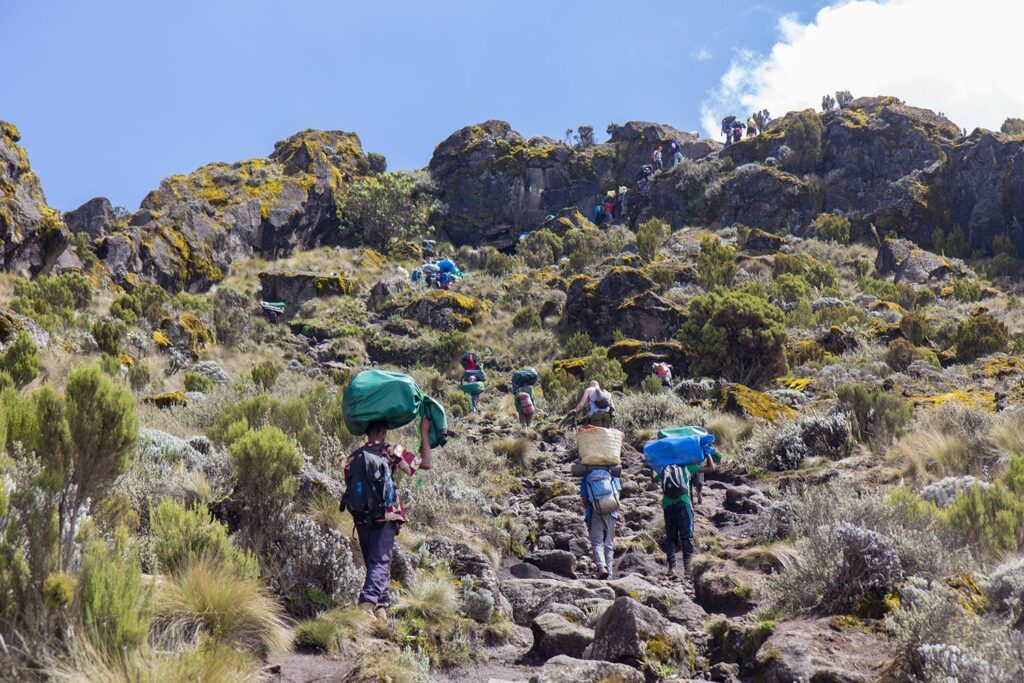
The gate complex includes ranger stations, toilet facilities, a registration office, and a large assembly area where porters sort and weigh equipment before departure. All climbers must register, pay park fees, and have their gear inspected here. The atmosphere is vibrant and exciting — a melting pot of international climbers, local guides, and hundreds of Chagga porters preparing loads under the shade of giant fig trees.
Because Machame is the second most popular route on Kilimanjaro (after Lemosho on a percentage success-rate basis), the gate can get busy, especially during peak season (July–September). Early morning arrivals — ideally by 8:00 AM — are highly recommended to complete registration before the midday rush and to maximize daylight for the first day’s trek.
Quick Facts at a Glance
Altitude of Machame Gate | 1,800 m (5,906 ft) above sea level |
Location | Machame Village, Kilimanjaro Region, Tanzania |
Coordinates | 3°07′S 37°20′E |
Route Name | Machame Route (“Whiskey Route”) |
Recommended Duration | 6 Days (7 days recommended for better acclimatization) |
Total Distance (6 days) | ~49 km (30 miles) round trip |
Summit Altitude | 5,895 m / 19,341 ft (Uhuru Peak) |
Best Trekking Seasons | January–March & June–October |
Park Entry (TANAPA) | USD 70/day (conservation fee) |
Difficulty Rating | Moderate to Challenging |
Machame Gate Altitude
Machame Gate stands at 1,800 metres (5,906 feet) above sea level. This elevation places it within the rich montane forest zone of Kilimanjaro, where temperatures are mild, humidity is high, and the surrounding landscape is dominated by dense tropical rainforest. Unlike many Kilimanjaro entry points, Machame Gate’s relatively low starting altitude means that altitude sickness is rarely a concern on the first day of hiking — a major advantage.
Elevation Comparison Across Kilimanjaro Gates
Gate | Altitude (m) | Altitude (ft) | Route |
Machame Gate | 1,800 m | 5,906 ft | Machame |
Lemosho Gate (Londorossi) | 2,100 m | 6,890 ft | Lemosho |
Marangu Gate | 1,879 m | 6,165 ft | Marangu |
Rongai Gate | 1,950 m | 6,398 ft | Rongai |
Umbwe Gate | 1,641 m | 5,384 ft | Umbwe |
The altitude gain from Machame Gate (1,800 m) to Uhuru Peak (5,895 m) represents a total elevation change of 4,095 metres (13,435 feet) — one of the greatest altitude gains accessible to non-technical climbers anywhere in the world. This dramatic ascent is spread across the six-day itinerary, with careful staging designed to maximize acclimatization and summit success rates.
How to Get to Machame Gate
Machame Gate is located approximately 27 kilometres (17 miles) from Moshi town, in the Kilimanjaro Region of northern Tanzania. Most climbers arrive via Kilimanjaro International Airport (JRO) or fly through Julius Nyerere International Airport (DAR) in Dar es Salaam before connecting onward. Here is everything you need to know about reaching the gate.
Flying Into Tanzania
Kilimanjaro International Airport (IATA: JRO) is the primary gateway for Kilimanjaro trekkers. It is located between Arusha and Moshi, roughly 50 km from Moshi and about 75 km from Machame Gate. Major airlines serving JRO include Ethiopian Airlines (via Addis Ababa), Kenya Airways (via Nairobi), Qatar Airways (via Doha), KLM (via Amsterdam), and Precision Air (domestic). Most climbers land at JRO and either spend the night in Moshi or Arusha before heading to the gate early the next morning.
Julius Nyerere International Airport (DAR) in Dar es Salaam is an alternative entry point, with domestic flights or an overnight train connecting onward to Moshi. This route adds a travel day but is useful if international connections only serve Dar.
Getting from Moshi to Machame Gate
Moshi is the closest major town to Machame Gate and serves as the base of operations for most Machame Route climbers. The distance is approximately 27 km and takes 45–60 minutes by road, depending on traffic and road conditions.
Option A: Private Transfer (Recommended)
The most convenient and reliable option is a private transfer arranged through your tour operator. Vehicles typically depart Moshi at 6:00–7:00 AM to reach the gate by 8:00 AM. Your operator will include this transfer as part of your climb package. Private Land Cruisers or minibuses are used, and luggage is transported directly to the gate where porters will collect it.
Option B: Hired Taxi from Moshi
Independent travellers can hire a taxi from Moshi town to Machame Gate. The standard fare is USD 30–50 for the vehicle (not per person). Negotiate before departure and confirm the driver knows the exact gate location, as Machame village and Machame Gate are distinct points roughly 2 km apart. Book through your hotel or a reputable taxi stand.
Option C: Dalla-Dalla (Local Minibus)
Budget travellers may use the local dalla-dalla (shared minibus) network. Take a dalla-dalla from Moshi bus stand headed to Machame village (cost: approx. TZS 1,500–2,000 / USD 0.60–0.80). From Machame village, negotiate a boda-boda (motorcycle taxi) or short taxi ride to the gate, adding another 2–3 km. This is inexpensive but can be slow, unreliable for early starts, and impractical if you have heavy gear. Not recommended for summit day transfers.
Option D: From Arusha
If you are based in Arusha (90 km from the gate), arrange a private vehicle transfer through your tour operator. Journey time is approximately 90–120 minutes depending on traffic. This is a common option for climbers on multi-destination safari-and-climb packages.
3.3 Road Directions to Machame Gate
From Moshi town centre, head west on the B1 road towards Arusha. After approximately 8 km, turn right (north) at the Machame junction signposted for ‘Machame/Kilimanjaro National Park.’ Follow the tarmac road north through Machame village for approximately 8 km, continuing onto a murram (dirt) road for the final 2 km to the gate. The road is passable year-round by standard 4WD vehicles, though it can be muddy during peak rainfall. GPS coordinates: 3°07’00″S, 37°20’00″E.
3.4 What to Expect at the Gate
Upon arrival at Machame Gate, the following procedures take place:
- Registration: All climbers and guides sign into the TANAPA register. Ensure your passport and permit documentation are ready.
- Gear weigh-in: Porter loads are weighed and must not exceed 20 kg per porter (including their personal gear — typically 5–7 kg — leaving a maximum of 15 kg for client luggage per porter).
- Park fees: If not pre-paid, fees are settled here. Credit cards may be accepted at some periods; carry USD cash as backup.
- Safety briefing: Your lead guide will brief the group on trail rules, wildlife protocols, and emergency procedures.
- Toilet facilities: Basic long-drop toilets are available at the gate. Use them before departing — next facilities are at Machame Camp.
The Machame Route — 6-Day Itinerary
The Machame Route is widely regarded as one of the finest ascent routes on Kilimanjaro, offering extraordinary scenery, excellent acclimatization profiles, and a genuine sense of wilderness adventure. The 6-day itinerary below is the standard commercial schedule. A 7-day variation (adding an extra acclimatization day at Barranco or Karanga) is increasingly recommended by guides and is associated with meaningfully higher summit success rates — often 85–90% versus 70–80% on the 6-day version.
Route Summary Table
Day | Start | End | Dist. | Camp Alt. | Hike Time |
Day 1 | Machame Gate (1,800m) | Machame Camp (3,000m) | 11 km | 3,000 m | 5–7 hrs |
Day 2 | Machame Camp (3,000m) | Shira Camp (3,840m) | 5 km | 3,840 m | 4–6 hrs |
Day 3 | Shira Camp (3,840m) | Barranco Camp (3,960m) | 10 km | 3,960 m | 6–8 hrs |
Day 4 | Barranco Camp (3,960m) | Karanga Camp (4,035m) | 5 km | 4,035 m | 4–5 hrs |
Day 5 | Karanga Camp (4,035m) | Barafu Camp (4,640m) | 5 km | 4,640 m | 4–5 hrs |
Day 6a | Barafu Camp (4,640m) | Uhuru Peak (5,895m) | 5 km | 5,895 m | 6–8 hrs |
Day 6b | Uhuru Peak (5,895m) | Mweka Gate (1,640m) | 12 km | 1,640 m | 4–6 hrs |
4.1 Day 1 — Machame Gate to Machame Camp
Elevation: 1,800 m → 3,000 m | Distance: ~11 km | Time: 5–7 hours
The adventure begins the moment you sign the register at Machame Gate. The trail immediately plunges into dense montane rainforest — one of the most biodiverse environments on the mountain — carpeted in mosses, ferns, and draped with old-man’s-beard lichen. The canopy overhead filters golden light, and the calls of Hartlaub’s turaco and Kilimanjaro white-eye echo through the trees. The path ascends steadily on a well-maintained track, gaining 1,200 metres of elevation over approximately 11 kilometres.
The forest zone protects vital watershed for communities downstream and is home to black-and-white colobus monkeys, duikers, and African elephants (rarely seen but their trails cross the path). After approximately 3–4 hours, the forest begins to thin as you approach the heath and moorland transition zone. Machame Camp (3,000 m) is a large, well-established campsite with spectacular views — on clear evenings, Kibo’s glaciers glow orange in the setting sun.
Key tips for Day 1: Start early (depart gate by 9:00 AM at the latest). Pace yourself — the full day ahead is deceptively strenuous. Drink at least 3 litres of water. Expect rain, particularly in the afternoon; pack your rain gear in an accessible location.
4.2 Day 2 — Machame Camp to Shira Camp
Elevation: 3,000 m → 3,840 m | Distance: ~5 km | Time: 4–6 hours
Day 2 emerges from the forest belt into the open moorland, characterized by giant heather (Erica arborea) reaching tree height, and studded with the iconic giant groundsel (Senecio kilimanjari) and lobelia — plants found nowhere else on Earth at this scale. The landscape is dramatic and otherworldly. Kilimanjaro’s volcanic history becomes visible: the Shira Plateau is the remnant of an ancient volcanic crater, now a vast, gently sloping alpine plateau.
Shira Camp (3,840 m) sits on the southern edge of the Shira Plateau with breathtaking views of the Western Breach and the Shira Cathedral rock formation. This is the first camp where altitude effects may begin to be noticed — mild headaches, reduced appetite, and disturbed sleep are normal and expected. The guide’s mantra applies: ‘Pole pole’ (slowly, slowly in Swahili).
4.3 Day 3 — Shira Camp to Barranco Camp (via Lava Tower)
Elevation: 3,840 m → 4,600 m (Lava Tower) → 3,960 m (camp) | Time: 6–8 hours
Day 3 is one of the most important acclimatization days of the entire climb. The trail ascends across the alpine desert towards the iconic Lava Tower (4,600 m) — a 300-metre volcanic rock plug that dominates the skyline. This ‘climb high, sleep low’ profile is the key physiological strategy behind the Machame Route’s success: your body is exposed to 4,600 m during the day but you descend 640 metres to sleep at 3,960 m. This stimulates red blood cell production without overstressing the body.
After lunch at Lava Tower, the trail descends dramatically through a series of spectacular valleys into the Barranco Valley — a lush, protected gorge where giant senecios grow in profusion and the Great Barranco Wall looms dramatically. The contrast between the lunar landscape above and the verdant valley below is astonishing. Barranco Camp (3,960 m) is set against the base of the wall, with Kibo filling the sky above.
4.4 Day 4 — Barranco Camp to Karanga Camp (via Barranco Wall)
Elevation: 3,960 m → 4,035 m | Distance: ~5 km | Time: 4–5 hours
The Barranco Wall is the most memorable non-summit challenge of the entire Machame Route. This near-vertical 300-metre volcanic cliff face requires hands-and-feet scrambling in several sections, but it is not technically difficult — no ropes or climbing equipment are needed. Guides and porters ascend confidently alongside, and the wall is wide enough that queues rarely form dangerously. The views from the top — looking back over the Barranco Valley and across to Mount Meru floating above the clouds — are reward enough for the effort.
After the wall, the trail traverses the southern slopes of Kibo through a series of ridges and valleys, each offering different perspectives of the glaciers above. Karanga Camp (4,035 m) is a compact campsite perched on the edge of a valley with direct views of the Rebmann Glacier and the final push to Barafu. Water is available at Karanga from a stream — one of the last reliable water sources before the summit.
4.5 Day 5 — Karanga Camp to Barafu Camp
Elevation: 4,035 m → 4,640 m | Distance: ~5 km | Time: 4–5 hours
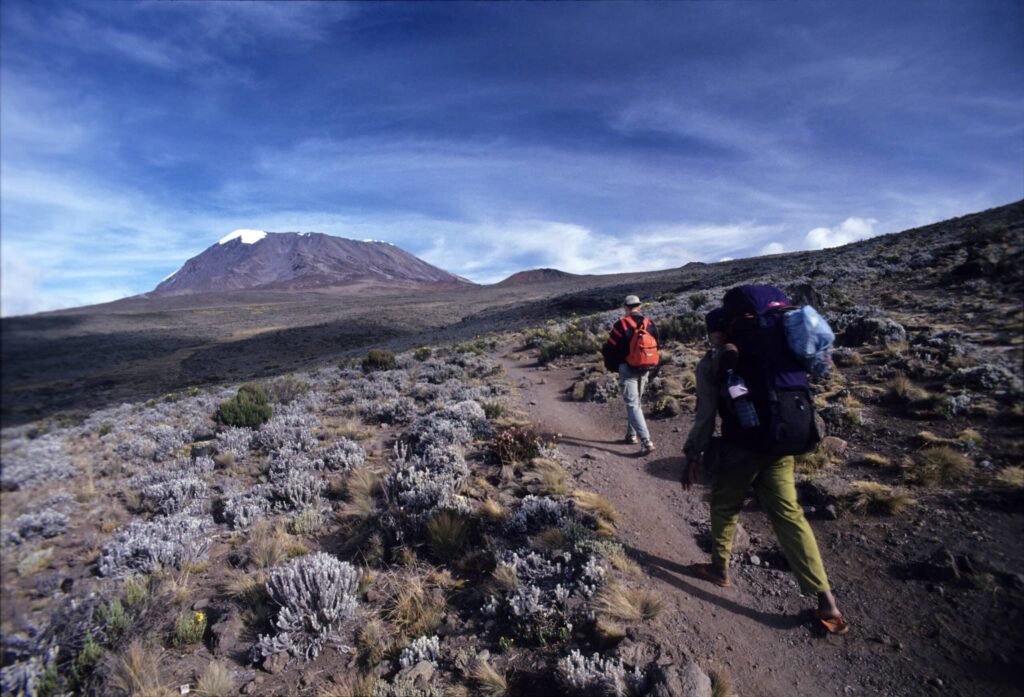
A relatively short but significant day: the ascent from Karanga to Barafu Base Camp (4,640 m) moves entirely through the alpine desert zone — a stark, wind-swept landscape of volcanic scree, glacial moraines, and thin soil. Vegetation is sparse; only the hardiest lichens and mosses survive. The trail is well-marked and relatively straightforward, but the altitude means the pace slows considerably and every step requires conscious effort.
Barafu Camp (‘ice’ in Swahili) is the final camp before the summit bid and the highest camp on the Machame Route. The name is apt — temperatures drop sharply at night, often to -10°C to -15°C (14°F to 5°F) or lower. Climbers typically arrive at Barafu by 1:00–2:00 PM, eat an early dinner, and attempt to sleep by 6:00–7:00 PM for a midnight summit start. Sleep is difficult at this altitude, and this is entirely normal.
4.6 Day 6 — Summit Day: Barafu to Uhuru Peak and Descent to Mweka Gate
Summit Elevation: 5,895 m (19,341 ft) — Uhuru Peak, Kibo Crater Rim
The alarm rings at midnight. Climbers dress in their heaviest layers, strap on headlamps, and step into the cold and dark for the most demanding stretch of the entire climb: the summit push. The route ascends the volcanic scree of Kibo’s southern slopes in a series of long, zigzagging switchbacks — a relentless, grinding ascent in thin air where oxygen availability is roughly half that at sea level.
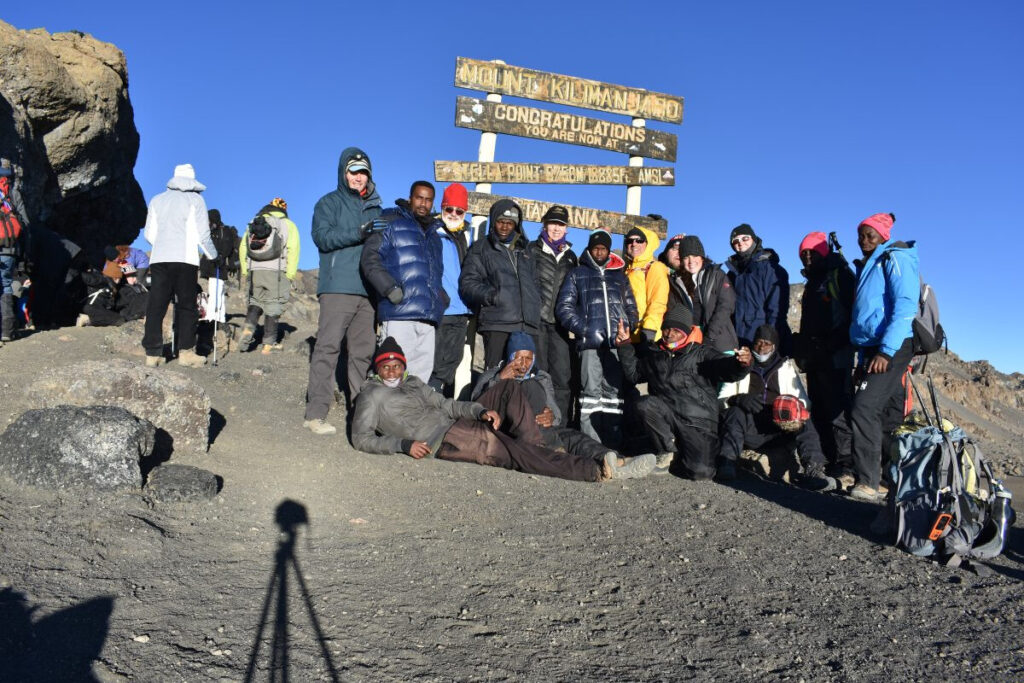
Stella Point (5,756 m) on the crater rim is typically reached after 5–7 hours of climbing — a major psychological milestone, often greeted with emotion and relief. From Stella Point, the trail follows the crater rim for another 45–60 minutes to Uhuru Peak (5,895 m), passing ancient glaciers along the way. Uhuru Peak — ‘Freedom Peak’ in Swahili — is the highest point in Africa, and the celebratory moment is one of the most powerful experiences in adventure travel.
Descent follows the Mweka Route — a direct route down the southeastern slopes. The scree descent to Barafu is rapid (1–2 hours), after which climbers collect gear and continue down to Mweka Camp (3,100 m) or all the way to Mweka Gate (1,640 m) depending on energy and group preference. A second night at Mweka Camp (between gates and the summit) is sometimes included for tired groups, particularly on 7-day itineraries.
5. Essential Tips for the Machame Route
5.1 Acclimatization
- Follow the ‘climb high, sleep low’ principle — Day 3’s Lava Tower detour is built for this purpose.
- Consider the 7-day itinerary for an extra acclimatization night — success rates increase significantly.
- Drink 4–5 litres of water per day. Dehydration is a major contributor to altitude sickness.
- Diamox (Acetazolamide) is used by many climbers as a prophylactic — consult your physician before the climb.
- Know the symptoms of AMS (Acute Mountain Sickness): persistent headache, nausea, dizziness, loss of coordination. Report immediately to your guide.
5.2 Best Time to Climb
- January–March: Clear skies, less crowded, cold but excellent visibility. Summit temperatures can drop to -20°C.
- June–October: The busiest and most popular season. Dry conditions, warm days, cold nights. July–August trails can be crowded.
- April–May and November: Long and short rainy seasons respectively. Not recommended — trails are muddy, visibility poor.
5.3 Gear Checklist
- Clothing: Moisture-wicking base layers, insulating mid-layers (fleece/down), waterproof shell jacket and trousers, summit parka rated to -20°C
- Footwear: Waterproof trekking boots (broken in), thermal socks (multiple pairs), gaiters
- Accessories: Balaclava, beanie hat, neck gaiter, liner gloves + heavy expedition gloves, UV-protective sunglasses, sun hat
- Equipment: 70-litre duffel bag (for porters), 25–35 litre daypack with rain cover, trekking poles, headlamp + spare batteries
- Hydration: 2 × 1-litre water bottles or hydration bladder, water purification tablets or Steripen
- Medications: Diamox (prescribed), ibuprofen, antihistamine, blister pads, personal prescriptions
5.4 Permits and Costs
All fees are paid to TANAPA (Tanzania National Parks Authority) and must be settled before ascending. As of 2025, key fees include:
- Conservation fee: USD 70 per day per person
- Camping fee: USD 50 per day per person
- Guide fee: USD 20 per day per guide
- Porter rescue fee: USD 2 per day per porter
A typical 6-day Machame climb incurs gate fees of approximately USD 720–800 per climber before operator margins, guide fees, and tips. All-inclusive packages from reputable operators typically range from USD 2,000–3,500 per person depending on group size, operator, and level of service.
Responsible Trekking
- Tip your crew well: porters carry your journey — the recommended tipping guideline is USD 20/day for head guides, USD 15/day for assistant guides, USD 10/day for cooks, and USD 8/day for porters.
- Carry out all waste. Kilimanjaro’s trails suffer from litter; bring a small bag for personal rubbish.
- Use biodegradable soaps and avoid washing in streams.
- Choose operators registered with the Kilimanjaro Porters Assistance Project (KPAP) and the Tanzania Association of Tour Operators (TATO) to ensure fair treatment of porters.
Conclusion
Machame Gate is far more than an administrative entry point — it is the threshold between the ordinary world and one of Earth’s most extraordinary journeys. Beginning at a comfortable 1,800 metres in the lush rainforest and culminating at 5,895 metres on the roof of Africa, the Machame Route offers a trekking experience that is both physically demanding and profoundly transformative. With proper preparation, a qualified guiding team, and respect for the mountain’s altitude, the majority of determined climbers who pass through Machame Gate carry with them the memory of a lifetime.
Plan well, start training early, hire ethical operators, tip your crew generously, and above all — pole pole. The summit will wait for those who approach it with patience and respect.