Lemosho Route
The Lemosho Route is widely celebrated as the finest, most scenic, and most successful approach to the summit of Mount Kilimanjaro (5,895 m / 19,341 ft) — the highest peak in Africa. Established relatively recently compared to older paths like the Marangu or Machame routes, Lemosho was designed with two primary goals in mind: superior acclimatisation and a wilderness experience far away from crowds.
The route approaches Kilimanjaro from the remote western slopes, traversing the rarely visited Shira Plateau before swinging south to join the Southern Circuit. This long, sweeping path allows hikers to gain altitude slowly, spend multiple nights at progressively higher camps, and dramatically improve their chances of reaching Uhuru Peak — the true summit.
Whether you are a seasoned alpinist or an enthusiastic first-time high-altitude trekker, the Lemosho Route offers the ideal combination of challenge, beauty, and achievement. This comprehensive guide answers every question you might have before lacing up your boots.
KEY FACT |
Lemosho is consistently ranked the #1 route on Kilimanjaro for scenic value and summit success. With an 8-day itinerary, guided operators report summit success rates exceeding 90% — the highest of any route on the mountain. |
2. How Many Kilometres is the Lemosho Route?
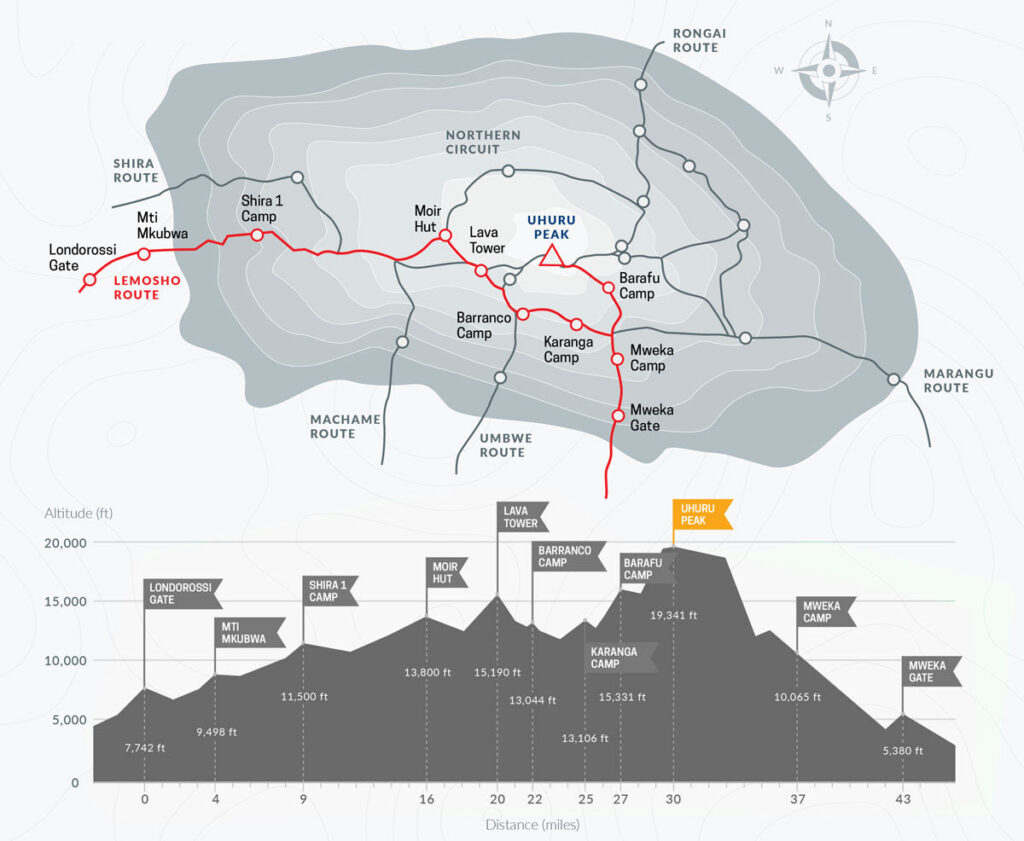
One of the most frequently asked questions is the total distance of the Lemosho Route. The answer depends slightly on the exact trailhead and the number of days chosen, but the figures below provide a reliable reference:
Metric | 7-Day Route | 8-Day Route |
Total Distance | ~70 km (43 miles) | ~80 km (50 miles) |
Avg. Daily Distance | 10–12 km/day | 9–11 km/day |
Total Ascent | ~4,900 m | ~4,900 m |
Total Descent | ~4,800 m | ~4,800 m |
Trailhead Elevation | 1,800 m (Lemosho Gate) | 1,800 m (Lemosho Gate) |
Summit Elevation | 5,895 m (Uhuru Peak) | 5,895 m (Uhuru Peak) |
The 8-day variation is recommended for most trekkers because the extra day is used as an acclimatization rest day on the Shira Plateau, significantly boosting summit chances. The additional kilometers walked on the longer version include an extended traverse of the Southern Circuit before the final summit push.
3. What Park Do You Need to Climb Kilimanjaro?
Mount Kilimanjaro lies entirely within Kilimanjaro National Park (KINAPA), a UNESCO World Heritage Site administered by the Tanzania National Parks Authority (TANAPA). Every climber — regardless of route — must enter and pay fees within this park.
3.1 Park Entry & Climbing Fees
All fees are collected by TANAPA and paid through your licensed Tanzanian operator. Fees are typically included in your operator’s package price. The main categories are:
Fee Category | Rate (USD, approx.) |
Conservation Fee (per day) | $70 per person per day |
Camping Fee (per night) | $50 per person per night |
Rescue Fee | $20 per person |
VAT (18%) | Applied to all fees |
Guide & Porter Fees | Separate, set by operator |
3.2 Permit Requirements
- All climbers must be accompanied by a licensed Tanzanian mountain guide.
- Climbers must use a KINAPA-registered operator — independent climbing is not permitted.
- A minimum of one guide and two porters per climber is standard.
- Permits are obtained by the operator on behalf of the trekker.
- There is no set climbing permit quota on Lemosho — but early booking is strongly advised.
3.3 Why a Licensed Operator Matters
Beyond legal compliance, using a reputable, licensed operator ensures your guides hold Wilderness First Responder or equivalent certifications, your porters are treated ethically and paid fairly (critical under the Kilimanjaro Porters Assistance Project standards), and emergency rescue resources are in place should altitude sickness strike.
4. How Difficult is the Lemosho Route?
4.1 Overall Difficulty Rating
The Lemosho Route is rated Moderate to Challenging. Unlike technical alpine climbs, it requires no ropes, ice axes, or prior mountaineering experience. The challenge is primarily physiological — the extreme altitude — rather than technical. However, do not underestimate it. Kilimanjaro kills several climbers every year, primarily due to Acute Mountain Sickness (AMS), High Altitude Pulmonary Oedema (HAPE), and High Altitude Cerebral Oedema (HACE).
4.2 Physical Demands
Factor | Details |
Fitness Level Required | Good general fitness; ability to hike 6–8 hours per day with a daypack |
Recommended Prep | 3–6 months of hiking, trail running, or regular cardio |
Daily Hiking Hours | 5–8 hours on trail days; up to 14–16 hours on summit night |
Temperature Range | Base: +25°C / Summit: -20°C to -30°C (wind chill) |
Terrain | Rainforest, moorland, alpine desert, glacial scree, ice, rocky summit |
Altitude Gained | ~4,095 m net gain from trailhead to summit |
Minimum Age (TANAPA) | 10 years (operators typically recommend 12+) |
4.3 Summit Night — The Hardest Part
The summit push typically begins around midnight and can take 6–8 hours to reach Uhuru Peak, followed by a 4–6 hour descent back to high camp. At this altitude (above 5,500 m), oxygen saturation in the blood can fall below 70%. Symptoms of AMS — headache, nausea, fatigue, dizziness — are common and expected. The key distinction between Lemosho’s 8-day option and shorter routes is that extra acclimatization days dramatically reduce the severity of these symptoms and the likelihood of forced turnaround.
4.4 Key Altitude Points
Location | Elevation |
Lemosho Trailhead (Forest Gate) | 1,800 m (5,906 ft) |
Shira 1 Camp | 3,500 m (11,483 ft) |
Shira 2 Camp | 3,840 m (12,598 ft) |
Lava Tower | 4,630 m (15,190 ft) |
Barranco Camp | 3,960 m (12,992 ft) |
Karanga Camp | 4,035 m (13,238 ft) |
Barafu High Camp | 4,600–4,673 m (15,092 ft) |
Stella Point (crater rim) | 5,739 m (18,828 ft) |
Uhuru Peak (Summit) | 5,895 m (19,341 ft) |
Mweka Descent Camp | 3,100 m (10,170 ft) |
Mweka Gate (exit) | 1,640 m (5,381 ft) |
5. What is the Most Successful Route on Kilimanjaro?
Based on decades of guided expedition data, the Lemosho Route — particularly its 8-day variation — records the highest summit success rate of any route on Kilimanjaro when operated by experienced outfitters. Here is a comparative overview:
Route | Min. Days | Success Rate | Difficulty | Crowds |
Lemosho (8 days) | 8 | 90–95% | Mod-Hard | Low-Med |
Northern Circuit (9 days) | 9 | 90–95% | Mod-Hard | Very Low |
Machame (7 days) | 6–7 | 80–85% | Hard | High |
Rongai (7 days) | 6–7 | 75–80% | Moderate | Medium |
Marangu (5 days) | 5–6 | 50–65% | Moderate | Very High |
Umbwe (6 days) | 6 | 60–70% | Very Hard | Low |
The key driver of Lemosho’s outstanding success rate is the ‘climb high, sleep low’ acclimatisation principle built into the itinerary. On Day 4, trekkers hike up to Lava Tower at 4,630 m before descending to sleep at Barranco at 3,960 m. This physiological trick of ascending to stimulate red blood cell production and then descending to rest is the most effective non-pharmaceutical acclimatisation strategy known at altitude.
6. Lemosho Route Elevation Profile
The elevation profile of the Lemosho Route is one of its defining features. Unlike the dangerously steep Umbwe Route or the insufficiently paced Marangu ‘Coca-Cola’ Route, Lemosho follows a sweeping, physiologically intelligent ascent profile:
Day | Route Segment | Start Elev. | End Elev. | Gain/Loss | Km |
1 | Lemosho Gate → Big Tree Camp | 1,800 m | 2,780 m | +980 m | 7 km |
2 | Big Tree Camp → Shira 1 | 2,780 m | 3,500 m | +720 m | 9 km |
3 | Shira 1 → Shira 2 | 3,500 m | 3,840 m | +340 m | 9 km |
4 | Shira 2 → Lava Tower → Barranco | 3,840 m | 3,960 m | +790/−670 m | 14 km |
5 | Barranco → Karanga (8-day) or Barafu (7-day) | 3,960 m | 4,035 m / 4,600 m | +75/+640 m | 5/8 km |
6 | Karanga → Barafu High Camp (8-day) | 4,035 m | 4,600 m | +565 m | 5 km |
7 | Barafu → Uhuru Peak → Mweka Camp | 4,600 m | 5,895 m / 3,100 m | +1,295/−2,795 m | 18 km |
8 | Mweka Camp → Mweka Gate | 3,100 m | 1,640 m | −1,460 m | 10 km |
Note: On the 8-day itinerary, Day 3 may include an optional acclimatisation walk from Shira 2 toward Shira Cathedral (4,000+ m) before returning to sleep at Shira 2 — a classic ‘climb high, sleep low’ bonus that pays dividends on summit day.
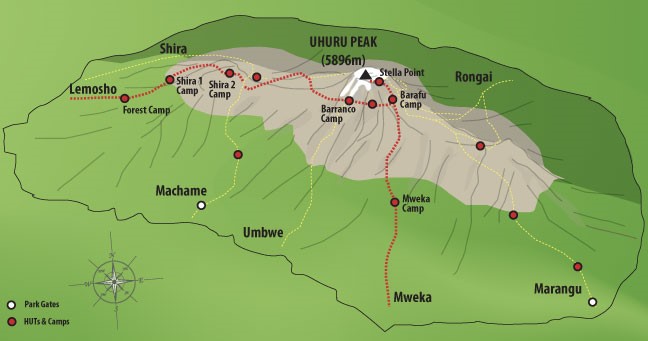
7. Lemosho Route Map & Geography
The Lemosho Route traces a long arc from the remote western face of Kilimanjaro, crossing multiple ecological and geological zones before culminating at Uhuru Peak. Understanding the geography helps trekkers mentally prepare for what lies ahead.
7.1 Approach & Trailhead
The journey begins at Lemosho Gate (also written as Londorossi Gate on some maps), reachable by vehicle from Moshi or Arusha in approximately 3–4 hours. The trailhead sits at 1,800 m in the rich montane rainforest on Kilimanjaro’s less-visited western flank.
7.2 Ecological Zones Traversed
Zone | Altitude Band | Characteristics |
Cultivation Zone | 800–1,800 m | Coffee, banana plantations; small villages |
Montane Rainforest | 1,800–2,800 m | Dense canopy, colobus monkeys, giant ferns, frequent mist |
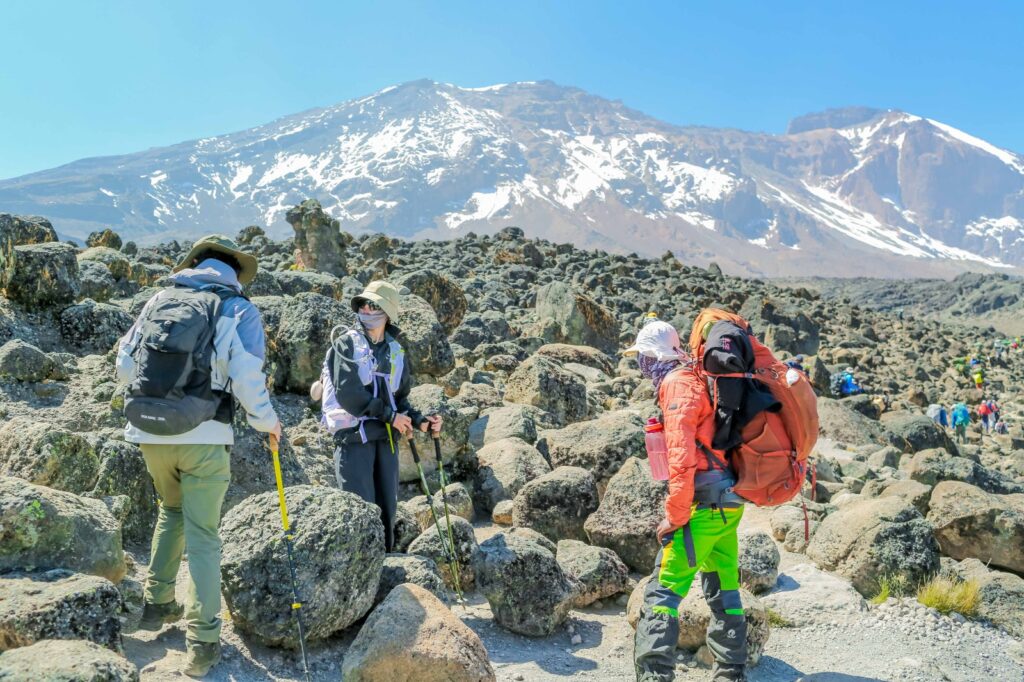
Heath & Moorland | 2,800–4,000 m | Giant heather, senecio, lobelia; open vistas across the Shira Plateau |
Alpine Desert | 4,000–5,000 m | Sparse vegetation, volcanic rock, scree, extreme UV radiation |
Arctic Summit Zone | 5,000–5,895 m | Glacial ice, loose scree, Furtwangler Glacier, Uhuru Peak |
7.3 Key Landmarks on the Map
- Shira Plateau — A vast volcanic plateau at ~3,800 m, one of the most photogenic high-altitude plains in Africa.
- Lava Tower — A dramatic 300 m volcanic plug rising to 4,630 m; a critical acclimatization waypoint.
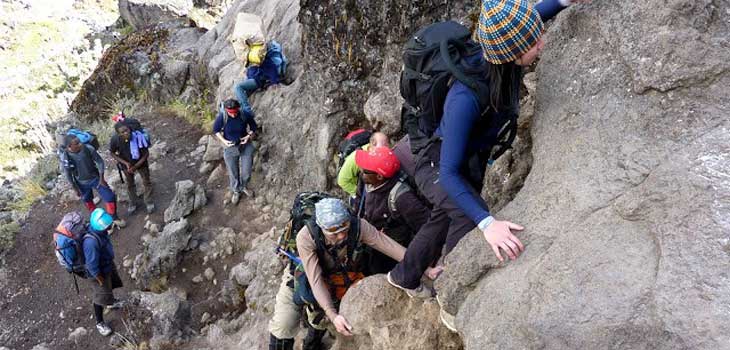
- Barranco Wall — A near-vertical 257 m scramble over ancient lava; the most exhilarating non-technical section of the climb.
- Southern Circuit — A broad traverse linking Barranco to Barafu, with panoramic views of Kibo, Mawenzi, and the glaciers.
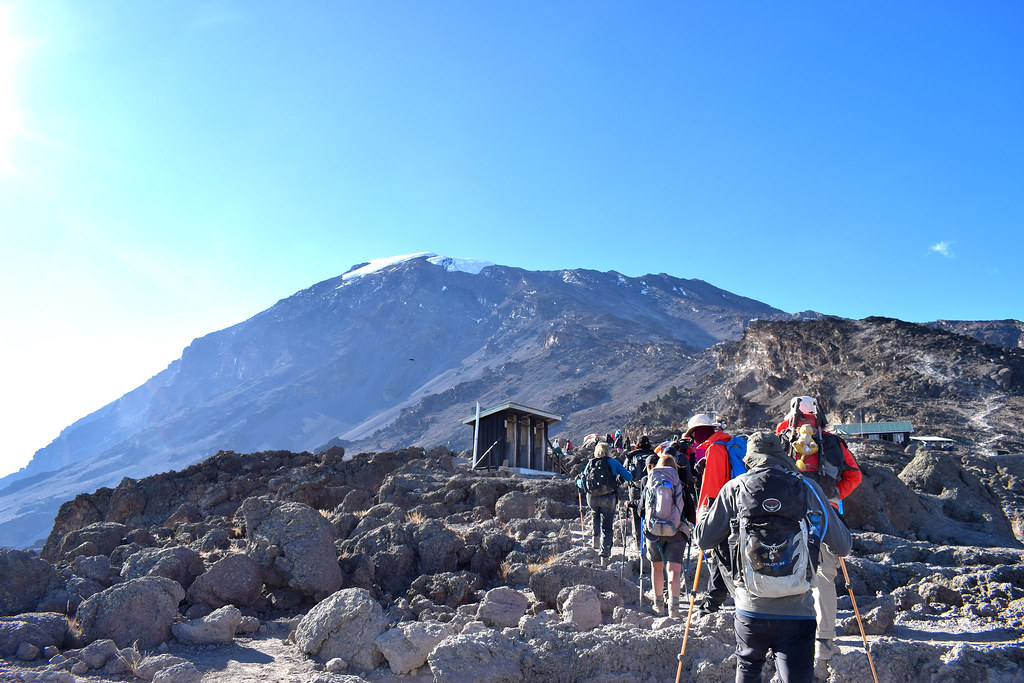
- Barafu Camp — The standard high camp for the summit bid; named for the Swahili word for ‘ice’.
- Stella Point — First point on the crater rim (5,739 m); certificates are awarded here to those who don’t continue to Uhuru.
- Uhuru Peak — The true summit of Africa (5,895 m), marked by the iconic wooden sign and glacial backdrop.
8. Lemosho Route — 7-Day Itinerary
The 7-day itinerary is suitable for physically fit trekkers with some prior high-altitude experience. It skips the dedicated rest/acclimatization day at Shira 2 and combines Karanga and Barafu camps into one long day.
Day 1 — Lemosho Gate to Big Tree Camp
Distance: ~7 km | Elevation Gain: +980 m | Sleep: 2,780 m | Time: ~3–4 hours |
Your adventure begins with a drive from Moshi through the Kilimanjaro foothills to Lemosho Gate. After park registration and a box lunch, you enter the spectacular montane rainforest. The trail is wide and shaded, climbing steadily through old-growth trees draped in lichen. Wildlife is abundant — look for black-and-white colobus monkeys overhead and blue duiker on the forest floor. Camp is set in a mossy clearing known as ‘Big Tree Camp’, named for the enormous Podocarpus trees that tower overhead.
Day 2 — Big Tree Camp to Shira 1 Camp
Distance: ~9 km | Elevation Gain: +720 m | Sleep: 3,500 m | Time: ~5–6 hours |
The forest gradually gives way to giant heather and then open moorland as you climb above the tree line. The Shira Ridge emerges like the edge of another world — suddenly the vast Shira Plateau opens before you, with views across the caldera to Kibo’s southern ice fields. The wind picks up significantly above the ridge. Shira 1 Camp sits in an exposed but spectacular location. Drink extra water today; altitude effects begin here.
Day 3 — Shira 1 to Shira 2 Camp
Distance: ~9 km | Elevation Gain: +340 m | Sleep: 3,840 m | Time: ~4–5 hours |
A relatively gentle traverse across the Shira Plateau leads to Shira 2 Camp, positioned with a direct view of Kibo’s snow cap. Many guides will take you on an optional side hike toward Shira Cathedral (4,000+ m) to gain altitude before returning to sleep lower — your first taste of the ‘climb high, sleep low’ technique that defines Lemosho’s superiority. The plateau is studded with giant groundsels (Senecio kilimanjari) — ancient, otherworldly plants found nowhere else on Earth.
Day 4 — Shira 2 to Lava Tower to Barranco Camp
Distance: ~14 km | Elevation Gain: +790 m / Loss: -670 m | Sleep: 3,960 m | Time: ~6–7 hours |
This is the physiological heart of the Lemosho Route and arguably the most important day on the mountain. The trail climbs relentlessly toward Lava Tower (4,630 m) — well above comfortable altitude. Most people feel the thin air acutely here. After lunch at the base of the tower, the route descends steeply into the Great Barranco Valley. The descent is dramatic and the relief physical and psychological. Sleeping at Barranco (3,960 m) after spending hours above 4,600 m is the single most effective acclimatisation event of the entire trek.
Day 5 — Barranco Camp to Barafu High Camp (7-day)
Distance: ~13 km | Elevation Gain: +640 m | Sleep: 4,600 m | Time: ~6–7 hours |
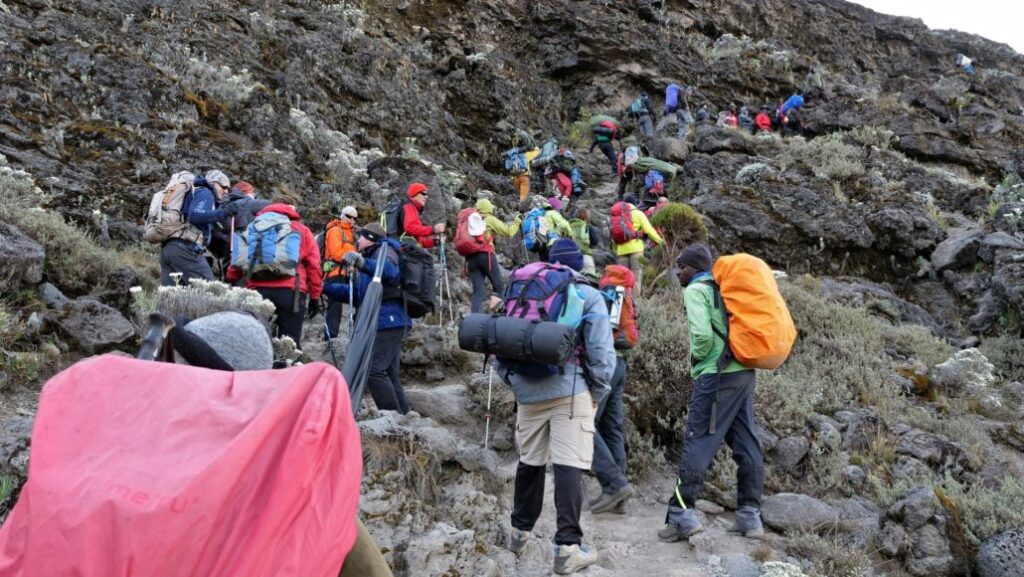
Day 5 opens with the infamous Barranco Wall — a scramble that looks terrifying but is perfectly manageable with a steady guide. Hands and feet are required; trekkers form a cheerful queue and pass their packs up in sections. Above the wall, the path traverses the Southern Circuit through Karanga Valley before the final climb to Barafu. This is a long, draining day — eat well at Karanga, rest here briefly, and drink constantly. Arrive at Barafu in the afternoon, eat dinner early, and try to sleep by 7 PM.
Day 6 — Summit Push: Barafu to Uhuru Peak to Mweka Camp
Distance: ~18 km | Elevation: +1,295 m to summit / -2,795 m to camp | Time: ~14–16 hours total |
Wake at midnight or 1 AM. Don every layer you own. The summit push begins in darkness and bitter cold. The trail switchbacks relentlessly up the scree of the Kibo cone toward Stella Point on the crater rim. This section (Barafu to Stella) takes most trekkers 5–7 hours. Many experience nausea, intense headache, and profound exhaustion. The guides keep you moving with the mantra: ‘Pole, pole’ (slowly, slowly in Swahili).
Reaching Stella Point (5,739 m) as dawn breaks is an overwhelming experience. The final 45 minutes of relatively flat walking along the crater rim leads to Uhuru Peak, the Roof of Africa. After photographs at the sign and a few precious minutes of triumph, the descent begins. By afternoon, you will reach Mweka Camp at 3,100 m for a well-earned final night on the mountain.
7 — Mweka Camp to Mweka Gate (Exit)
Distance: ~10 km | Elevation Loss: -1,460 m | Time: ~4–5 hours |
The final descent through the re-entering rainforest is surprisingly pleasant. Legs recover quickly at lower altitude and the oxygen feels impossibly rich. You will be showered with congratulations from porters and guides at Mweka Gate, and your summit certificate will be waiting. Transfer back to Moshi for a celebration dinner.
9. Lemosho Route — 8-Day Itinerary
The 8-day itinerary is the most highly recommended version of the Lemosho Route and the one that consistently delivers 90%+ summit success rates. The critical difference from the 7-day is the insertion of a dedicated acclimatization day at Shira 2 on Day 3, and the separation of the Karanga–Barafu segment into its own shorter day.
Day | Section | Distance | Start | Finish | Hours |
1 | Lemosho Gate → Big Tree Camp | 7 km | 1,800 m | 2,780 m | 3–4 h |
2 | Big Tree Camp → Shira 1 | 9 km | 2,780 m | 3,500 m | 5–6 h |
3 | Shira 1 → Shira 2 + Acclimatisation Walk | 9 km | 3,500 m | 3,840 m | 4–5 h |
4 | Shira 2 → Lava Tower → Barranco | 14 km | 3,840 m | 3,960 m | 6–7 h |
5 | Barranco Wall → Karanga Camp | 5 km | 3,960 m | 4,035 m | 3–4 h |
6 | Karanga Camp → Barafu High Camp | 5 km | 4,035 m | 4,600 m | 3–4 h |
7 | Barafu → Uhuru Peak → Mweka Camp | 18 km | 4,600 m | 3,100 m | 14–16 h |
8 | Mweka Camp → Mweka Gate (Exit) | 10 km | 3,100 m | 1,640 m | 4–5 h |
The 8-day version’s extra day creates a crucial advantage: trekkers spend TWO nights on the Shira Plateau (at Shira 1 and Shira 2), allowing their bodies to adapt to altitudes above 3,500 m before ascending further. The shorter, separate Karanga–Barafu day (Day 6) also means climbers arrive at Barafu earlier and with significantly more energy reserves for summit night.
10. Why Climb Kilimanjaro via the Lemosho Route?
With seven official routes to choose from, selecting the right one is the most important planning decision you will make. Here are the compelling reasons Lemosho consistently stands above the rest:
10.1 Unmatched Scenic Diversity
No other route traverses as many distinct environments in a single climb. You begin in ancient rainforest teeming with wildlife, cross the open heath and moorland of the Shira Plateau, scramble through the dramatic Barranco Wall, traverse the alpine desert of the Southern Circuit, and finish through glacial scree to the summit. Each day looks and feels entirely different from the last.
10.2 Superior Acclimatization Profile
Lemosho’s western approach provides a more gradual ascent profile than any other southern route. The route spends two to three nights between 3,500 m and 4,000 m before committing to higher elevations. This extended mid-altitude aclimatisation period is the primary reason for the route’s exceptional success rate. The ‘climb high, sleep low’ day at Lava Tower adds a further physiological boost unavailable on routes that skip the western plateau approach.
10.3 Low Crowd Density
Lemosho Gate’s remote location on the western side of the mountain naturally limits overcrowding. On most days you will encounter only your own group on the trail between Lemosho Gate and the Shira Plateau. Even after joining the Southern Circuit — where some Machame trekkers also travel — the trail is far less congested than on peak season Machame or Marangu days.
10.4 Pristine Wilderness Experience
The Shira Plateau and the western approach are among the least disturbed ecosystems on the entire mountain. Wildlife sightings — including serval cats, eland, and a spectacular array of sunbirds and raptors — are far more common here than on the heavily trafficked eastern slopes. The silence and solitude of the first two days are extraordinary.
10.5 Combines with the Northern Circuit
Trekkers who opt for the 9-day Northern Circuit continue from Shira 2 around the northern face of Kibo rather than descending to Barranco — completing almost a full circumnavigation of the mountain. The Lemosho approach feeds directly into the Northern Circuit, making it the gateway to the most remote and least-visited section of the entire mountain. If you have the time, the 9-day Northern Circuit via Lemosho is arguably the finest high-altitude trek in Africa.
10.6 No Congestion at Camps
Camps like Barranco and Barafu serve multiple routes, but the number of trekkers arriving via Lemosho is smaller than via Machame. This means better camp positions, less queuing for toilet facilities, and a quieter, more focused atmosphere during the critical pre-summit rest period.
11. Lemosho Route — Camps in Detail
Each camp on the Lemosho Route has its own character, altitude challenges, and facilities. Understanding what to expect helps you pace yourself and maintain morale throughout the climb.
Camp 1 — Big Tree Camp (Mti Mkubwa)
Elevation | 2,780 m (9,120 ft) |
Terrain | Dense montane rainforest; open mossy clearing |
Facilities | Pit latrines; no running water; porter mess tent |
Weather | Warm and humid; afternoon clouds; mist likely |
Key Notes | Watch for colobus monkeys; keep food in tent; stream nearby for porter water |
Camp 2 — Shira 1 Camp
Elevation | 3,500 m (11,483 ft) |
Terrain | Open moorland at edge of Shira Plateau; exposed |
Facilities | Composting toilets; basic tent pads; stream 200 m away |
Weather | Cooler; wind picks up in afternoon; clear nights with exceptional star visibility |
Key Notes | First night most people notice altitude; drink 4–5 L water; acclimatisation headaches common |
Camp 3 — Shira 2 Camp
Elevation | 3,840 m (12,598 ft) |
Terrain | Central Shira Plateau; wide, flat, volcanic lava field |
Facilities | Composting toilets; rangers post nearby; fixed tent platforms available |
Weather | Direct views of Kibo summit; dramatic cloud formations; very cold nights (−5°C to −10°C) |
Key Notes | Optional acclimatisation walk to Shira Cathedral (4,050 m) strongly recommended on 8-day itinerary |
Camp 4 — Barranco Camp
Elevation | 3,960 m (12,992 ft) |
Terrain | Sheltered valley with giant groundsels and lobelias; below the iconic Barranco Wall |
Facilities | Multiple toilet blocks; one of the largest camps on the mountain |
Weather | Often cloudy in evenings; warmer than Shira due to valley shelter; sunrise over Kibo is extraordinary |
Key Notes | Machame route trekkers also camp here; wake early for Barranco Wall to beat crowds |
Camp 5 — Karanga Camp (8-day only)
Elevation | 4,035 m (13,238 ft) |
Terrain | Small ridgeline camp in Karanga Valley above the ravine |
Facilities | Toilet tents; water source below camp (treated before use) |
Weather | Exposed; cold and windy; alpine desert begins here |
Key Notes | On the 7-day itinerary, this is a lunch stop only — not a sleep camp |
Camp 6 — Barafu High Camp
Elevation | 4,600–4,673 m (15,092 ft) |
Terrain | Rocky, steeply sloped ridge; sparse vegetation; exposed volcanic scree |
Facilities | Toilet tents; rangers station; emergency evacuation point |
Weather | Very cold; strong wind; temperature can drop to −15°C; altitude effects most pronounced |
Key Notes | Arrive early, eat, hydrate, sleep by 7 PM. Summit bid departs midnight to 1 AM |
Descent Camp — Mweka Camp
Elevation | 3,100 m (10,170 ft) |
Terrain | Transition zone between alpine desert and moorland; re-entering vegetation |
Facilities | Toilet blocks; one of the better equipped descent camps |
Weather | Warm, oxygen-rich air; immediate altitude relief felt after summit descent |
Key Notes | Porters and guides celebrate here; tips are traditionally given at this camp before final descent |
12. Lemosho Route Success Rate
The Lemosho Route’s success rate is the primary reason experienced mountaineers and first-time high-altitude trekkers alike choose it over competitors. Here is a detailed breakdown of the factors that drive the numbers:
12.1 Published Success Rate Data
Itinerary | Success Rate | Operator Quality Factor |
Lemosho 7-Day | ~85% | High quality: ~88% |
Lemosho 8-Day | ~90–95% | High quality: ~95%+ |
Lemosho 9-Day (N. Circuit) | ~92–95% | High quality: ~96% |
12.2 Key Factors Driving the High Success Rate
- Gradual elevation profile — The longest approach of any southern-face route.
- ‘Climb high, sleep low’ at Lava Tower — The single most impactful acclimatisation event on the mountain.
- Two nights on the Shira Plateau (8-day) — Extended mid-altitude adaptation before higher camps.
- Shorter final day to Barafu — Trekkers arrive at high camp with more energy reserves.
- Experienced guide ratios — Reputable Lemosho operators typically maintain 1:1 or 1:2 guide-to-trekker ratios.
- Diamox use — Most medical advisors recommend prophylactic acetazolamide (Diamox); Lemosho’s pacing also reduces the required dose for many trekkers.
- Small group sizes — Lemosho’s remote trailhead naturally filters out budget-only tour groups that crowd shorter routes.
12.3 Why People Fail to Summit
Even on the best-designed route, some trekkers do not reach the top. Understanding why can help you prepare:
- Acute Mountain Sickness (AMS) — Headache, vomiting, confusion, ataxia; the most common reason for forced descent.
- Insufficient physical preparation — Trekkers who arrive without adequate cardiovascular base struggle on summit night.
- Dehydration — A major contributor to AMS; drinking 4–5 litres per day is essential.
- Budget operators skipping acclimatisation — Not all 7-day or 8-day itineraries are equal; always ask operators for their specific camp schedule.
- Cold and adverse weather — The summit can see temperatures of −30°C with wind chill; inadequate gear is dangerous.
- Starting summit too late — Groups leaving after 1 AM risk being caught on exposed sections in full afternoon sun, exhausted.
13. What to Pack for Lemosho Route
13.1 Layering System — The Essential Strategy
Temperature on Kilimanjaro swings from +25°C at the forest gate to −30°C wind chill on summit night. A proper layering system is not a luxury — it is survival equipment. The standard three-layer approach is:
- Base layer — Moisture-wicking merino wool or synthetic long johns and top; worn from Shira 1 upward at night.
- Mid layer — Insulated fleece or down jacket (minimum 600-fill power down); provides core warmth at all high camps.
- Outer shell — Waterproof, windproof hard-shell jacket and trousers; essential for summit night and rain in the forest.
13.2 Complete Packing Checklist
Category | Items |
Footwear | Waterproof hiking boots (broken in), thick wool socks (×5 pairs), camp shoes/sandals, gaiters |
Clothing — Warm | Down jacket, fleece layer, thermal base set, balaclava, insulated gloves + liner gloves, summit mittens |
Clothing — Rain | Waterproof hard shell jacket and trousers, pack rain cover |
Sleeping | Sleeping bag rated to −15°C minimum, sleeping bag liner, small pillow or inflatable |
Navigation & Safety | Trekking poles (×2), headlamp + spare batteries, GPS device (optional), whistle |
Hydration | 2 × 1L water bottles (insulated), 2L hydration bladder, water purification tablets |
Medical | Diamox (acetazolamide — prescription), ibuprofen, blister kit, altitude sickness test kit, pulse oximeter |
Sun / Cold Protection | SPF 50+ sunscreen, lip balm SPF 30, UV-blocking glacier goggles or wraparound sunglasses, sun hat |
Toiletries | Wet wipes (no showers on mountain), hand sanitiser, trowel, toilet paper, small towel |
Nutrition | High-energy snacks: nuts, dried fruit, chocolate, energy bars, electrolyte sachets |
Documents & Money | Passport copy, travel insurance documentation, USD cash (for tips and gate fees), summit certificate request form |
Bag Setup | Main duffel bag (≤15 kg for porters), 20–30L daypack for your daily carry, dry bags for waterproofing |
14. Best Time to Climb Kilimanjaro via Lemosho
Kilimanjaro can technically be climbed year-round, but timing has a significant impact on weather, visibility, and summit conditions. The mountain sits just 3 degrees south of the equator and has its own microclimate, but broadly follows Tanzania’s seasonal rainfall patterns.
Period | Months | Weather | Recommendation |
Peak Season 1 | Jan–Feb | Dry, cold, clear skies | Excellent — book early |
Short Rains | Mar–May | Heavy rain, clouds, muddy trails | Not recommended |
Peak Season 2 | Jun–Oct | Dry, stable, cold at altitude | Best time — July/Aug ideal |
Short Dry Period | Nov | Variable; transition month | Acceptable with flexibility |
Short Rains | Dec | Wet but clearing by mid-Dec | Late Dec acceptable |
The absolute sweet spots are January–February and June–October. July and August bring the clearest summit views and the most stable conditions, though these months also see peak demand. For solitude combined with excellent weather, January and February are outstanding — the mountain is quieter post-Christmas and the skies are reliably clear.
15. Health, Safety & Altitude Sickness
15.1 Acute Mountain Sickness (AMS) — Know the Signs
Every climber on Kilimanjaro will experience some symptoms of altitude sickness. The critical skill is distinguishing normal acclimatisation discomfort from dangerous progression toward HAPE or HACE.
Condition | Symptoms | Action Required |
Mild AMS | Headache, fatigue, mild nausea | Rest, hydrate, take ibuprofen; DO NOT ascend |
Moderate AMS | Severe headache, vomiting, dizziness, loss of appetite | Descend immediately if no improvement after 24 hrs |
HAPE (Pulmonary Oedema) | Breathlessness at rest, pink frothy cough, crackling sounds in chest | EMERGENCY: Descend immediately, administer oxygen, call rescue |
HACE (Cerebral Oedema) | Confusion, ataxia (stumbling), cannot tandem-walk, altered consciousness | EMERGENCY: Descend immediately, dexamethasone, call rescue |
15.2 The Golden Rule
GOLDEN RULE OF HIGH ALTITUDE: |
Never ascend with symptoms of AMS. If in doubt, do not go up. Descend even a few hundred metres and symptoms often improve dramatically within hours. No summit is worth your life. |
15.3 Diamox (Acetazolamide)
Acetazolamide (brand name Diamox) is the only pharmaceutical intervention proven to prevent and reduce AMS. It works by stimulating faster, deeper breathing, accelerating acclimatisation. Standard prophylactic dose is 125 mg twice daily, starting 24 hours before ascending above 2,500 m. Consult your physician before your trip. Common side effects include increased urination (drink more water!), tingling in the fingers, and a strange metallic taste in carbonated drinks.
15.4 Pulse Oximetry Monitoring
Most good operators and guides carry pulse oximeters — small devices that clip to a fingertip and read blood oxygen saturation (SpO2). Normal SpO2 at sea level is 95–100%. On the Shira Plateau expect 88–92%; at Barafu, 80–88%; near the summit, 70–80%. Values below 70% are serious; below 60% are dangerous. Your guide should check SpO2 each morning and evening from Shira 2 upward.
16. Expert Tips for Summit Success on Lemosho
16.1 Before the Trek
- Train for 3–6 months: Focus on cardiovascular endurance — long hikes with a loaded pack are ideal.
- Do a pre-acclimatisation trek: Even a weekend at moderate altitude (2,000–3,000 m) helps your body prepare.
- Book your operator carefully: A cheap operator cutting corners on food, guides, and safety equipment is the fastest route to failure.
- Get your gear tested: Do not wear new boots on summit day — break them in on multiple training hikes first.
- See your doctor: Discuss Diamox, altitude sickness signs, and ensure travel vaccinations are current.
16.2 During the Trek
- Pole, pole (slowly, slowly): The most experienced trekkers walk at a pace that feels almost frustratingly slow. This is correct.
- Hydrate aggressively: At altitude, your breathing rate increases and you lose moisture rapidly. 4–5 litres per day is the minimum.
- Eat even when you don’t feel like it: Caloric deficit at altitude accelerates fatigue; force yourself to eat every meal.
- Sleep in all your layers from Barafu: Do not undress for summit night — stay in your thermal system from arrival at high camp.
- Protect summit night extremities: Frostbite risk is real above 5,000 m; wiggle fingers and toes regularly; use chemical hand warmers in gloves.
- Maintain a positive mental attitude: Studies show psychological preparation correlates directly with summit success. Visualise standing at Uhuru.
16.3 Tipping Your Team
Tipping your guides, lead guide, and porters is a critically important part of Kilimanjaro climbing culture. These professionals make your summit possible and most earn the majority of their income from tips. Recommended amounts (per client, for a full team):
- Head guide: USD $25–30 per day
- Assistant guide: USD $15–20 per day
- Porter: USD $8–12 per day
- Cook: USD $10–15 per day
Tips are typically collected in a group envelope and distributed at Mweka Camp on the final evening.
17. Sustainability & Responsible Climbing
Kilimanjaro receives tens of thousands of trekkers annually and the ecosystem impact is significant. Here is how to minimise your footprint:
- Use only KPAP-certified operators: The Kilimanjaro Porters Assistance Project sets ethical standards for porter treatment, wages, and gear.
- Carry out all waste: Leave No Trace principles apply strictly. Pack out all non-biodegradable waste.
- Do not pick plants or disturb wildlife: The endemic giant groundsels and lobelias on the Shira Plateau are protected.
- Use provided toilet facilities: Never urinate or defecate outside designated latrine areas.
- Offset your carbon: The return flight to Tanzania is likely your largest environmental impact; consider a reputable offset program.
- Support local communities: Buy Tanzanian-made goods, eat at local restaurants before and after the trek, and engage with Chagga cultural guides.
18. Conclusion — Is the Lemosho Route Right for You?
The Lemosho Route is the finest path to the summit of Africa’s highest mountain. It is the right choice for you if:
- You want the best possible chance of reaching Uhuru Peak.
- You value scenic diversity and wilderness solitude over speed.
- You are willing to invest in a 7–9 day schedule rather than rush the ascent.
- You are a first-time high-altitude trekker looking for the most forgiving acclimatisation profile available.
- You want an experience that feels like a genuine expedition — not a tourist conveyor belt.
No route guarantees a summit on Kilimanjaro — the mountain ultimately decides. But the Lemosho Route, walked at the right pace with the right operator and the right preparation, gives you the strongest possible hand to play. The rest is up to the mountain, your body, and your spirit.
FINAL WORD |
“Kilimanjaro is not conquered by strength — it is earned by patience. Choose Lemosho. Walk pole, pole. And you will stand on the Roof of Africa.” |