6 Days Umbwe Route - Most challenging Route to Uhuru Peak
The Umbwe Route is widely regarded as one of the most dramatic, challenging, and rewarding ways to climb Mount Kilimanjaro. Often called the ‘direct route,’ it cuts a steep and relentless path through the southern face of Africa’s highest mountain, offering seasoned trekkers an unmatched sense of adventure and solitude.
Unlike the more popular Marangu or Lemosho routes, the Umbwe Route attracts experienced mountaineers who crave a serious physical challenge and wish to avoid the crowds. The trail begins in the lush, low-lying rainforest near the town of Moshi and ascends with extraordinary steepness through distinct ecological zones — each more awe-inspiring than the last.
The route was first pioneered in the early 1960s and has since become synonymous with raw Kilimanjaro adventure. Its narrow forest paths, exposed ridgelines, and unrelenting gradient demand excellent fitness, mental fortitude, and careful acclimatization strategy. Despite the difficulty, trekkers who complete this route often describe it as a life-defining achievement.
This comprehensive 6-day itinerary is designed to maximize acclimatization opportunities while managing the inherent challenges of the route. The classic Umbwe Route joins the Southern Circuit before the final summit push, allowing trekkers to benefit from altitude variation and broader views of the mountain.
Elevation: 5,895 m (19,341 ft) | Difficulty: Very Challenging | Route: Steepest on Kilimanjaro
Route Name | Umbwe Route (Umbwe Direct) |
Duration | 6 Days / 5 Nights |
Total Distance | Approximately 53 km (33 miles) round trip |
Summit Elevation | 5,895 m / 19,341 ft — Uhuru Peak, Kilimanjaro |
Starting Point | Umbwe Gate (1,640 m / 5,380 ft) |
Difficulty | Very Challenging — Steepest and most direct route |
Best Season | January–March and June–October |
Success Rate | Approximately 60–70% (lower than Marangu/Lemosho) |
Country | Tanzania, East Africa |
Park Fees | Kilimanjaro National Park fees apply (approx. $700–$800 USD) |
Why Choose the Umbwe Route?
- The steepest and most direct route — ideal for experienced trekkers
- Far less foot traffic than Marangu, Machame, or Lemosho routes
- Dramatic and varied scenery from dense rainforest to alpine desert
- Combines with the Southern Circuit for superior acclimatization
- A true wilderness experience with exceptional solitude
- Stunning approach ridgeline with sweeping views of the Shira Plateau
- Highly rewarding summit success for well-prepared climbers
Route Character and Terrain
The Umbwe Route is characterized by its unrelenting gradient, particularly in the first two days where trekkers gain over 3,000 meters of altitude in dense montane forest. The path follows a narrow, mossy ridge offering little shelter from rain but providing extraordinary views when conditions clear.
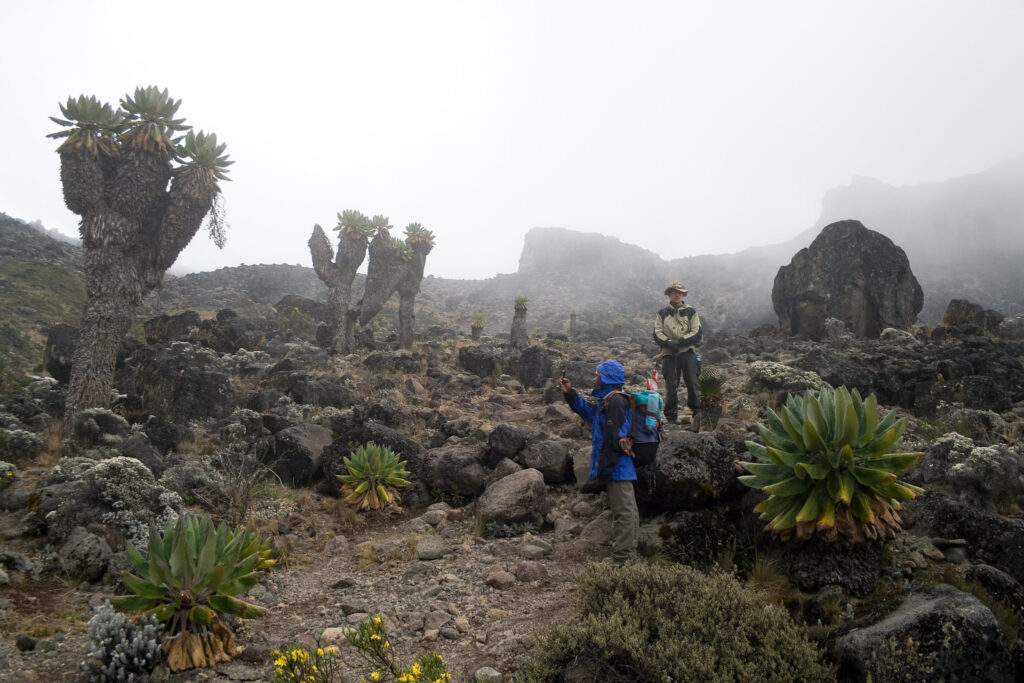
Above the treeline, the route traverses the surreal alpine moorland studded with giant groundsels (Senecio Kilimanjaro) and lobelias — plant species found nowhere else on Earth. Above 4,000 meters, the landscape transitions to rocky alpine desert before reaching the glaciated zone near the summit crater.
From Barranco Camp, the route merges with the Machame Route along the Southern Circuit, which adds a valuable acclimatization day and passes beneath the iconic Breach Wall — one of the greatest rock faces in Africa.
Day 1 — Umbwe Gate to Umbwe Cave Camp
Day 1: Entering the Forest | |
Start Point | Umbwe Gate — 1,640 m (5,380 ft) |
End Point | Umbwe Cave Camp — 2,940 m (9,646 ft) |
Distance | Approximately 8 km (5 miles) |
Elevation Gain | +1,300 m (+4,265 ft) |
Estimated Time | 5–7 hours |
Terrain | Dense montane rainforest; muddy root-laden trails; steep ridge |
Difficulty | Strenuous |
Trail Description
Your Kilimanjaro adventure begins at Umbwe Gate, located a short drive from the bustling town of Moshi. After completing formalities at the park gate — registering your group, verifying permits, and receiving safety briefings — you set off into one of Africa’s most spectacular montane rainforests.
The trail immediately establishes the character of the Umbwe Route: steep, narrow, and immersive. The path follows the crest of a narrow ridge formed between two stream valleys, the Lonzo River to the east and the Umbwe River to the west. This ridge walk offers a continuous, uninterrupted ascent through ancient forest.
The forest canopy is extraordinarily diverse. Enormous Podocarpus trees draped in lichen and moss tower above the trail, while African violets, orchids, and ferns carpet the forest floor. Colobus monkeys are commonly spotted swinging through the canopy, and the air rings with birdsong. On clear mornings, shafts of golden light penetrate the forest creating a truly magical atmosphere.
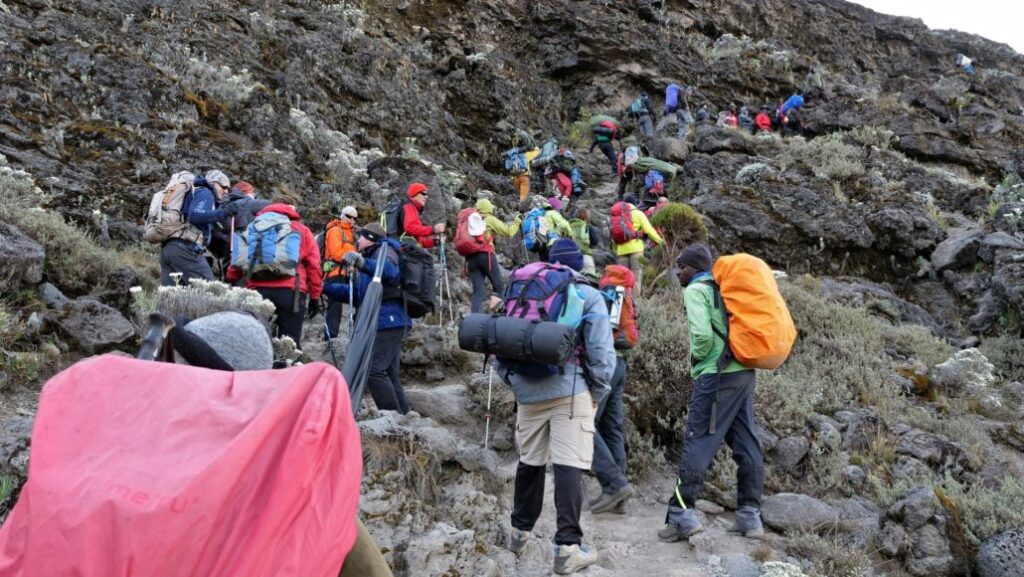
The final approach to Umbwe Cave Camp steepens considerably. Trekkers scramble over exposed tree roots and slippery rock faces requiring careful footwork. The ‘cave’ itself is a large basalt overhang that has served as shelter for generations of mountaineers. The campsite nearby provides adequate space for tents, and a small stream provides water for cooking.
Acclimatization Notes
Day 1 is primarily about transition — both physically and psychologically. Your body begins adjusting to the increasing altitude, and the sheer steepness of the trail serves as an immediate introduction to the demands ahead. Drink at least 3–4 liters of water throughout the day, eat well at all stops, and resist the urge to rush.
What to Expect at Camp
- Basic campsite with flat tent pitches near the cave overhang
- Crew cooks a hot dinner — typically soup, pasta, and fresh fruit
- Temperatures drop to 5–10°C; sleeping bag rated to -10°C recommended
- Stars visible on clear nights through the forest canopy
Day 2 — Umbwe Cave Camp to Barranco Camp
Day 2: Above the Clouds | |
Start Point | Umbwe Cave Camp — 2,940 m (9,646 ft) |
End Point | Barranco Camp — 3,976 m (13,044 ft) |
Distance | Approximately 9 km (5.6 miles) |
Elevation Gain | +1,036 m (+3,399 ft) |
Estimated Time | 5–7 hours |
Terrain | Moorland; heather zone; exposed ridge; rocky trail |
Difficulty | Very Strenuous |
Trail
Day 2 is arguably the most physically demanding day of the entire route. The trail continues its relentless climb from the upper forest boundary through the heather-moorland zone, emerging above the clouds into a dramatically different world.
As you leave the forest behind, the vegetation transitions to giant heather (Erica arborea) draped in silvery lichen called Old Man’s Beard. The heather forms ghostly tunnels over the trail in places, creating an otherworldly atmosphere. Higher still, giant groundsels and lobelias begin to appear — iconic Afro-alpine plants that exist in very few places on Earth.
The ridge narrows and becomes increasingly exposed, offering heart-stopping views down both flanks of the Umbwe Ridge when clouds permit. On clear days, the entire Shira Plateau stretches out to the west, and the distant peaks of Mount Meru are visible to the southwest.
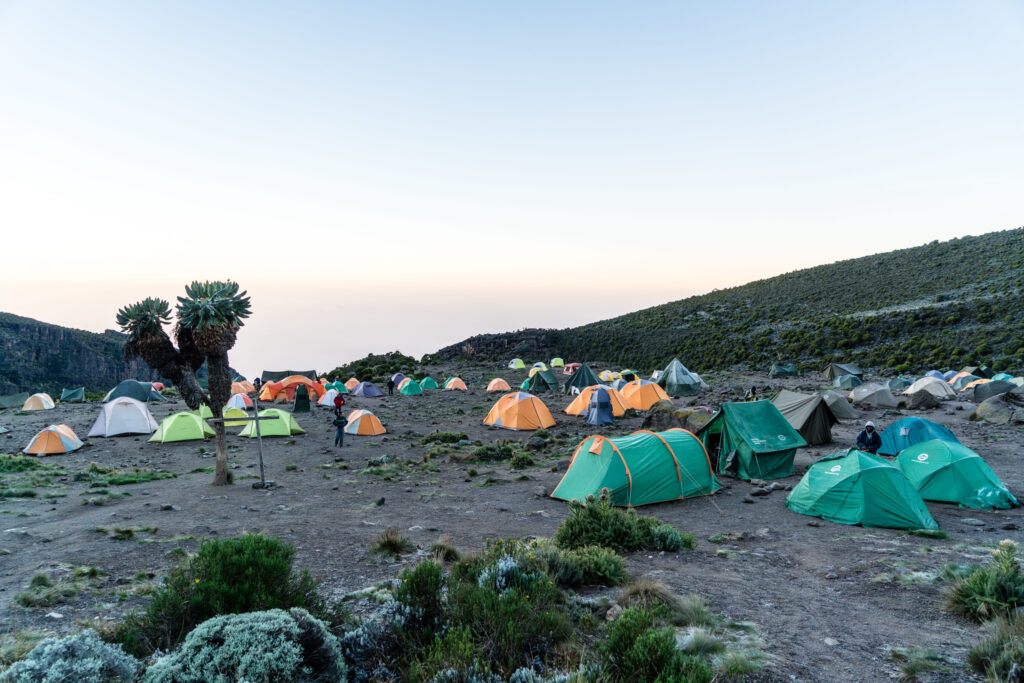
The final descent to Barranco Camp crosses a broad glacial valley and follows the distinctive Barranco Wall — a massive volcanic escarpment that dominates the horizon. Barranco Camp sits in a sheltered bowl at the base of this wall, surrounded by giant groundsels that create one of the most iconic campsites on Kilimanjaro.
Altitude Awareness
By the end of Day 2, you will have gained over 2,300 meters of elevation in just two days — an aggressive ascent profile that requires careful attention to symptoms of Acute Mountain Sickness (AMS). Common symptoms include headache, nausea, fatigue, and loss of appetite. Report any symptoms to your guide immediately.
- Drink minimum 4 liters of water throughout the day
- Walk slowly and deliberately — ‘pole pole’ (slowly slowly) in Swahili
- Eat all meals even if appetite is reduced
- Take Diamox (acetazolamide) as directed by a physician if prescribed
- Rest at camp — avoid any unnecessary physical exertion
Day 3 — Barranco Camp: Acclimatization & Barranco Wall
Day 3: The Great Wall Scramble | |
Start Point | Barranco Camp — 3,976 m (13,044 ft) |
End Point | Karanga Camp — 4,035 m (13,238 ft) |
Distance | Approximately 5 km (3.1 miles) |
Elevation Gain / Loss | +600 m ascent / -500 m descent |
Estimated Time | 4–6 hours |
Terrain | Exposed rock scramble on Barranco Wall; glacial valley crossing |
Difficulty | Strenuous with technical scrambling sections |
The Barranco Wall
Day 3 opens with the defining challenge of the Southern Circuit: the ascent of the Barranco Wall. This 300-meter (980-foot) volcanic escarpment requires genuine rock scrambling with both hands and feet, and is unlike anything else on the standard trekking routes.
Despite its imposing appearance from below, the Barranco Wall is a non-technical scramble with clear hand and footholds. Your guide will lead you through the safest line, which winds through clefts and ledges in the basalt rock face. At certain points, the trail narrows to a single-person width with significant exposure on one side.
The ‘Kissing Rock’ is a famous landmark partway up the wall — a large boulder that juts into the path, requiring trekkers to hug the rock face and edge around it carefully. It has become something of a rite of passage on Kilimanjaro.
The view from the top of the Barranco Wall is extraordinary. Looking back down, Barranco Camp appears miniature far below, while ahead the Southern Circuit stretches across the mountain’s broad southern flank. The glaciers of the Southern Ice Field glitter in the distance above.
Descent to Karanga Camp
After cresting the Barranco Wall, the trail descends steeply into the Karanga Valley — a deep glacial ravine carved by ancient ice flows. The valley bottom harbors a small stream, one of the last reliable water sources on the route. From here, a stiff climb through loose rocky terrain leads to Karanga Camp.
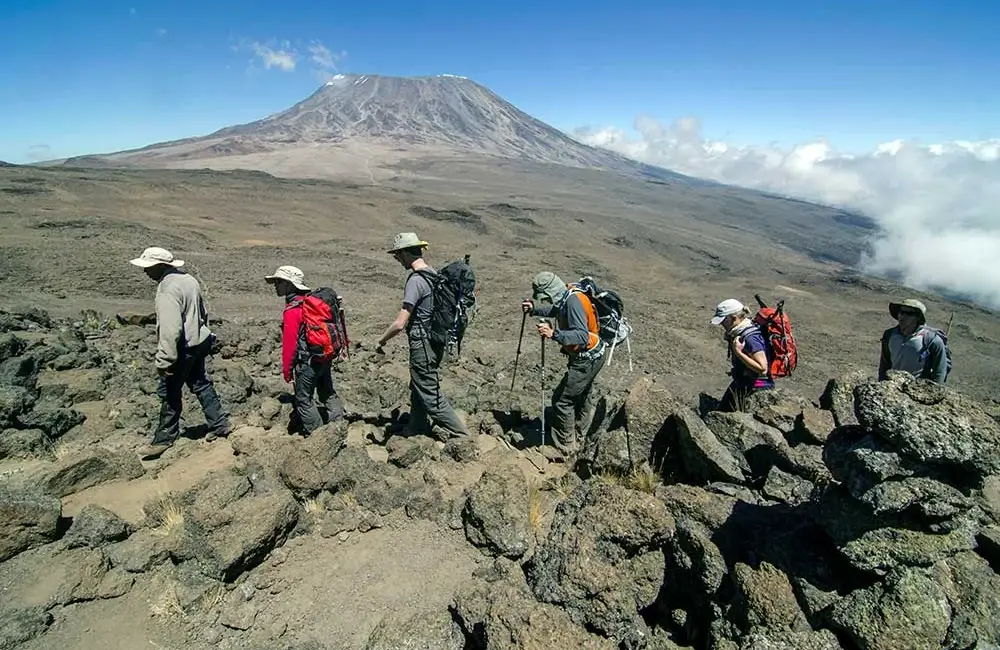
Karanga Camp offers one of the best views of the Kibo volcanic cone from the southern side. On clear evenings, the glaciers turn golden in the alpenglow — a sight that inspires even the most exhausted trekkers.
Day 4 — Karanga Camp to Barafu Camp
Day 4: High Camp Preparation | |
Start Point | Karanga Camp — 4,035 m (13,238 ft) |
End Point | Barafu High Camp — 4,673 m (15,331 ft) |
Distance | Approximately 4 km (2.5 miles) |
Elevation Gain | +638 m (+2,093 ft) |
Estimated Time | 3–4 hours |
Terrain | Rocky alpine desert; scree slopes; exposed ridgeline |
Difficulty | Moderate — short but high altitude |
Trail Description
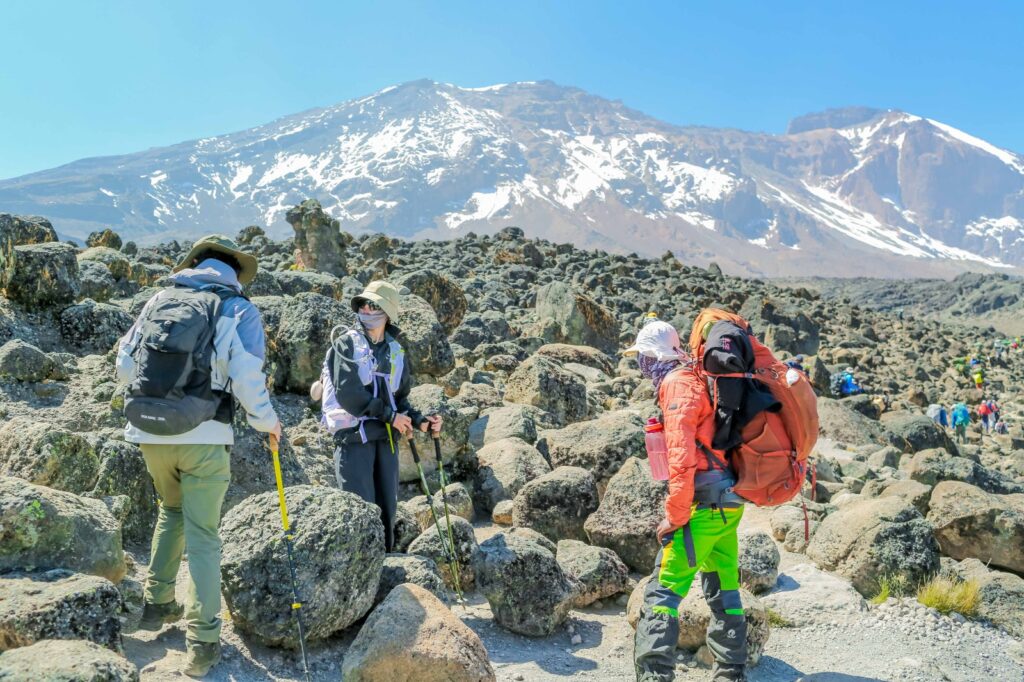
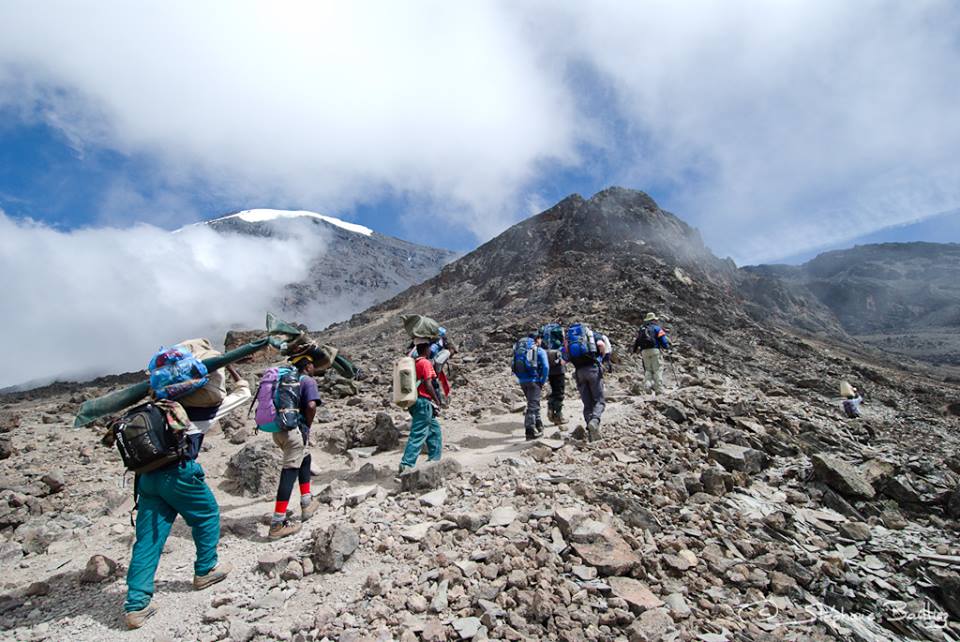
Day 4 is a relatively short day in terms of distance, but the high altitude makes even moderate exertion feel demanding. The trail climbs steadily through the barren alpine desert zone — a landscape of dark volcanic rock, scree, and gravel with virtually no vegetation.
Barafu Camp — whose name means ‘ice’ in Swahili — sits on a narrow exposed ridge at 4,673 meters, wedged between two rocky outcrops. It is the highest dedicated camp on the southern routes and serves as the launch pad for summit attempts. The camp is bare, windswept, and functional, offering little comfort but magnificent views of Mawenzi Peak to the northeast and the vast plains of Tanzania far below.
This is a critical day for physical and mental preparation. Guides typically conduct detailed summit briefings at Barafu, covering the route to the crater rim, pace management, turnaround protocols, and emergency procedures.
Pre-Summit Protocol
- Arrive at camp by early afternoon and rest immediately
- Eat a substantial hot meal — your last proper meal before the summit
- Hydrate aggressively throughout the afternoon and evening
- Prepare your summit pack: headlamp, extra layers, snacks, water, crampons if required
- Sleep if possible — departure is typically midnight to 1:00 AM
- Discuss any symptoms with your guide before sleeping
Gear Check for Summit Night
Summit night on Kilimanjaro demands serious cold-weather preparation. Temperatures at the crater rim can fall to -20°C (-4°F) or colder with wind chill. Ensure all the following are accessible in your summit pack:
- Thermal base layer (top and bottom)
- Insulating mid-layer (fleece or down jacket)
- Windproof and waterproof outer shell jacket and trousers
- Balaclava, neck gaiter, and warm hat
- Insulated gloves with waterproof overmitts
- High-altitude trekking boots — well broken in
- Gaiters to prevent snow and scree entry
- Trekking poles — essential for balance on scree
- Headlamp with fresh batteries (cold drains batteries quickly)
- High-calorie snacks: energy gels, chocolate, nuts, dried fruit
- Thermos of hot water or warm juice
Day 5 — Summit Night & Descent to Mweka Camp
Day 5: Summit Push — Uhuru Peak | |
Departure | Barafu High Camp — Midnight to 1:00 AM |
Summit | Uhuru Peak — 5,895 m (19,341 ft) |
Descent End Point | Mweka Camp — 3,068 m (10,065 ft) |
Total Distance | Approximately 15 km (9.3 miles) |
Elevation Gain / Loss | +1,222 m ascent / -2,827 m descent |
Estimated Time | 6–8 hours ascent; 3–4 hours descent |
Terrain | Steep scree and volcanic gravel; crater rim; forest descent |
The Summit Ascent — Midnight to Dawn
The summit bid begins in the deep cold of the African night, typically departing between midnight and 1:00 AM. The timing is deliberate — the scree slopes are frozen at night, providing better footing than the loose, soft conditions of the afternoon. Beginning in darkness also allows trekkers to reach the crater rim at Stella Point just as sunrise ignites the horizon in a blaze of orange and gold.
The trail zigzags relentlessly up the southeastern slope, gaining altitude with every switchback on a surface of volcanic scree and compacted gravel. At this altitude, each step demands deliberate effort — the air contains roughly half the oxygen available at sea level. Your guide will set a deliberately slow pace, emphasizing the Swahili mantra ‘pole pole’ — slowly, slowly.
The first major landmark is Stella Point at 5,756 meters — reached after approximately 5–7 hours of climbing. Reaching Stella Point represents a significant psychological and physiological milestone; the crater rim is breached and the summit crater stretches out before you. Some trekkers experience overwhelming emotion at this point.
From Stella Point, the trail follows the crater rim in a gentle arc for approximately 45–60 minutes to Uhuru Peak — the highest point in Africa. The views from the rim are staggering: the vast glaciers of the Northern Ice Field rise above the crater floor, the summit plateau glitters in the early morning sun, and far below, the plains of Tanzania stretch to the horizon in every direction.
Uhuru Peak
Uhuru Peak marks the absolute summit of Kilimanjaro at 5,895 meters above sea level. The famous green wooden sign reading ‘Congratulations! You are now at Uhuru Peak, Tanzania, 5895m AMSL’ awaits every trekker who completes the climb. Photographs at the summit sign are among the most treasured keepsakes of any Kilimanjaro expedition.
Time at the summit is typically limited to 15–30 minutes due to the extreme cold, high altitude, and the need to begin descent promptly. However, even a brief visit to the roof of Africa is a profoundly humbling and exhilarating experience that many trekkers describe as one of the greatest moments of their lives.
Descent via Mweka Route
The descent from Barafu to Mweka Camp is a long and knee-intensive slog through scree, moorland, and rainforest. Despite fatigue, maintaining careful footing is essential — the majority of Kilimanjaro injuries occur on descent. Trekking poles are invaluable on the loose scree slopes.
As altitude decreases, energy and appetite rapidly return. The reappearance of vegetation — first isolated shrubs, then heather moorland, then the magnificent montane rainforest — signals the completion of the altitude journey. Mweka Camp sits at 3,068 meters in a beautiful forest glade, offering the first truly comfortable sleeping altitude since the first night.
Day 6 — Mweka Camp to Mweka Gate
Day 6: Final Descent & Celebration | |
Start Point | Mweka Camp — 3,068 m (10,065 ft) |
End Point | Mweka Gate — 1,630 m (5,348 ft) |
Distance | Approximately 10 km (6.2 miles) |
Elevation Loss | -1,438 m (-4,718 ft) |
Estimated Time | 3–4 hours |
Terrain | Dense rainforest; muddy forest trail; well-maintained path |
Difficulty | Easy to Moderate |
The Final Walk
Day 6 is the triumphant conclusion of your Umbwe Route adventure. The descent through lush montane rainforest is a joyful contrast to the stark alpine landscapes of the summit zone. The air is warm and rich with oxygen, birds call from the canopy overhead, and the sound of running streams accompanies your passage through the forest.
The trail is well-maintained and relatively gentle compared to the ascent route, following a broad forest path rather than the narrow ridge taken on the way up. Many trekkers find this final walk deeply meditative — a time to process the extraordinary experiences of the past five days.
Porter and guide singing is a cherished tradition on Kilimanjaro. Your crew will often break into Swahili songs celebrating your achievement as you approach the gate, creating an emotionally resonant finale to the expedition.
Mweka Gate Ceremony
Arrival at Mweka Gate is marked by the official summit certificate ceremony. Your guides will present you with a Kilimanjaro National Park summit certificate — green for reaching Uhuru Peak, or gold for summiting any Kilimanjaro peak. This document is both a formal record of your achievement and a treasured memento.
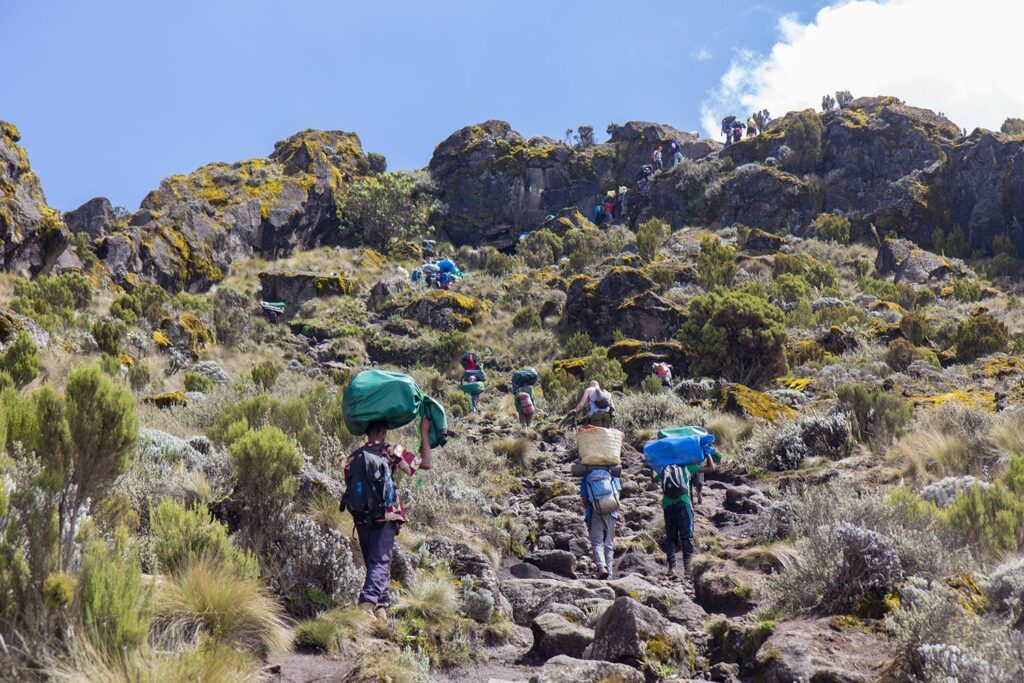
Tips for your crew are traditionally given at the gate. Your porters, cooks, and guides have worked tirelessly throughout the expedition, often carrying extraordinary loads and working in challenging conditions. Appropriate tipping is an important part of the Kilimanjaro culture and makes a genuine difference to the livelihoods of local communities.
Essential Preparation Guide
Physical Training Recommendations
The Umbwe Route demands a high level of cardiovascular fitness, leg strength, and mental endurance. Begin a structured training program at least 4–6 months before your climb.
Cardiovascular Training
- Hiking: 15–20 km hikes with elevation gain, progressively increasing distance
- Running: 3–5 runs per week, including hill intervals
- Stair climbing: An excellent simulator for the gradient demands of the route
- Cycling: Long rides build cardiovascular endurance without joint impact
Strength Training
- Squats and lunges: Build the quadriceps and gluteal strength essential for descent
- Step-ups with a loaded pack: Directly simulates Kilimanjaro trekking
- Core exercises: A strong core improves stability on uneven terrain
- Shoulder exercises: Reduces fatigue from carrying a daypack for 6–8 hours
Acclimatization Strategy
The Umbwe Route’s aggressive ascent profile makes careful acclimatization essential. The 6-day itinerary includes a built-in acclimatization day at Barranco Camp; however, additional strategies significantly improve summit success rates.
- Arrive in Tanzania 2–3 days early to recover from jet lag
- Consider a training hike on Mount Meru (4,562 m) before Kilimanjaro
- Consult a physician about Diamox (acetazolamide) prophylaxis
- Practice the ‘climb high, sleep low’ principle where itinerary allows
- Monitor and report any AMS symptoms immediately to your guide
Health and Medical Considerations
Kilimanjaro is a wilderness environment with limited medical facilities above the lower gate areas. All trekkers should carry a comprehensive personal first aid kit and have travel insurance that includes high-altitude evacuation coverage.
- Visit a travel medicine clinic 6–8 weeks before departure
- Ensure all standard vaccinations are current (typhoid, hepatitis A & B, yellow fever)
- Malaria prophylaxis is recommended for Tanzania
- Carry a pulse oximeter to monitor blood oxygen saturation
- Know the symptoms of AMS, HACE, and HAPE and take them seriously
Complete Packing List
Clothing
- Moisture-wicking thermal base layers — 2 sets (top and bottom)
- Fleece or synthetic insulating jacket
- Down jacket rated to -15°C or colder — critical for summit night
- Waterproof/windproof shell jacket with sealed seams
- Waterproof shell trousers
- Trekking trousers — 2–3 pairs
- Long-sleeve hiking shirts — 2–3
- Warm hat / balaclava
- Sun hat with wide brim
- Neck gaiter or buff
- Thin liner gloves + warm insulating gloves + waterproof overmitts
- Merino wool hiking socks — 5–6 pairs
- Camp sandals or lightweight shoes for rest periods
Footwear
- Waterproof high-top trekking boots — well broken in before the trek
- Gaiters — keeps scree and mud out of boots
Equipment
- Trekking poles — adjustable, with rubber tips and snow baskets
- Daypack 25–35 litres with rain cover
- Duffel bag for porters to carry (max 15 kg)
- Sleeping bag rated to -15°C
- Sleeping mat (optional — usually provided by operators)
- Headlamp with spare batteries — LED type
- Sunglasses with UV protection — Category 3 or 4
- Trekking watch with altimeter
- Pulse oximeter
Nutrition and Hydration
- Water bottles or hydration reservoir (3-litre capacity minimum)
- Water purification tablets or filter straw as backup
- High-calorie snacks: energy bars, nuts, chocolate, dried fruit, jerky
- Electrolyte tablets or powders — critical at altitude
- Thermos for hot drinks on summit night
Costs, Logistics & Practical Information
Permit and Park Fees
Kilimanjaro National Park fees are mandatory for all trekkers and are typically included in operator packages. For the 6-day Umbwe Route, fees include conservation fees, camping fees, rescue fees, and guide/porter park entrance fees.
Fee Category | Approx. Cost (USD) |
Park Conservation Fee (6 days) | $70 per day = ~$420 |
Camping Fees (5 nights) | $50 per night = ~$250 |
Rescue Fee | ~$20 per trek |
Operator Package (all inclusive) | $1,800 – $3,500 per person |
Recommended Porter/Guide Tips | $200 – $300 per trekker |
Best Time to Trek
Kilimanjaro can be climbed year-round, but two main seasons offer the most favorable conditions for the Umbwe Route:
- January to March: The driest period with excellent summit visibility. Nights are cold but days are generally clear. February is considered the optimal month.
- June to October: The long dry season offers reliable weather windows. July and August see the most foot traffic. September and October offer a good balance of stable weather and lighter crowds.
- April, May, and November: The wet seasons bring heavy rainfall, particularly in the lower forest zones. The Umbwe Route’s notorious mud and slippery roots become extremely hazardous. Not recommended.
Getting There
- Fly into Kilimanjaro International Airport (JRO) near Moshi, Tanzania
- Direct connections from Nairobi, Dar es Salaam, Addis Ababa, Amsterdam, and London
- From Kampala, Uganda: fly via Nairobi (approximately 3–4 hours total travel)
- Moshi town is the trekking hub — most operators are based here
- Transfer to Umbwe Gate takes approximately 45 minutes from Moshi
Safety, Responsibility & Environmental Ethics
Altitude Sickness: Recognize and Respond
High Altitude Sickness is the single greatest risk on Kilimanjaro and is the primary cause of unsuccessful summit attempts and evacuations. No previous altitude experience guarantees immunity — AMS can affect anyone regardless of age, fitness, or prior experience.
Symptoms of AMS (Acute Mountain Sickness)
- Persistent headache not relieved by paracetamol
- Nausea or vomiting
- Fatigue and weakness beyond normal trekking tiredness
- Dizziness or lightheadedness
- Loss of appetite
HACE (High Altitude Cerebral Edema) — Medical Emergency
- Confusion, altered mental state, irrational behavior
- Severe headache unresponsive to medication
- Loss of coordination or inability to walk in a straight line
- IMMEDIATE descent required — life-threatening if untreated
HAPE (High Altitude Pulmonary Edema) — Medical Emergency
- Breathlessness at rest
- Persistent dry or wet cough, sometimes with pink frothy sputum
- Extreme fatigue, cyanosis (blue lips or fingertips)
- IMMEDIATE descent required — leading cause of altitude death
Environmental Responsibility
Kilimanjaro National Park is a UNESCO World Heritage Site and one of Africa’s most precious ecological treasures. Every trekker has a responsibility to minimize their environmental impact.
- Carry out all waste — leave no trace
- Use designated toilet facilities and never defecate within 50 meters of a water source
- Do not pick plants, disturb wildlife, or remove any natural materials from the park
- Support operators who pay fair wages and maintain ethical porter treatment standards
- Choose reputable operators who adhere to the Kilimanjaro Porters Assistance Project (KPAP) guidelines
Choosing an Operator
Selecting a reputable licensed operator is one of the most important decisions you will make for your Kilimanjaro expedition. Your safety, success, and experience depend directly on the quality of your guides, logistics, and equipment.
- Verify KINAPA (Kilimanjaro National Park Authority) operator licensing
- Ensure guides hold Wilderness First Responder or equivalent certification
- Confirm the operator carries supplemental oxygen and a pulse oximeter
- Check reviews on independent platforms such as TripAdvisor and Trustpilot
- Ask specifically about porter welfare — maximum loads, proper clothing, fair wages
- Request a detailed equipment manifest — tent specifications, sleeping mat quality, food standards
Final Thoughts
The Umbwe Route is not simply a trail — it is a test of character. Of the seven official routes on Kilimanjaro, none demand more from a trekker in terms of raw physical output, mental resilience, and respect for altitude. Yet for those who are well prepared, properly guided, and approach the mountain with patience and humility, the Umbwe Route delivers an experience of breathtaking power.