Londorossi Gate
Londorossi Gate is one of the most important entry points into Kilimanjaro National Park — and arguably one of the most overlooked. Positioned on the northwestern foothills of Africa’s highest mountain, it serves as the primary administrative hub for two of Kilimanjaro’s most scenic and rewarding trekking routes: the Lemosho Route and the Shira Route. Unlike the busy southeastern gates such as Marangu or Machame, Londorossi offers trekkers a quieter, more remote introduction to the mountain’s majestic wilderness.
The gate itself is not a traditional “gate” in the conventional sense. Rather, it is an open administrative field housing several ranger offices operated by the Tanzania National Parks Authority (TANAPA). Surrounded by tree plantations and a scattering of modest houses, the area has a rural, frontier-like character that sets it distinctly apart from more developed entry points. Climbers who pass through Londorossi often describe it as the point where their great adventure truly begins — a place where paperwork gives way to forest, and civilization gives way to the wild.
Whether you are a first-time hiker or a seasoned mountaineer, understanding Londorossi Gate — its location, function, facilities, and the routes it serves — is essential to planning a successful Kilimanjaro expedition from the western side of the mountain.
Quick Facts at a Glance
Location | Northwestern slopes of Mount Kilimanjaro, Tanzania |
Coordinates | Approx. 3°08′S, 36°56′E — near Bomba la Mbulu village |
Altitude | Approx. 2,100–2,250 m (6,890–7,380 ft) above sea level |
Distance from Moshi | ~82 km / approx. 1 hr 45 min – 3 hrs by road |
Distance from Arusha | ~120 km / approx. 2.5–3 hrs by road |
Distance from Kenya border | ~40 km (25 miles) |
Routes Served | Lemosho Route & Shira Route |
Road to Gate | Tarmac to edge of town; last section murram/gravel |
Vehicle Required | 4×4 recommended (especially in wet season) |
Best Season to Visit | January–March & June–October (dry seasons) |
Park Authority | Tanzania National Parks Authority (TANAPA) |
Location and Geography
Where Is Londorossi Gate?
Londorossi Gate sits on the northwestern flank of Mount Kilimanjaro, in the Kilimanjaro Region of northern Tanzania. The gate lies close to the small village of Bomba la Mbulu and is approximately 40 kilometres (25 miles) from the Kenya–Tanzania border. It is situated at the foot of Kilimanjaro’s dense montane forest belt — the thick, mist-wrapped jungle that forms the lower ecological zone of the mountain.
The area around Londorossi Gate is characterised by cypress and pine tree plantations, open fields, and scattered rural homesteads. Just beyond this agricultural fringe, the landscape transitions rapidly into thick rainforest, heralding the beginning of Kilimanjaro’s dramatic series of ecological zones.
Distance and Driving Time
Reaching Londorossi Gate requires planning, as it is further from the main hub of Moshi than most other Kilimanjaro gates. Below is a summary of approximate travel times from key points:
- From Moshi town: approximately 82 km, taking between 1 hour 45 minutes and 3 hours depending on road conditions.
- From Arusha: approximately 120 km, taking roughly 2.5 to 3 hours by road.
- From Kilimanjaro International Airport (JRO): approximately 2 to 2.5 hours.
- From the Kenya border: approximately 40 km (25 miles).
The road from Moshi or Arusha is mostly tarmacked until it approaches the rural outskirts, where it gives way to a gravel and murram (compacted red soil) road. This unpaved final stretch can be particularly challenging during the wet seasons, as heavy rainfall creates deep ruts and slippery conditions. Tour operators universally recommend travelling in a 4×4 vehicle to navigate this terrain safely.
Ecological Setting
Londorossi Gate lies at approximately 2,100–2,250 metres above sea level, placing it in the montane zone just below the dense rainforest. The gate is surrounded by a transitional landscape: farmland on one side, and towering indigenous trees on the other. Annual rainfall in this area is moderate to high owing to the proximity of the montane forest, which creates its own microclimate. The area receives the heaviest rainfall between March and mid-June (the long rains) and again briefly in November and December (the short rains).
Routes Served by Londorossi Gate
Londorossi Gate is the administrative entry point for two distinct routes on the western side of Mount Kilimanjaro: the Lemosho Route and the Shira Route. Understanding the difference between these routes — and the role Londorossi plays in each — is critical for trekkers planning their ascent.
The Lemosho Route — Africa’s Most Scenic Kilimanjaro Trail
The Lemosho Route is widely considered the most scenic and rewarding path to Kilimanjaro’s summit, Uhuru Peak. It is a relatively newer addition to the roster of official Kilimanjaro routes, designed to address the acclimatisation deficiencies of the older Shira Route while offering a spectacular traverse of the mountain’s western wilderness.
The Lemosho Route officially begins at Londorossi Gate, where trekkers complete all park registration formalities. After registration, climbers board vehicles for a further 12 km drive to the actual trailhead — a point variously referred to as Lemosho Glades, Simba Camp area, or simply the Lemosho Trailhead. The hiking proper begins from this secondary starting point.
Key Lemosho Route Statistics
Total Distance | Approx. 70 km (42 miles) gate to gate |
Duration | 6 to 9 days (8-day itinerary is the gold standard) |
Start Gate | Londorossi Gate (registration) → Lemosho Trailhead (hiking) |
End Gate | Mweka Gate (south side of the mountain) |
Summit Success Rate | ~90–95% on 8-day itinerary; ~80% on 7-day; ~60% on 6-day |
Difficulty | Moderate — strenuous due to distance, elevation gain, terrain variety |
Traffic Level | Low to moderate in early stages; joins Machame trail later |
First Camp | Big Tree Camp / Mti Mkubwa (2,650 m / 8,695 ft) |
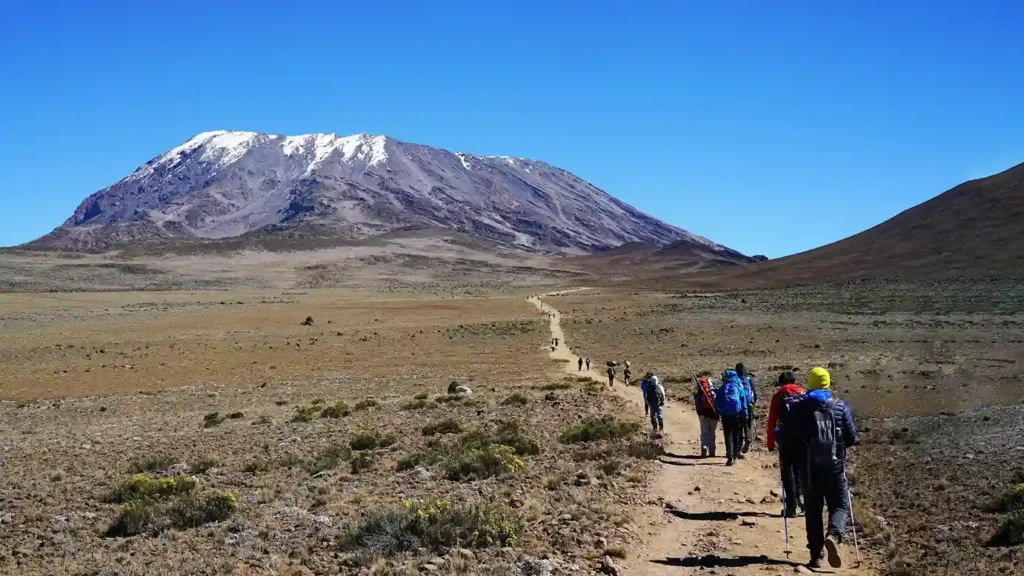
One of the Lemosho Route’s defining characteristics is its exceptional acclimatisation profile. By starting at a lower elevation and ascending gradually through multiple ecological zones — montane forest, heath, moorland, alpine desert, and arctic summit — the route allows the body to adapt incrementally to altitude. This gradual ascent is directly responsible for the route’s industry-leading summit success rates.
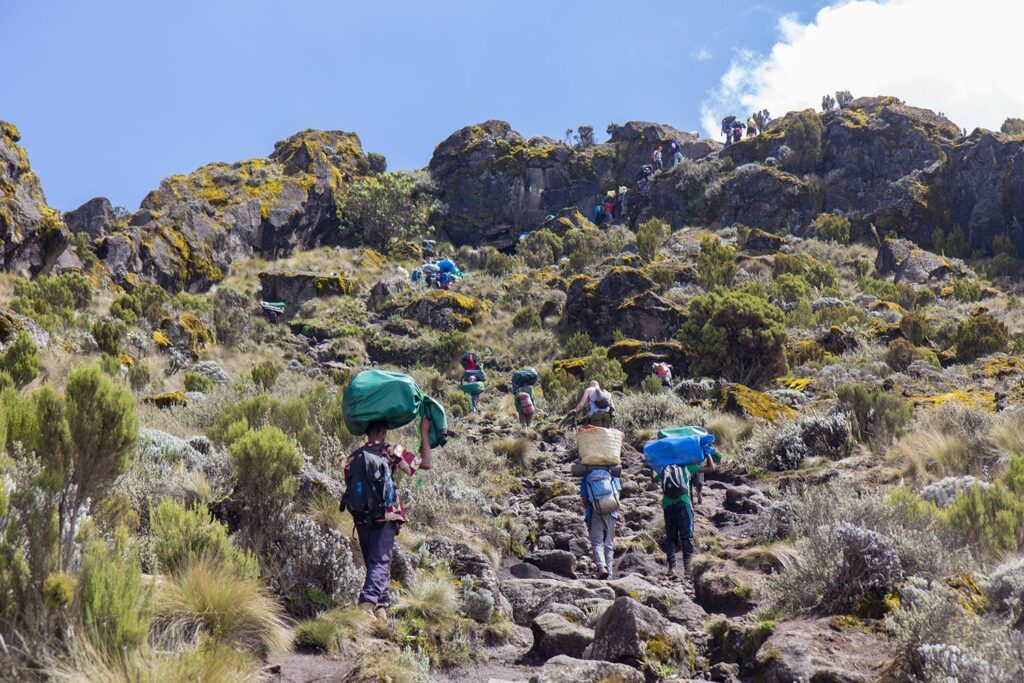
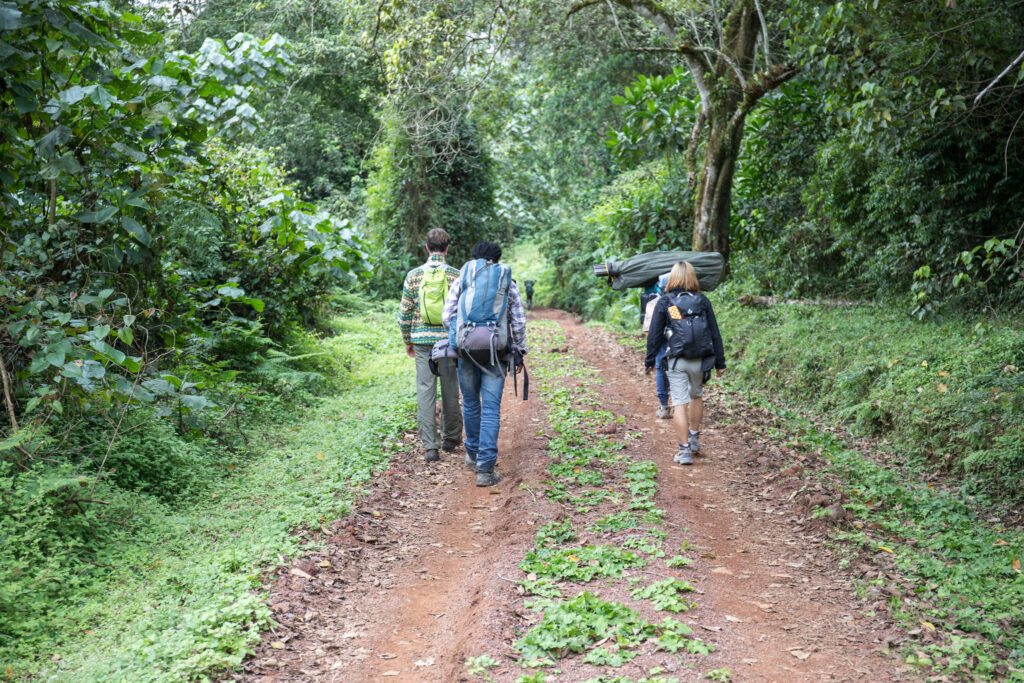
The early stages of the Lemosho Route offer a sense of solitude and deep wilderness that is increasingly rare on Kilimanjaro. Trekkers in the montane forest may encounter black-and-white colobus monkeys, blue monkeys, forest birds, and occasional signs of buffalo and elephant. Eventually, the route joins the popular Machame trail near Lava Tower, merging the Lemosho experience with a more social mountain environment.
Day-by-Day Lemosho Route Overview
- Day 1 — Londorossi Gate to Big Tree Camp (Mti Mkubwa): 6 km, 2–3 hrs hiking, altitude gain ~550 m. Dense rainforest, colobus monkeys, first night camping.
- Day 2 — Big Tree Camp to Shira I Camp: 8 km, 4–5 hrs hiking, altitude gain ~830 m. Transition from forest to lower moorland.
- Day 3 — Shira I to Shira II (Shira Huts) via Shira Cathedral: 7 km, 4–5 hrs. Expansive Shira Plateau views open up.
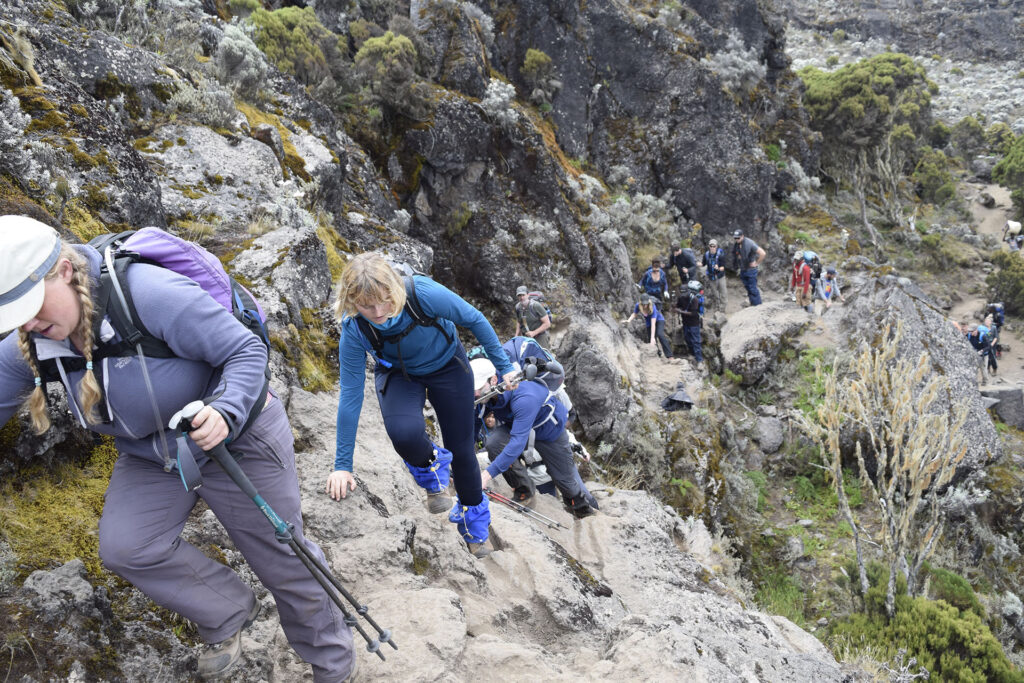
- Day 4 — Shira Huts to Lava Tower (4,640 m) to Barranco Camp (3,985 m): 9 km, 6–8 hrs. The classic “climb high, sleep low” acclimatisation day.
- Day 5 — Barranco Camp to Karanga Camp: 5.5 km, 4–5 hrs. Includes the famous Barranco Wall scramble.
- Day 6 — Karanga Camp to Barafu Camp (4,673 m): 5 km, 4–5 hrs. Final high camp before summit push.
- Day 7 — Summit Day: Barafu to Uhuru Peak (5,895 m) and descent to Millennium/Mweka Hut. Up to 16 hrs total.
- Day 8 — Descent to Mweka Gate and transfer back to Moshi or Arusha.
The Shira Route — The Original Western Approach
The Shira Route is the oldest trail on the western side of Kilimanjaro, and it also uses Londorossi Gate as its administrative registration point. However, unlike the Lemosho Route, Shira trekkers are driven a considerable distance up the mountain by 4×4 vehicle — passing through the murram barrier gate and ascending directly to the Shira Plateau at around 3,500–3,600 metres above sea level. This is where trekking begins on the Shira Route.
The significant disadvantage of the Shira Route is the loss of the lower elevation acclimatization stages. By bypassing the montane forest and lower moorland zones, trekkers on the Shira Route arrive at altitude much more quickly than their Lemosho counterparts, which statistically reduces summit success rates. For this reason, the Shira Route is less commonly recommended today, and some operators consider it primarily suitable for emergency evacuations, as a helicopter landing pad is available on the Shira Plateau.
That said, for climbers with robust prior altitude acclimatization experience, or those with tight schedules, the Shira Route does offer direct access to the plateau’s expansive, otherworldly landscape.
The Registration Process at Londorossi Gate
Arriving at Londorossi Gate is the first official interaction trekkers have with the Kilimanjaro National Park administration. The registration process is thorough, and trekkers should expect to spend between one and two hours at the gate completing formalities.
What Happens at the Gate
The TANAPA rangers stationed at Londorossi Gate are responsible for verifying all climbing permits, recording climber details, and ensuring every trekking team has the required resources before being allowed to proceed. The process typically unfolds as follows:
- Step 1 — Arrival and queue: Your tour operator will lead you through check-in. Have your passport and booking documents ready.
- Step 2 — Permit verification: Rangers check your park entry and camping fees, which are paid by your tour operator in advance.
- Step 3 — Porter weigh-in: Each porter’s load is officially weighed to comply with TANAPA regulations, which set a maximum carry weight per porter for welfare reasons.
- Step 4 — Team roster confirmation: Your guides, assistant guides, porters, and cooks are all logged in the official register.
- Step 5 — Equipment check: Rangers may verify that your group has sufficient tents, food, water, and safety equipment.
- Step 6 — Briefing: Guides may receive or conduct a final safety briefing.
- Step 7 — Onward transfer: After registration, your group boards vehicles for the transfer to the actual trailhead.
One unique logistical feature of Londorossi Gate is that after registration, climbers do not begin hiking from the gate itself. Instead, documents and equipment are transported by vehicle to the relevant trailhead — either Lemosho Glades (approximately 12 km further) for the Lemosho Route, or the murram barrier gate for the Shira Route. During particularly wet conditions in April and May, even the 4×4 vehicles may struggle with the road to Lemosho Glades, and trekkers may need to walk part of this transfer on foot.
Documentation Required
Ensure you and your tour operator have the following documents in order before arriving at Londorossi Gate:
- Valid passport (original — not a photocopy).
- Proof of booking and paid park fees (your tour operator will hold these).
- Travel insurance documentation covering high-altitude trekking and emergency evacuation.
- Yellow Fever vaccination certificate (required for travellers arriving from or transiting through endemic countries).
- Any special climbing permits if applicable (e.g., Western Breach access permit).
Facilities at Londorossi Gate
Londorossi Gate is a functional administrative post rather than a tourist facility. Travellers should temper expectations accordingly and ensure that all major preparations — food, water, gear, and accommodation — are sorted before arrival.
What Is Available
- TANAPA Ranger Offices: Multiple offices for different administrative functions — permit checking, porter weight verification, and record keeping.
- Basic Toilet Facilities: Simple toilet blocks are available at or near the gate. These are basic pit latrines, not flush facilities.
- Ranger Accommodation: Rangers live and work at the gate. There are some basic buildings in the compound.
- Wildlife Observation: Colobus monkeys are commonly seen in the trees surrounding the ranger quarters — a wonderful way to pass the time during registration.
What Is NOT Available
Unlike Marangu Gate, which functions as a full-service park headquarters, Londorossi Gate has limited amenities. Trekkers should not expect:
- Restaurants, cafes, or food vendors.
- Shops or souvenir stalls.
- ATMs or currency exchange facilities.
- Accommodation at the gate (the nearest lodging is in Moshi or Arusha).
- Mobile phone charging points or reliable internet connection.
- Medical facilities beyond basic ranger first aid.
All meals during the climb are provided by your tour operator’s cook, and all supplies — from tents to food to water — are carried by the porter team. Ensure your tour operator has confirmed all arrangements well before the day of the climb.
Wildlife Around Londorossi Gate
One of the most pleasant surprises for trekkers arriving at Londorossi Gate is the immediacy of wildlife. Even before the hike formally begins, the gate environment and its surrounding forest offer memorable encounters with some of East Africa’s most distinctive wildlife.
Colobus Monkeys
Black-and-white colobus monkeys have established a troop in the trees immediately adjacent to the ranger quarters at Londorossi. These strikingly beautiful primates — with their flowing white capes of fur and black bodies — are often visible during the registration process, swinging through the canopy or perching on high branches above the compound. This alone can be a highlight of the first day.
Blue Monkeys
Blue monkeys also frequent the Londorossi area and the adjacent montane forest. They are generally more agile and elusive than colobus monkeys but are regularly spotted by sharp-eyed trekkers on the walk from the gate to the trailhead and during the first day of hiking.
Buffalo and Elephant
While encounters are far less common today than when the Lemosho Route first opened, buffalo and elephant do still inhabit the lower forest zones of the western mountain. In the early days of the route, armed rangers accompanied trekking groups specifically for buffalo protection. Today, the increased footfall of climbers means large mammals tend to stay further from the trails, but sightings — particularly of buffalo tracks and elephant dung — are not unheard of.
Birdlife
The montane forest around Londorossi is exceptionally rich in birdlife. Kilimanjaro’s forests support over 150 bird species, including striking sunbirds, African olive pigeons, silvery-cheeked hornbills, cinnamon-chested bee-eaters, and a range of forest raptors. Birders are encouraged to spend time at and around the gate before beginning the climb.
Best Time to Visit Londorossi Gate
Understanding Kilimanjaro’s seasonal weather is vital to choosing the right time to begin your trek from Londorossi Gate. The mountain has two primary dry seasons that represent the optimal trekking windows.
Period | Conditions | Recommendation |
January–March | Dry and warm. Excellent visibility. Some cloud at altitude. | Excellent — High Season |
April–June | Long rains. Roads to gate very muddy and difficult. High risk. | Avoid if possible |
June–October | Peak dry season. Clear skies. Cool temperatures. High altitude cold. | Ideal — Peak Season |
November–December | Short rains. Wet but less severe than April–June. | Manageable — Off Season |
Note: The Kilimanjaro National Park is open year-round. However, visiting during the long rains (April–June) is strongly discouraged for Londorossi Gate specifically, as the murram road leading to the gate and trailhead can become dangerously impassable, potentially requiring trekkers to walk several kilometres extra in wet and muddy conditions before even reaching the forest.
Accommodation Near Londorossi Gate
Unlike gates such as Marangu, there is no established accommodation directly at or adjacent to Londorossi Gate. Trekkers overwhelmingly stay in Moshi or Arusha the night before their climb begins. Both cities offer a wide range of lodging options — from budget guesthouses to luxury safari lodges — and most tour operators include hotel accommodation in their package pricing.
Staying in Moshi
Moshi is the most popular base for Kilimanjaro climbers. It is a vibrant, compact town with excellent hotels, restaurants, and trekking gear shops, all oriented around the mountain tourism industry. Key areas for accommodation include the town centre and the slopes leading towards the mountain.
Staying in Arusha
Arusha is a larger city and the gateway to the northern Tanzania safari circuit. Some trekkers opt to stay here, particularly if they are combining a Kilimanjaro climb with a Serengeti or Ngorongoro safari. The drive from Arusha to Londorossi Gate is somewhat longer than from Moshi, but excellent roads make the journey manageable.
Bush Camps Near the Gate
For those seeking a more immersive pre-climb experience, a small number of remote bush camps and eco-lodges exist in the general Kilimanjaro foothills west of Moshi. These offer a wilderness setting and can reduce morning travel time on departure day, though amenities are basic. Ask your tour operator for specific recommendations if this appeals to you.
Practical Tips for Visiting Londorossi Gate
Transport
- Always use a reputable, licensed tour operator who will arrange all transport to and from the gate as part of your climbing package.
- A 4×4 vehicle is essential, particularly between March and June. Even in dry conditions, the final few kilometres to the gate involve an unpaved road.
- Build extra time into your schedule on departure day — registration can take longer than expected, particularly during peak season when multiple groups are checking in simultaneously.
Packing and Gear
- Pack a rain jacket in your day pack regardless of the season — the montane forest near Londorossi receives frequent rainfall, and conditions can change rapidly.
- Gaiters are useful for the first day of hiking if the forest trail is wet and muddy.
- All main luggage will be carried by your porter team. Agree on weight limits and load distribution with your tour operator in advance.
- Do not leave valuables in your vehicle during the registration process — use secure luggage locks and keep important documents on your person.
Health and Safety
- Begin altitude awareness from the moment you arrive at Londorossi Gate. Although 2,100 metres is not a dangerous altitude, it is a useful baseline to begin hydrating well and moderating exertion.
- Ensure your travel insurance explicitly covers high-altitude trekking above 4,000 metres and emergency helicopter evacuation. Standard policies are often insufficient.
- Bring a good supply of water for the day — there are no facilities for purchasing drinks at the gate.
- Apply sunscreen and lip balm even on overcast days; UV intensity increases significantly at altitude.
Administrative Tips
- Confirm with your tour operator that all park fees are paid in advance. These are substantial and must be settled before registration can be completed.
- Arrive at the gate early in the morning — ideally by 9:00 AM — to give yourself sufficient time to complete registration and still begin hiking before midday.
- Have your passport accessible and ready; rangers will record your details in the entry register.
- Be patient during the porter weigh-in process — TANAPA enforces strict weight limits per porter as part of its porter welfare programme.
Londorossi Gate vs Other Kilimanjaro Gates
To fully appreciate what Londorossi Gate offers, it is helpful to compare it with the other entry points on the mountain. Each gate reflects the character of its associated route — and Londorossi stands out for its wilderness setting and low visitor density.
Gate | Altitude | Route(s) | Traffic Level | Facilities |
Londorossi | 2,100 m | Lemosho, Shira | Low | Basic admin offices |
Marangu | 1,870 m | Marangu | Very High | Full park HQ |
Machame | 1,800 m | Machame | High | Moderate |
Rongai | 1,950 m | Rongai | Low | Basic |
Umbwe | 1,800 m | Umbwe | Very Low | Minimal |
Londorossi Gate’s combination of low traffic, proximity to pristine wilderness, and access to the highest-rated summit route (Lemosho) makes it the gateway of choice for trekkers who prioritise quality of experience over convenience of access.
Why Choose to Trek via Londorossi Gate?
With seven official entry gates on Kilimanjaro, the question of which to choose is a meaningful one. Here is a concise summary of the compelling reasons why Londorossi Gate — and the Lemosho Route in particular — continues to attract discerning Kilimanjaro climbers from around the world.
- Highest summit success rate: The 8-day Lemosho itinerary achieves summit success rates of 90–95% for well-operated expeditions — among the highest of any Kilimanjaro route.
- Most scenic route on the mountain: Lemosho crosses more ecological zones and diverse terrain than any other single route, earning its reputation as the most beautiful path to Uhuru Peak.
- Wildlife encounters: The western forest accessed from Londorossi offers better odds of spotting colobus monkeys, blue monkeys, and diverse birdlife than the busier southeastern routes.
- Solitude in the early stages: Before merging with the Machame trail near Lava Tower, the Lemosho Route has minimal traffic — an increasingly rare quality on a popular mountain.
- Superior acclimatisation: The low starting altitude and gradual elevation profile of the Lemosho Route give the human body the best possible chance of adapting to altitude without suffering mountain sickness.
- Quality operators: The longer duration and higher cost of Lemosho treks attract better-resourced operators, typically meaning better equipment, guides, food, and overall safety standards.
- Full ecological traverse: Trekking from western montane forest all the way to the arctic summit gives hikers a richer understanding of Kilimanjaro’s extraordinary biodiversity.
Park Fees and Costs
Kilimanjaro National Park operates on a fee structure set and periodically revised by TANAPA. These fees are typically included in the total cost charged by your tour operator and are non-negotiable. They cover park entry, camping, rescue fund contributions, and crew wages.
For an 8-day Lemosho Route climb, total park fees alone (before operator profits, staff wages, food, and equipment) are substantial. The overall cost of climbing Kilimanjaro on the Lemosho Route via a reputable operator typically ranges from approximately US$2,500 to US$5,000 or more per person, depending on group size, operator quality, and trip duration. Budget operators offering Kilimanjaro treks at significantly lower prices should be approached with caution, as cutting costs on Kilimanjaro inevitably means cutting corners on safety, staff welfare, or equipment quality.
Key fee categories levied by TANAPA include: park entrance fee (per day), camping fee (per night per person), rescue fee (mandatory contribution), crew entrance fee (per guide and porter per day), and conservation fee. Verify the current fees directly with TANAPA or your tour operator, as these are subject to annual revision.
Conclusion
Londorossi Gate may lack the creature comforts of Kilimanjaro’s more developed entry points, but what it offers in return is far more valuable: the gateway to one of the world’s greatest mountain trekking experiences. This quiet administrative post on the northwestern flanks of Africa’s tallest peak is the beginning of the Lemosho Route — a trail widely celebrated for its natural beauty, extraordinary biodiversity, gradual acclimatisation, and outstanding summit success rates.
Whether you stand beneath the colobus monkeys at the ranger quarters watching them leap through the forest canopy, or sit quietly while your guide completes the paperwork and the weight of Kilimanjaro begins to sink in, Londorossi Gate has an atmosphere unlike any other. There is something deeply compelling about a place that is so unremarkable in its infrastructure, yet so extraordinary in what lies beyond it.
For trekkers who choose to approach Kilimanjaro from the west, Londorossi Gate is not just an entry point — it is the first moment the mountain truly begins.
Summary: Top Tips for Londorossi Gate
Before You Go
On the Day
General Advice
|